



This page is one of several in our salinized land / tidal flat segment. See the full range of structures, foundations and configurations on the PV Mounting for Saline-Alkali Land, Tidal Flats & Salt Pans hub page.
Why Salinized Land / Tidal Flat sites are demanding
Salinized land and tidal flats put structures in the most corrosive environment short of open sea: brackish groundwater, salt crusts, tidal wet-dry cycles and soft soils. Success is decided by corrosion-class selection, pile detailing below the salt line, and layouts that respect aquaculture or salt-production operations continuing around the arrays.
Site challenges we engineer around:
Challenge 01
Tidal windows compress piling schedules into short daily or monthly slots
Challenge 02
Salt crust and spray reach above structure – the splash zone is where systems fail
Challenge 03
Aquaculture and salt operations continue: nets, pumps and harvest paths constrain layout
Challenge 04
Chloride attack on galvanizing and fasteners runs years ahead of inland rates
Challenge 05
Standard galvanizing corrodes prematurely in saline soils
Challenge 06
Soft saline profiles give piles little lateral resistance
Challenge 07
Salt crystallization degrades concrete and coatings differentially
Engineering requirements and design basis
- Long-pile design with lateral capacity verification in soft saline profiles
- Tidal-window installation planning with piling crews and equipment staged accordingly
- Splash-zone detailing: sealed bolt paths, higher zinc mass, duplex systems
- Layout coordination with pond operators: net corridors, aeration, harvest equipment
Selection guidance: Classify the site per ISO 12944 / 9223, then demand coating systems and fastener grades matched per zone – site-wide uniform specs either overspend or underserve.
Engineered solution
- Pile solutions for soft saline soils with tested lateral capacity
- Tidal-window installation methodology from comparable coastal projects
- Aquaculture-compatible layout service co-designed with pond operations
- Material certificates and coating logs supplied per batch for owner QA
- Maintenance plan with inspection intervals tied to measured corrosion rates
On this specific application we additionally provide:
- Zone-based corrosion packages: enhanced zinc mass, duplex systems, 316 fasteners at critical nodes
- Long-pile designs with lateral test verification in saline profiles
Installation method and site productivity
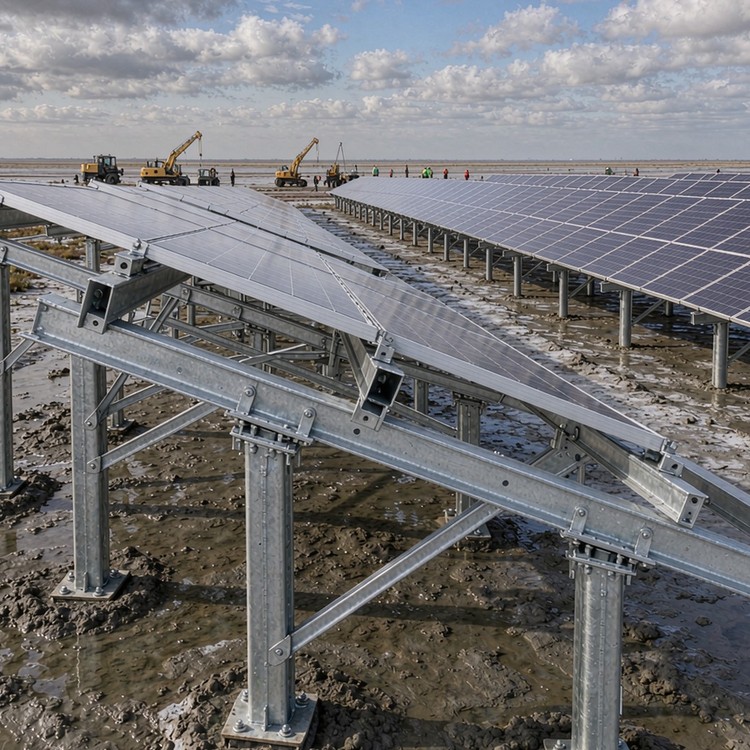
Field productivity decides whether a racking design is cheap or expensive. We engineer for the install crew: kit-based delivery so nothing is sorted on the ground; bolt-only connections with washers pre-fitted in the shop; pile heads that accept the table within a documented adjustment envelope instead of requiring rework; and module clamps that align without shimming. The installation manual includes planned crew sizes, equipment recommendations and realistic daily output figures by table type, plus tolerance acceptance criteria your site engineer can check with a tape and a level. Fewer site decisions mean faster blocks and a cleaner punch list.
Industry benchmarks
Benchmarks below are publicly documented industry reference projects of comparable type and scale, cited to illustrate engineering practice. They are not our delivery record; delivered references for your configuration are supplied with quotations.
- A 200 MW fishery-PV project in Binzhou, Shandong on coastal saline ponds, with pile rows spaced so harvesting nets keep working. Cited for brackish-water corrosion class and aquaculture-passable layouts.
Standards and compliance
- ISO 12944 C4-C5/Im2 coating selection methodology
- ISO 1461 galvanizing with enhanced zinc mass; duplex systems where specified
- Austenitic or duplex stainless fasteners in splash zones
- IEC 62738 and coastal structural codes as applicable
- ISO 9001 production quality management; batch traceability
- CE / EN 1090 documentation where destination markets require
Budget drivers and lead time
- Corrosion packages add 8-15 percent; they are cheaper than first repaint at year 5
- Long piles in soft saline soils are a discrete cost line – confirm with borings plus pull-out tests
- Tidal logistics can add 5-10 percent to installation if not planned
- Lead time: 8-12 weeks including corrosion packages; batch certificates included
- Quotations state steel grade, zinc mass and coating system explicitly; Incoterms and container plans are quoted to your destination port
Comparing supplier quotations
Before signing, make the quotes apples-to-apples. Ask each bidder to confirm: design wind speed and terrain category used, snow or ice loads, seismic requirements if any; the geotechnical assumptions behind foundation pricing and who pays when soils disagree; the exact steel grade, coating standard and zinc mass; module clamping compatibility with your module datasheet revision; delivery terms – Incoterms, lead time ex-works versus to-port, partial-shipment flexibility; and warranty scope including fasteners and coatings, not just structure. Suppliers who answer these in writing are suppliers who have built before. We answer them by default, in the quotation, not after a chase.
Frequently asked questions
How much does the corrosion package add?
Why do piles need lateral testing here?
Is stainless everywhere the answer?
More questions buyers ask
Can we get samples before committing to volume?
Do you allow third-party or customer inspections before shipment?
What to include in your RFQ
- Soil chemistry and corrosivity data
- Groundwater level and salinity
- Design wind data for lateral load cases
From RFQ to commissioning: how we work
A typical engagement runs in five gates: (1) RFQ review – we check drawings, geotech reports and load assumptions before quoting, and flag gaps that would move cost later; (2) proposal – structural basis, bill of quantities, foundation options and Incoterms stated side by side; (3) engineering freeze – pile tests or pre-drilling trials where soils demand them, shop drawings signed off by both engineering teams; (4) production – batch QA documents issued per lot, pre-shipment inspection open to your inspector or a third party; (5) delivery and install support – container plans matched to EPC sequence, installation manuals, torque tables and commissioning guidance. Each gate produces a document you can file; buyers tell us the discipline matters more than the brochures.
Send documents to our engineering mailbox; a structure engineer replies within one working day – not a sales script, an engineering answer.
Quality, warranty and delivery
Production follows ISO 9001 procedures with batch traceability from coil to container; galvanizing runs to ISO 1461 with zinc mass selected by your site corrosivity class. We publish our first-maintenance estimates in writing, and our warranty documentation names what is covered, for how long, and under which load cases.
Documentation you receive
Buyers comparing suppliers should compare document depth, because claims are easy and records are not. We provide: design basis documents that name standards, load cases and safety factors explicitly; batch-level quality records (steel, galvanizing, fasteners) retained for the warranty period; installation and maintenance manuals written for site crews, not marketing; warranty terms that specify what is covered, for how long, and the claim process; and end-of-project dossiers suitable for handover to your O&M contractor. For multi-project buyers we keep a document history per site, so year-eight extensions reference year-one assumptions instead of starting from zero.
Service life and maintenance planning
Racking is a thirty-year decision, and the first maintenance event is where cheap hardware shows its cost. We design coating systems from your site’s corrosivity class – C2 for dry inland zones, C3-C4 for most coastal and agricultural areas, C5 toward heavy industrial and marine exposure – and we state the expected time to first maintenance in writing. Bolt selection follows the same logic: coated high-strength fasteners with controlled torque, because mixed hardware is the most common early-corrosion finding in field inspections. A spare-parts kit sized to your environment ships with the order.
Search terms this page is engineered for
saline-alkali land PV mounting, saline land solar racking, saline soil photovoltaic bracket, salt-tolerant PV racking, PV mounting for saline alkali land, racking for saline alkali wasteland, solar mounting for salt pan co production.
Ready to Discuss Your Project?
Send soil chemistry data – we will return the zone-based corrosion spec with pile designs tested for lateral capacity, priced transparently.
