
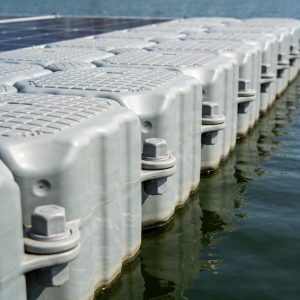




This page is one of several in our salinized land / tidal flat segment. See the full range of structures, foundations and configurations on the PV Mounting for Saline-Alkali Land, Tidal Flats & Salt Pans hub page.
Why Salinized Land / Tidal Flat sites are demanding
Salinized land and tidal flats put structures in the most corrosive environment short of open sea: brackish groundwater, salt crusts, tidal wet-dry cycles and soft soils. Success is decided by corrosion-class selection, pile detailing below the salt line, and layouts that respect aquaculture or salt-production operations continuing around the arrays.
Site challenges we engineer around:
Challenge 01
Aquaculture and salt operations continue: nets, pumps and harvest paths constrain layout
Challenge 02
Chloride attack on galvanizing and fasteners runs years ahead of inland rates
Challenge 03
Soft saline soils give poor pile lateral capacity; long piles flex under wind
Challenge 04
Tidal windows compress piling schedules into short daily or monthly slots
Challenge 05
Piling only proceeds in tidal windows; unmanaged schedules slip
Challenge 06
Splash zones corrode faster than any other part of the structure
Challenge 07
Soft sediments need long piles with lateral verification
Engineering requirements and design basis
- Layout coordination with pond operators: net corridors, aeration, harvest equipment
- Corrosion class mapping (C4/C5/Im2) with coating system selected per zone, not site-wide
- Long-pile design with lateral capacity verification in soft saline profiles
- Tidal-window installation planning with piling crews and equipment staged accordingly
Selection guidance: Require the tide-window method statement and Im2 coating schedules in the offer; these two documents predict whether the supplier has actually built on mudflats.
Engineered solution
- Corrosion-package supply: duplex coatings, 316-class fasteners where justified, sealed detailing
- Pile solutions for soft saline soils with tested lateral capacity
- Tidal-window installation methodology from comparable coastal projects
- Aquaculture-compatible layout service co-designed with pond operations
- Material certificates and coating logs supplied per batch for owner QA
On this specific application we additionally provide:
- Tidal-window installation planning with crews and equipment staged to the tide table
- Im2-class coating systems on all splash and immersion surfaces
Installation method and site productivity
Ask how a structure installs before you compare its steel price. Our systems install with standard construction equipment – no proprietary tools, no site welding on the critical path. Piles are driven or screwed with industry-standard rigs and template jigs hold embedment tolerance; tables arrive preassembled in kits sequenced to your stacking plan; torque-controlled bolting with supplied torque values replaces welded connections; and rail adjustment ranges absorb the terrain error that grading leaves behind. We provide installation drawings, a step-by-step manual, torque and tolerance acceptance tables, and remote support during your install window. On request, an installation supervisor trains your crew on the first blocks.
Industry benchmarks
Benchmarks below are publicly documented industry reference projects of comparable type and scale, cited to illustrate engineering practice. They are not our delivery record; delivered references for your configuration are supplied with quotations.
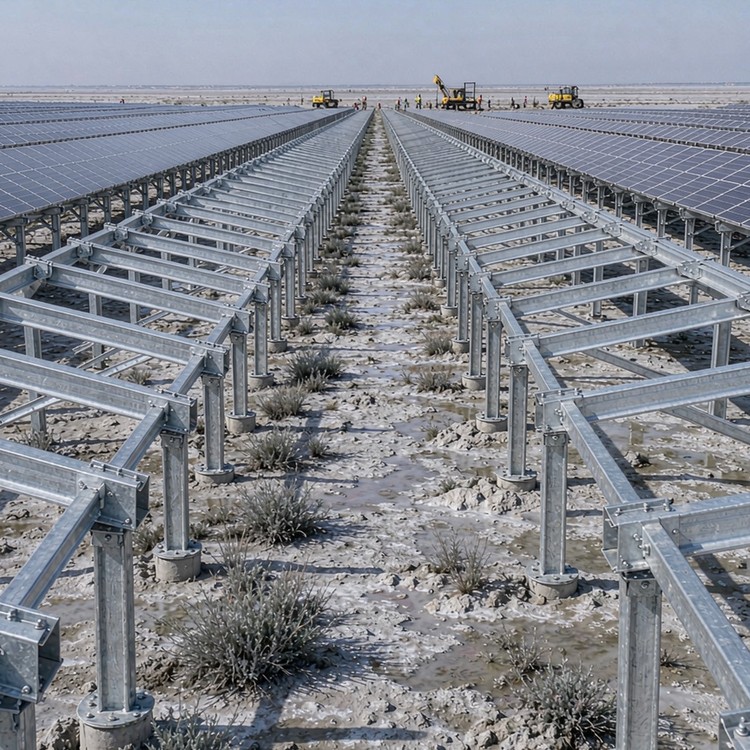
- A 30 MW mudflat PV plant in Haiyan, Zhejiang, built with piling executed in tidal windows. Reference for tidal-flat access planning and C5-class corrosion protection.
- A 16 MW PV project on salt-pan ponds at Zhangpu, Fujian, on highly corrosive brine soils. Shows the coating and material upgrades required for salt-making ponds.
Standards and compliance
- ISO 12944 C4-C5/Im2 coating selection methodology
- ISO 1461 galvanizing with enhanced zinc mass; duplex systems where specified
- Austenitic or duplex stainless fasteners in splash zones
- IEC 62738 and coastal structural codes as applicable
- ISO 9001 production quality management; batch traceability
- CE / EN 1090 documentation where destination markets require
Budget drivers and lead time
- Corrosion packages add 8-15 percent; they are cheaper than first repaint at year 5
- Long piles in soft saline soils are a discrete cost line – confirm with borings plus pull-out tests
- Tidal logistics can add 5-10 percent to installation if not planned
- Lead time: 8-12 weeks including corrosion packages; batch certificates included
- Quotations state steel grade, zinc mass and coating system explicitly; Incoterms and container plans are quoted to your destination port
Comparing supplier quotations
Quotations for the same site can differ 30 percent and both be honest – the difference hides in stated assumptions. When comparing bids, normalize five items: steel grade and section weights (lighter rails with tighter spacing is not always cheaper per megawatt once pile counts rise); zinc mass and coating system against your corrosivity class; foundation scope – piles only, or piles plus anchors, caps and grading hardware; connection hardware – bolt classes and whether torque values are specified; and logistics – container utilization, port of discharge and inland transport responsibility. A bid that states all five is comparable; a bid that omits them is a discount you will pay for later.
Frequently asked questions
How do tidal windows shape the schedule?
Which coating class applies above the tide line?
What lateral capacity should we expect in marine mud?
More questions buyers ask
What are your payment terms for first orders?
Can we get samples before committing to volume?
What to include in your RFQ
- Tide table and bathymetry
- Sediment borings with salinity data
- Aquaculture operations in adjacent ponds
From RFQ to commissioning: how we work
Procurement runs smoother when both sides know the sequence. Our standard flow: RFQ received – acknowledged within one working day with a list of anything missing (geotech data, design wind speed, module model, terrain category); engineering review – typically three to five working days; quotation – itemized, with steel grade, zinc mass, coating system and Incoterms explicit; sample or pilot lot – available for new partners who want to verify fit and finish before volume; production and inspection – your QC team or a third party is welcome at pre-shipment; shipping – container optimization against your unloading equipment; installation – manuals, videos and a named contact through commissioning. The flow is boring on purpose: fewer surprises, faster approvals.
Send documents to our engineering mailbox; a structure engineer replies within one working day – not a sales script, an engineering answer.
Quality, warranty and delivery
Every batch ships with mill certificates, coating-thickness logs and bolt records; welds follow EN 1090 or AISC execution classes. Structure warranty runs to 10 years with a 25-30 year service design life, and spare-part packages are documented so year-12 repairs do not depend on year-1 memory.
Documentation you receive
We document in the format procurement teams actually file. Standard set: technical proposal with design basis; issued-for-construction drawings; structural calculations signed by our engineering department, third-party endorsement arranged where required; material and coating certificates per batch; installation manual with step sequences, torque values and tolerance acceptance criteria; and packing lists reconciled against container numbers. Optional add-ons: wind-tunnel or code-based fatigue notes for extreme sites, seismic calculation packages, corrosion service-life projections by environment, and spare-parts schedules with recommended holding quantities. Tell us your owner’s documentation standard at RFQ stage and we quote to it rather than discovering it at delivery.
Service life and maintenance planning
Service life claims deserve engineering behind them. Our structures are designed for a 25-30 year service window with a 10-year structure warranty, and the supporting logic is documented: load cases per applicable code, corrosion protection selected against site class, fatigue consideration at high-cycle connections, and tolerance ranges that keep trackers and tables within manufacturer limits over decades. Maintenance is inspection-led: defined intervals, defined checkpoints, defined acceptance values – supplied with the project documentation. When components eventually need replacement, part numbers and production batches are traceable, so spares match the original hardware rather than whatever the market carries that year.
Search terms this page is engineered for
tidal flat photovoltaic support, tidal zone solar bracket, solar bracket for tidal marsh, PV for coastal tidal flat, floating PV for tidal flat.
Ready to Discuss Your Project?
Send the tide table and borings – we will return a tidal-window installation plan with zone-mapped coatings and tested pile designs.
