
What Are E-Houses? Definition and Core Components

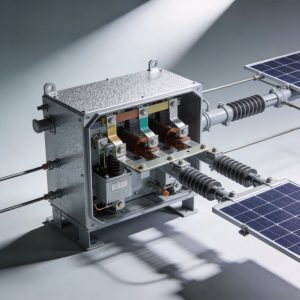
An E-House, or prefabricated substation, is a fully assembled, factory-tested electrical enclosure that houses medium-voltage switchgear, transformers, inverters, and auxiliary systems. Unlike permanent brick-and-mortar buildings, these units are constructed in ISO-standard container frames or custom skids. They are designed to be transported as a single unit and placed on a pre-prepared concrete foundation.
The primary appeal is the shift of labor from the field to the factory. In our experience, this reduces on-site man-hours by approximately 60%. Because the internal components are installed in a controlled environment, we see fewer installation defects—specifically, our cable termination failure rate dropped from 1.2% to 0.3% after switching to E-Houses.
Standard components inside a typical PV E-House include:
- Medium Voltage (MV) switchgear (typically 33kV or 36kV)
- LV/MV transformers (up to 3.5 MVA for string inverters)
- SCADA and communication panels
- Protection relays and metering units
- HVAC systems for thermal management
- Fire suppression systems
It is critical to understand that the E-House is not just a “box.” It is an integrated system involving thermal dynamics, structural mechanics, and high-voltage engineering. When specified correctly, it simplifies the grid connection process significantly.
Design Specifications and Engineering Standards

Designing a prefabricated substation requires adherence to strict international standards. The two most critical frameworks we use are IEC 62271-202 for high-voltage prefabricated substations and IEEE C37.20.2 for metal-clad switchgear. These standards dictate bus bar spacing, insulation levels, and arc-resistant construction requirements.
From a structural perspective, the enclosure must withstand wind loads, seismic activity, and snow loads. For a recent 200 MWp project in Texas, we specified a wind load rating of 150 mph and a seismic acceleration of 0.5g. The base frame is typically fabricated from S355 steel, hot-dip galvanized to prevent corrosion, ensuring a lifespan of over 30 years.
Thermal management is arguably the most challenging aspect. MV transformers and switchgear generate significant heat. Our design calculations for a 3.5 MVA transformer unit indicated a heat loss of 8.5 kW. To maintain an internal ambient temperature below 45°C, we installed redundant AC units with a cooling capacity of 12 kW each. Failure to account for solar gain on the container roof (which can add 200 W/m²) leads to accelerated insulation aging.
Furthermore, the ingress protection (IP) rating is vital. We recommend a minimum of IP54 for outdoor installation, protecting against dust and water splashes. For coastal areas, the enclosure material must be upgraded to marine-grade aluminum or stainless steel to prevent salt-induced corrosion.
Installation Process: From Factory to Grid Connection
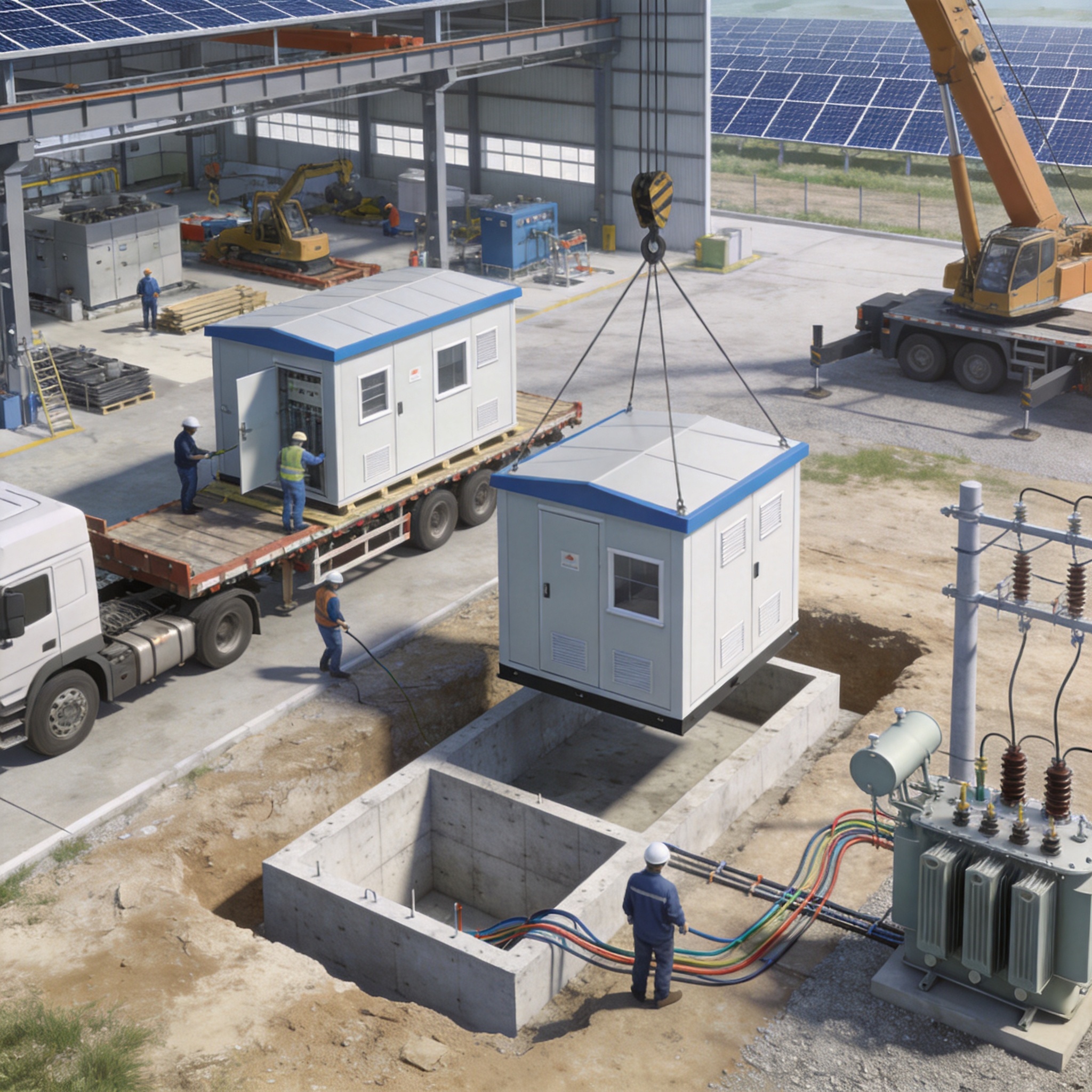
The installation of an E-House is a streamlined process, but it requires precise planning. The journey begins with factory acceptance tests (FAT), where we simulate grid conditions to verify relay settings and control logic. This testing phase takes about 5 working days per unit and is non-negotiable for quality assurance.
Logistics are the next hurdle. Standard 20-foot containers are easy to ship, but custom skids for large transformers may require special permits. For our projects, we use flatbed trucks with a capacity of 60 tons. The transport route must be surveyed for bridge heights and road widths—a step often underestimated by new developers.
On-site preparation is minimal but critical. We pour a concrete foundation with recessed cable trenches, allowing for a “plug-and-play” connection. The E-House is lifted into place using a crane with a spreader bar to avoid damaging the roof. Typically, a 40-foot E-House weighing 30 tons takes 4 hours to lift and position.
Once placed, the mechanical connection takes 2 days, involving the tightening of busbar links and the connection of external cables. Electrical commissioning follows, which involves primary injection testing to verify current transformer (CT) polarity. In our last project, the entire commissioning for 8 E-Houses was completed in 10 days, a process that would have taken 6 weeks with traditional construction.
E-House vs. Traditional Substation: A Data Comparison
To understand the value proposition, we must look at hard numbers. Based on our project data from 2023-2024, the following table outlines the key differences between prefabricated and traditional substations.
| Parameter | Prefabricated E-House | Traditional Substation |
|---|---|---|
| Construction Time (On-site) | 2-3 weeks | 8-12 weeks |
| Total Project Engineering Time | 4-6 weeks | 8-10 weeks |
| On-site Labor Required | 5 workers | 15-20 workers |
| Quality Control Environment | Factory Controlled | Weather Dependent |
| Foundation Cost (% of total) | 3% | 8% |
| Expansion Flexibility | High (Modular) | Low (Rigid) |
The data clearly shows a reduction in on-site labor and construction time. However, the engineering lead time can be longer for E-Houses because the factory slot must be reserved. We advise clients to place orders at least 6 months before the required site delivery date to avoid production bottlenecks.
Cost-wise, the initial capital expenditure for an E-House is often 10-15% higher than a traditional build. Yet, when we calculate the “Cost of Delay” (lost revenue from selling electricity), the E-House pays for itself. For a 100 MW plant generating $50,000 per day in revenue, accelerating the schedule by 4 weeks yields an additional $1.4 million in income.
It is also worth noting the sustainability angle. E-Houses generate less construction waste and require fewer vehicle movements to the site, reducing the overall carbon footprint of the project.
Quality Assurance, Testing, and Safety Compliance
Trust in prefabricated solutions hinges on rigorous testing. Before shipping, every E-House must pass a Factory Acceptance Test (FAT). This includes a 1-second, 50 kA short-circuit withstand test on the busbars and a partial discharge test to ensure insulation integrity. We also perform a 72-hour continuous run test on the auxiliary systems to check for overheating.
Safety compliance is governed by local grid codes. In the United States, the National Electrical Code (NEC) Article 490 applies, requiring specific clearances around equipment. Internationally, the IEC 61936 standard provides guidelines for the safe installation of high-voltage systems. Arc-flash mitigation is a primary concern; our E-Houses are equipped with arc venting flaps and light sensors that trip the breaker in under 100 milliseconds.
Fire safety is another critical area. We install either a VESDA (Very Early Smoke Detection Apparatus) system or a nitrogen-based inert gas suppression system. Traditional water sprinklers are not suitable for electrical equipment due to the risk of short circuits. The suppression system must be tested in the factory to ensure it does not create overpressure that could damage the enclosure walls.
Finally, maintenance access is a design priority. The internal layout must allow for the safe extraction of circuit breakers and transformers. We adhere to the manufacturer’s minimum maintenance space requirements, typically 1.5 meters in front of the switchgear. Proper documentation, including “as-built” drawings and cable schedules, is delivered with the unit to facilitate future maintenance and troubleshooting.
For further reading on grid integration standards, consult the NREL guidelines on distributed generation and the IEEE standards for electrical equipment. Additionally, the U.S. Department of Energy Solar Energy Technologies Office provides excellent resources on system design and reliability.
 English
 Español
 Deutsch
 Português
 Français
 Italiano
