



Pourquoi c'est difficile
Long-term availability fails for reasons that have little to do with the component and everything to do with continuity.
- Product families are revised over time, so the clamp that fitted the original module frame may no longer be in production by the time replacement is needed
- Module formats change during the asset life, so replacement modules may need different clamping positions and therefore different clamps
- Original suppliers change ownership, exit the market or discontinue markets, which affects both spares and warranty support
- Inventory has a cost, so spares held in excess tie up capital while spares held in deficiency cause outage at the worst moment
- Spares for the structure interact with spares for the modules, so replacement planning has to consider both together
- Documentation determines whether a replacement component can be identified at all, since an undocumented structure cannot be re-ordered from a specification
Exigences d'ingénierie
These are the elements of a long-term spares and availability arrangement.
- Component families identified for spares purposes, distinguishing the parts most likely to require replacement from those that effectively never do
- Spares quantity by component family, sized against array capacity and the environment class rather than set as a flat percentage
- Availability commitment for high-turnover components over the asset life, with the form of the commitment stated
- Storage specification and rotation procedure, so stored spares remain usable rather than corroding on a shelf
- Documentation sufficient to re-order any component by specification, including drawings, material and coating details
- Interface with module replacement planning, since clamp compatibility depends on the module format in use at the time
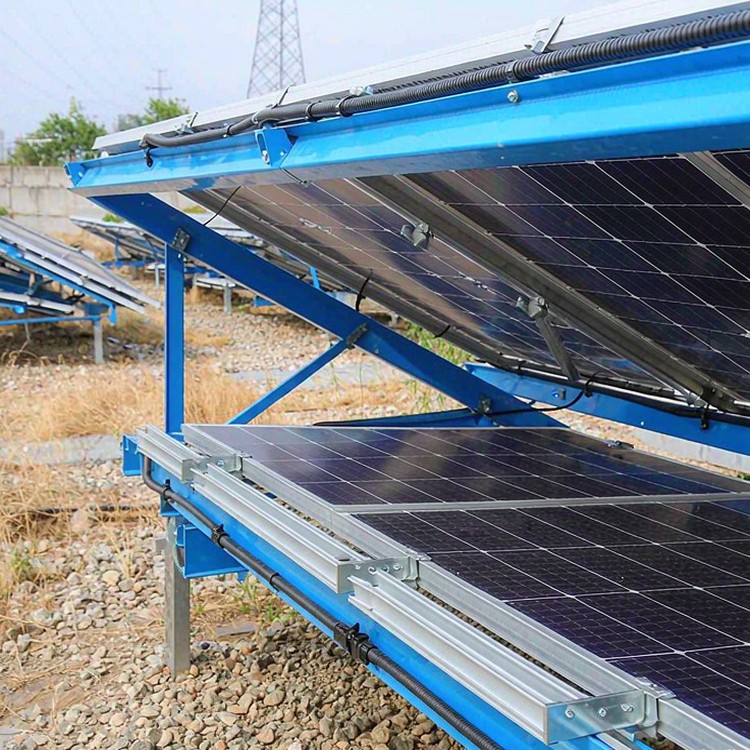
Selection guidance: specify availability and documentation, not only quantity. A stock of spares without the drawings to re-order more is a one-off provision rather than a long-term arrangement.
Comment nous résolvons le problème
- Spares sized by component family against capacity and environment class, focused on the parts with realistic replacement probability
- Availability commitment stated for high-turnover components, covering the asset life rather than a fixed short period
- Drawings and specifications supplied with the structure, so any component can be re-ordered by specification even if the product family is revised
- Storage and rotation procedure documented, so spares remain usable and the stock reflects current requirements
- Compatibility assessment at module replacement, so the clamp position and load rating are checked against the replacement module format
- A spares register maintained with the asset, so inventory position and replacement history are visible to whoever operates the site
Au-delà de la structure
- Fleet-level spares planning where an owner has multiple sites, since shared stock reduces the quantity held at each location
- Support at handover, so the incoming O&M contractor inherits a complete spares and documentation package
Points de référence
Les projets de référence ci-dessous, de type et d'envergure comparables et documentés publiquement, sont cités à titre d'illustration des pratiques d'ingénierie. Ils ne constituent pas un historique de réalisations.
- A 200 MW owner-operator project in the United States holding spares sized by component family rather than as a flat percentage, reducing inventory while covering realistic replacement needs.
- A 150 MW project in Spain where drawings and specifications were supplied with the structure, allowing components to be re-ordered after the original product family was revised.
- A 250 MW portfolio in Australia where fleet-level spares planning allowed stock to be shared across sites instead of held at each.
Normes et conformité
- Charges de vent ASCE 7 / EN 1991 résolues avec des facteurs de terrain et d'exposition spécifiques au site
- Compatibilité de l'interface du module IEC 61215 / IEC 61730 vérifiée par rapport à la fiche technique de votre module
- Classes d'exécution EN 1090 ou AISC pour les ouvrages métalliques soudés et boulonnés
- Galvanisation à chaud selon la norme ISO 1461, masse de zinc spécifiée en fonction de la corrosivité du sol et de l'atmosphère
- Gestion de la qualité de la production selon la norme ISO 9001 avec traçabilité au niveau du lot
- Dossier de documentation CE/EN 1090 lorsque les marchés de destination l'exigent
Assurance qualité
Every batch ships with mill certificates, coating-thickness logs and bolt records; welds follow EN 1090 or AISC execution classes. Structure warranty runs to 10 years against a 25-30 year service design life, and spare-part packages are documented so year-12 repairs do not depend on year-1 memory.
Documents que vous recevez
La documentation est conçue pour les audits, et non pour la décoration : notes de calcul de structure indiquant les cas de charge et les normes utilisées ; base de conception des fondations alignée sur votre rapport géotechnique ; certificats de matériaux pour l’acier et la visserie ; certificats de galvanisation avec l’épaisseur de revêtement mesurée par lot ; plans d’assemblage avec tableaux de couples de serrage ; et documentation d’emballage correspondant aux manifestes des conteneurs. Pour les projets financés, nous ajoutons des déclarations de conformité au format des organismes prêteurs ; pour les appels d’offres publics, nous répondons aux cahiers des charges documentaires point par point.
Planification de la durée de vie et de la maintenance
La durée de vie est un résultat de conception, non une promesse. La masse de zinc, la classe de revêtement des fixations, les détails de drainage et l'isolation entre métaux dissemblables sont sélectionnés en fonction du niveau de corrosivité de votre site, et l'intervalle prévu pour la première maintenance est indiqué par écrit. Pour les environnements agressifs, nous optons pour un système de revêtement plus performant dès la conception, ce qui est toujours plus économique qu'une rénovation.
Considérations relatives aux coûts et au commerce
- Spares inventory ties up working capital, so quantity should follow from replacement probability rather than from a conventional percentage
- Fleet-level spares reduce total inventory across a portfolio, since the coverage requirement is shared rather than duplicated
- Storage and rotation carry a cost that is small against the cost of a seized or corroded spare at the moment it is needed
- Documentation sufficient to re-order has almost no cost at supply stage and is very expensive to reconstruct later
- Availability commitments from a supplier who continues to operate in the market are worth more than a larger stock from one who does not
Foire aux questions
How many spares should we hold?
What happens when a product family is discontinued?
Does module replacement affect racking spares?
How do we handle spares across a portfolio?
What should be handed over with the asset?
Guides et pages d'application associés
Poursuivez avec les pages les plus proches de votre type de projet.
- IPP & Asset Owner Programs – Aperçu du groupe pour cette gamme
- Standardisation des rayonnages pour les portefeuilles d'actifs
- Conception d'accessibilité pour l'exploitation et la maintenance des systèmes de montage solaire
- Wastewater Treatment Plant Solar Projects
- Projets solaires flottants terrestres
- Projets complémentaires pêche-solaire
Ce que nous devons citer
- Fleet or site capacity and the intended maintenance cycle
- Environment class at each location, since it affects which components are likely to need replacement
- Whether spares will be held at site or centrally across a portfolio
- Any planned module replacement or repowering during the asset life
Parlez à un ingénieur en structure
Send the capacity, locations and maintenance cycle, and we will return a spares schedule by component family with the availability commitment and the documentation set included.
 English
 Español
 Deutsch
 Português
 Français
 Italiano