




Warum das schwierig ist
Long-term availability fails for reasons that have little to do with the component and everything to do with continuity.
- Product families are revised over time, so the clamp that fitted the original module frame may no longer be in production by the time replacement is needed
- Module formats change during the asset life, so replacement modules may need different clamping positions and therefore different clamps
- Original suppliers change ownership, exit the market or discontinue markets, which affects both spares and warranty support
- Inventory has a cost, so spares held in excess tie up capital while spares held in deficiency cause outage at the worst moment
- Spares for the structure interact with spares for the modules, so replacement planning has to consider both together
- Documentation determines whether a replacement component can be identified at all, since an undocumented structure cannot be re-ordered from a specification
Technische Anforderungen
These are the elements of a long-term spares and availability arrangement.
- Component families identified for spares purposes, distinguishing the parts most likely to require replacement from those that effectively never do
- Spares quantity by component family, sized against array capacity and the environment class rather than set as a flat percentage
- Availability commitment for high-turnover components over the asset life, with the form of the commitment stated
- Storage specification and rotation procedure, so stored spares remain usable rather than corroding on a shelf
- Documentation sufficient to re-order any component by specification, including drawings, material and coating details
- Interface with module replacement planning, since clamp compatibility depends on the module format in use at the time
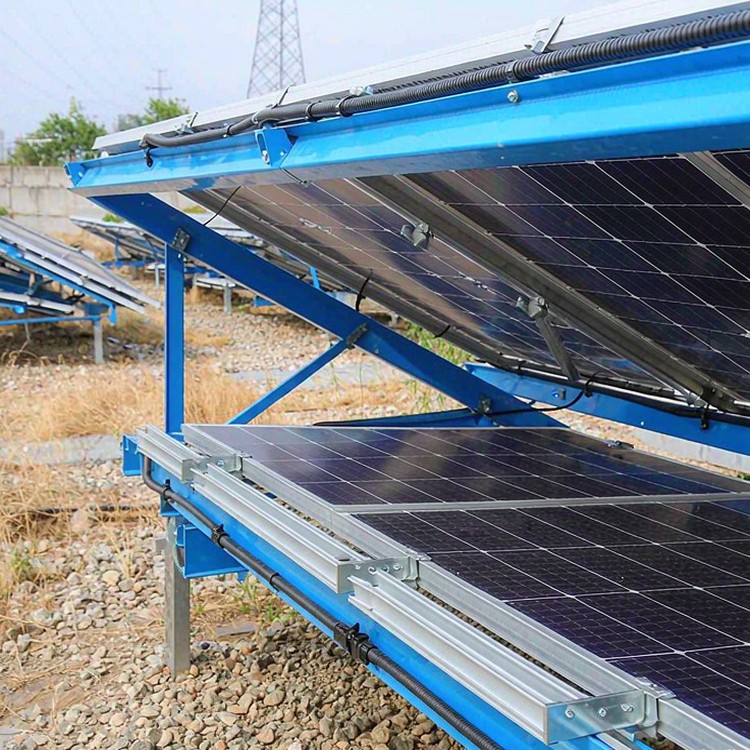
Selection guidance: specify availability and documentation, not only quantity. A stock of spares without the drawings to re-order more is a one-off provision rather than a long-term arrangement.
Wie wir es lösen
- Spares sized by component family against capacity and environment class, focused on the parts with realistic replacement probability
- Availability commitment stated for high-turnover components, covering the asset life rather than a fixed short period
- Drawings and specifications supplied with the structure, so any component can be re-ordered by specification even if the product family is revised
- Storage and rotation procedure documented, so spares remain usable and the stock reflects current requirements
- Compatibility assessment at module replacement, so the clamp position and load rating are checked against the replacement module format
- A spares register maintained with the asset, so inventory position and replacement history are visible to whoever operates the site
Jenseits der Struktur
- Fleet-level spares planning where an owner has multiple sites, since shared stock reduces the quantity held at each location
- Support at handover, so the incoming O&M contractor inherits a complete spares and documentation package
Referenz-Benchmarks
Die folgenden Benchmarks sind öffentlich dokumentierte Branchenreferenzprojekte vergleichbarer Art und Größenordnung, die zur Veranschaulichung der Ingenieurpraxis dienen. Sie stellen nicht unsere Leistungsbilanz dar.
- A 200 MW owner-operator project in the United States holding spares sized by component family rather than as a flat percentage, reducing inventory while covering realistic replacement needs.
- A 150 MW project in Spain where drawings and specifications were supplied with the structure, allowing components to be re-ordered after the original product family was revised.
- A 250 MW portfolio in Australia where fleet-level spares planning allowed stock to be shared across sites instead of held at each.
Standards und Konformität
- Windlasten nach ASCE 7 / EN 1991 unter Berücksichtigung standortspezifischer Gelände- und Expositionsfaktoren
- Die Kompatibilität der IEC 61215 / IEC 61730 Modulschnittstelle wurde anhand Ihres Moduldatenblatts überprüft.
- Ausführungsklassen nach EN 1090 oder AISC für geschweißte und geschraubte Stahlkonstruktionen
- Feuerverzinkung nach ISO 1461, Zinkmasse abhängig von der Boden- und atmosphärischen Korrosivität
- ISO 9001-konformes Produktionsqualitätsmanagement mit Rückverfolgbarkeit auf Chargenebene
- CE-/EN-1090-Dokumentationspaket, sofern in den Zielmärkten erforderlich
Qualitätssicherung
Jede Charge wird mit Werkszeugnissen, Schichtdickenprotokollen und Schraubenprotokollen ausgeliefert; die Schweißnähte entsprechen den Ausführungsklassen EN 1090 oder AISC. Die Gewährleistung auf die Struktur beträgt 10 Jahre bei einer geplanten Nutzungsdauer von 25–30 Jahren. Die Ersatzteilpakete sind so dokumentiert, dass Reparaturen im 12. Jahr nicht auf den Daten des ersten Jahres basieren.
Dokumentation, die Sie erhalten
Die Dokumentation dient Prüfungszwecken, nicht der Dekoration: Statische Berechnungshinweise mit Angabe der Lastfälle und verwendeten Normen; Fundamentberechnungsgrundlagen, die auf Ihren geotechnischen Bericht abgestimmt sind; Materialzertifikate für Stahl und Befestigungsmittel; Verzinkungszertifikate mit Angabe der Schichtdicke pro Charge; Montagezeichnungen mit Drehmomenttabellen; und Verpackungsdokumentation, die mit den Containermanifesten übereinstimmt. Bei finanzierten Projekten ergänzen wir die Dokumentation um Konformitätserklärungen im Format des Kreditgebers; bei öffentlichen Ausschreibungen erfüllen wir die Dokumentationsvorgaben Zeile für Zeile.
Lebensdauer- und Wartungsplanung
Die Nutzungsdauer ist ein Planungsergebnis, keine Garantie. Zinkmasse, Beschichtungsklasse der Befestigungselemente, Entwässerungsdetails und Trennung unterschiedlicher Metalle werden entsprechend der Korrosivitätskategorie Ihres Standorts ausgewählt, und das voraussichtliche erste Wartungsintervall wird schriftlich festgehalten. In aggressiven Umgebungen optimieren wir das Beschichtungssystem bereits in der Planungsphase, was stets kostengünstiger ist als eine nachträgliche Nachrüstung.
Kosten- und kommerzielle Überlegungen
- Spares inventory ties up working capital, so quantity should follow from replacement probability rather than from a conventional percentage
- Fleet-level spares reduce total inventory across a portfolio, since the coverage requirement is shared rather than duplicated
- Storage and rotation carry a cost that is small against the cost of a seized or corroded spare at the moment it is needed
- Documentation sufficient to re-order has almost no cost at supply stage and is very expensive to reconstruct later
- Availability commitments from a supplier who continues to operate in the market are worth more than a larger stock from one who does not
Häufig gestellte Fragen
How many spares should we hold?
What happens when a product family is discontinued?
Does module replacement affect racking spares?
How do we handle spares across a portfolio?
What should be handed over with the asset?
Verwandte Leitfäden und Anwendungsseiten
Fahren Sie mit den Seiten fort, die Ihrem Projekttyp am ehesten entsprechen.
- IPP & Asset Owner Programs – die Gruppenübersicht für dieses Skalenband
- Standardisierung der Regalsysteme für Anlageportfolios
- Zugänglichkeitsdesign für Betrieb und Wartung von Solaranlagen
- Solaranlagen in Kläranlagen
- Schwimmende Solaranlagen im Landesinneren
- Ergänzende Projekte zwischen Fischerei und Solarenergie
Was wir für ein Angebot benötigen
- Fleet or site capacity and the intended maintenance cycle
- Environment class at each location, since it affects which components are likely to need replacement
- Whether spares will be held at site or centrally across a portfolio
- Any planned module replacement or repowering during the asset life
Sprechen Sie mit einem Statiker
Send the capacity, locations and maintenance cycle, and we will return a spares schedule by component family with the availability commitment and the documentation set included.
 English
 Español
 Deutsch
 Português
 Français
 Italiano