


Pourquoi c'est difficile
Screws are usually selected for reasons other than cost, and the reason in each case changes the specification.
- Refusal in dense or rocky strata stops driven piles but does not stop a screw, which can be advanced with controlled torque
- Vibration-sensitive ground near pipelines, buildings, instrumentation or landfill caps rules out impact driving and often vibratory driving as well
- Sites with a decommissioning obligation need foundations that can be fully removed and the ground reinstated
- Installation torque gives a capacity indication on every pile rather than on a tested sample, which changes the verification economics
- Screw piles tolerate a wider range of soil conditions within one site, reducing the cost penalty of variable ground
- In deep frost zones the screw can be designed to bear below the frost line without the driving stresses a long driven pile would carry
Exigences d'ingénierie
These are the decisions that define a ground screw specification.
- Soil profile with corrosivity testing, since both helix diameter selection and coating class depend on it
- Design loads per foundation with the governing uplift and compression cases stated separately
- Installation torque target correlated to capacity, established from a site test programme rather than assumed from tables
- Helix geometry: number of helices, diameter and spacing, selected against soil type and required capacity
- Coating system for buried steel, with corrosion allowance or sacrificial thickness defined for the site soil class
- Equipment access and reinstatement plan, particularly where vegetation, surface finish or capped ground must be preserved
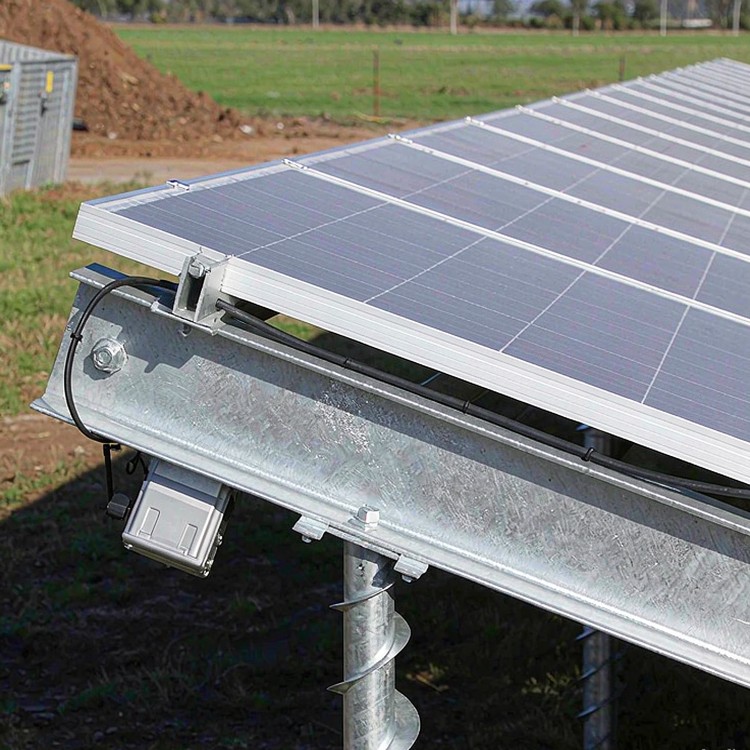
Selection guidance: correlate installation torque to capacity with a site test. Torque correlation is what makes screw piles verifiable, and a correlation assumed from a table rather than measured is not verification.
Comment nous résolvons le problème
- Helix geometry selected against the site soil type, with capacity delivered by bearing on the helix rather than by shaft friction alone
- Torque-correlated installation, so every foundation carries an installation record that indicates its capacity
- Corrosion allowance and coating system specified by soil class, with the buried section treated separately from the above-ground structure
- Installation with compact equipment where access or surface protection demands it, without a piling rig
- Reversible design: foundations can be extracted at decommissioning and the ground reinstated to meet restoration obligations
- Extension shafts for deeper frost penetration or for bringing the connection above finished grade without changing the foundation
Au-delà de la structure
- Ground disturbance limited to the screw footprint, preserving surface vegetation, drainage and any capping layer
- Installation records per foundation issued as part of the as-built set, supporting both warranty and future capacity assessment
Points de référence
Les projets de référence ci-dessous, de type et d'envergure comparables et documentés publiquement, sont cités à titre d'illustration des pratiques d'ingénierie. Ils ne constituent pas un historique de réalisations.
- A 40 MW landfill project in Italy using ground screws to avoid penetrating the cap, with foundations extracted and the surface reinstated at end of life.
- A 60 MW project in Japan where vibration limits near existing infrastructure ruled out driving, and torque-correlated screws provided per-foundation capacity records.
- A 25 MW community solar programme in the United States on shallow bedrock, where screws removed the refusal problem that had stopped a driven pile design.
Normes et conformité
- Charges de vent ASCE 7 / EN 1991 résolues avec des facteurs de terrain et d'exposition spécifiques au site
- Compatibilité de l'interface du module IEC 61215 / IEC 61730 vérifiée par rapport à la fiche technique de votre module
- Classes d'exécution EN 1090 ou AISC pour les ouvrages métalliques soudés et boulonnés
- Galvanisation à chaud selon la norme ISO 1461, masse de zinc spécifiée en fonction de la corrosivité du sol et de l'atmosphère
- Gestion de la qualité de la production selon la norme ISO 9001 avec traçabilité au niveau du lot
- Dossier de documentation CE/EN 1090 lorsque les marchés de destination l'exigent
Assurance qualité
Le contrôle qualité repose sur des points de contrôle : vérification de la réception des matières premières, inspection en cours de fabrication des soudures et du positionnement des trous, échantillonnage de l’épaisseur du revêtement et contrôle des conteneurs avant expédition. Chaque point de contrôle génère un document que votre équipe qualité peut archiver, et l’inspection avant expédition est ouverte à votre inspecteur ou à un tiers.
Documents que vous recevez
La traçabilité documentaire est aussi importante que l'acier lui-même. À chaque livraison, vous recevez des certificats d'essais en usine, traçables jusqu'aux numéros de coulée ; des rapports de galvanisation par lot, conformes à la norme ISO 1461 ou à votre norme spécifiée ; des rapports de contrôle dimensionnel des gabarits de pré-assemblage ; la traçabilité des lots de boulons et de quincaillerie ; les plans de récolement lorsque des adaptations ont été apportées au site ; et un document de garantie précisant les cas de charge couverts, la durée de vie nominale et les procédures de réclamation. Tout est indexé, ce qui garantit que votre registre d'actifs ne dépend pas de la mémoire d'un seul ingénieur.
Planification de la durée de vie et de la maintenance
La durée de vie est un résultat de conception, non une promesse. La masse de zinc, la classe de revêtement des fixations, les détails de drainage et l'isolation entre métaux dissemblables sont sélectionnés en fonction du niveau de corrosivité de votre site, et l'intervalle prévu pour la première maintenance est indiqué par écrit. Pour les environnements agressifs, nous optons pour un système de revêtement plus performant dès la conception, ce qui est toujours plus économique qu'une rénovation.
Considérations relatives aux coûts et au commerce
- Ground screws typically cost more per foundation than driven piles, with the gap driven by helix size, coating class and shaft length
- Installation speed is usually lower than driven piles in favourable soils, but higher where refusal would otherwise have stopped the rig
- Torque-correlated installation reduces verification cost, because per-foundation records replace an extensive separate test programme
- Reinstatement value is a real line item on leased or capped land, where extraction and surface restoration may be contractually required
- Lead time: 4-8 weeks for standard screw families, longer where a high hot-dip coating class or stainless components are specified
Foire aux questions
When do ground screws make more sense than driven piles?
How is capacity verified for a screw pile?
What about corrosion of buried steel?
Can screws be installed without heavy equipment?
Can they be removed and reused?
Guides et pages d'application associés
Poursuivez avec les pages les plus proches de votre type de projet.
- Foundation Strategy by Project Scale – Aperçu du groupe pour cette gamme
- Fondations sur pieux battus pour systèmes de montage solaire
- Étude géotechnique pour les projets solaires
- Saline-Alkali, Tidal Flat & Salt-Pan Solar Projects
- Gobi, Gravel & Hardpan Solar Projects
- Wetland, Marsh & Mangrove Solar Projects
Ce que nous devons citer
- Soil investigation data with resistivity and chemical test results for corrosivity class
- Design load per foundation, with governing uplift and compression cases stated separately
- Whether extraction or reinstatement is required at end of life
- Access constraints and the equipment you expect to use for installation
Parlez à un ingénieur en structure
Send the soil investigation and load case, and we will return a helix configuration, a torque target and a coating specification with the installation record structure the project will need.
 English
 Español
 Deutsch
 Português
 Français
 Italiano