


Pourquoi c'est difficile
Under-scoped investigations fail in predictable ways, and each failure has a well-known remedy that costs far less than the consequence.
- A single central borehole on a 200 hectare site describes one point and leaves the rest of the site as an assumption
- Soil corrosivity is frequently omitted from solar investigations, and it drives both pile coating class and corrosion allowance
- Foundation quantities are priced from the investigation, so an over-general report produces either over-design or a variation claim
- Refusal, groundwater and rock head depth are the three conditions that most often stop a piling programme, and all three are measurable in advance
- Foundation design risk is usually allocated to one party by contract, so an ambiguous investigation transfers a large contingent liability
- Later stages such as access roads, inverter pads and cable trenches reuse the same data, so under-scoping the investigation constrains the whole project
Exigences d'ingénierie
These are the elements a solar geotechnical investigation should contain.
- Borehole or cone penetration test density based on site area and variability, with a defined layout rather than an arbitrary number of holes
- Soil classification and stratification to the depth of interest for foundation design, typically beyond the maximum expected embedment
- Groundwater level and its seasonal variation, since it affects both capacity and foundation durability
- Corrosivity testing: soil resistivity, pH, sulphate and chloride content, mapped to a corrosivity class
- Rock head depth and refusal potential identified in the report rather than discovered by the piling rig
- Recommended foundation types with preliminary capacities, so the investigation produces design input rather than description
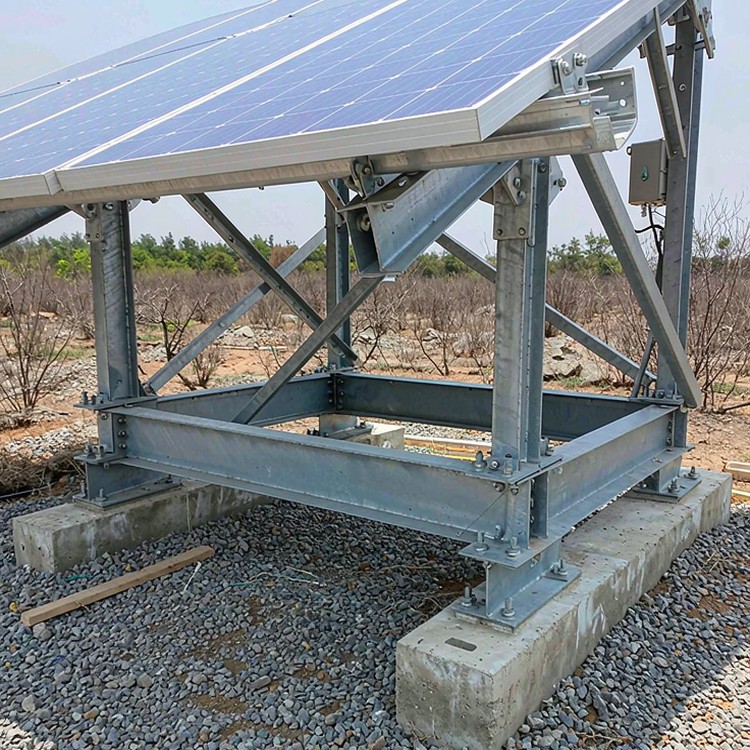
Selection guidance: scope the investigation against the foundation decision it has to support. The number of boreholes matters less than whether the layout captures the variability that will actually change the foundation design.
Comment nous résolvons le problème
- Investigation scoped to the site variability, with borehole density set by area and geological setting rather than by convention
- Corrosivity testing included as standard, producing a class that maps to a specific coating specification and corrosion allowance
- Findings presented as foundation design input: recommended types, preliminary capacities and refusal risk by zone
- Groundwater and rock head depths reported per zone, supporting both foundation design and civil works planning
- Results delivered in a format that supports the tender pack, so bidders price from the same data and variations are reduced
- Zone mapping across the site, so foundation types and depths can be varied where conditions change
Au-delà de la structure
- Data reused across the project, since access roads, inverter pads, trenches and civil works all draw on the same investigation
- An early investigation is also a procurement instrument, because it lets bidders price foundations rather than carry contingency
Points de référence
Les projets de référence ci-dessous, de type et d'envergure comparables et documentés publiquement, sont cités à titre d'illustration des pratiques d'ingénierie. Ils ne constituent pas un historique de réalisations.
- A 200 MW site in the Middle East where corrosivity testing drove a coating class change that would otherwise have been assumed from atmospheric conditions alone.
- A 150 MW project in Spain where rock head mapping allowed foundation types to be varied by zone, avoiding a uniform deep-pile design across the whole site.
- A 120 MW project in Australia where groundwater depth reported by zone changed the corrosion allowance and reduced a contingent risk carried in the EPC price.
Normes et conformité
- ASCE 7 / EN 1991 / AS-NZS 1170 wind load cases with site-specific terrain categories
- IEC 62727 tracker structural requirements where tracking structures are in scope
- EN 1090-2 or AISC 360 fabrication and execution class documentation
- ISO 1461 hot-dip galvanizing, ISO 9223 corrosivity classification driving zinc mass
- ISO 9001:2015 quality system, ISO 14001 environmental management on request
- Third-party aeroelastic wind tunnel study available for large-format modules
Assurance qualité
Every batch ships with mill certificates, coating-thickness logs and bolt records; welds follow EN 1090 or AISC execution classes. Structure warranty runs to 10 years against a 25-30 year service design life, and spare-part packages are documented so year-12 repairs do not depend on year-1 memory.
Documents que vous recevez
La documentation est conçue pour les audits, et non pour la décoration : notes de calcul de structure indiquant les cas de charge et les normes utilisées ; base de conception des fondations alignée sur votre rapport géotechnique ; certificats de matériaux pour l’acier et la visserie ; certificats de galvanisation avec l’épaisseur de revêtement mesurée par lot ; plans d’assemblage avec tableaux de couples de serrage ; et documentation d’emballage correspondant aux manifestes des conteneurs. Pour les projets financés, nous ajoutons des déclarations de conformité au format des organismes prêteurs ; pour les appels d’offres publics, nous répondons aux cahiers des charges documentaires point par point.
Planification de la durée de vie et de la maintenance
La planification du remplacement fait partie intégrante de la conception : la géométrie des fixations permet le remplacement individuel des modules sans découpe des rails, les têtes de pieux peuvent être rénivelées après tassement et les kits de pièces de rechange sont dimensionnés en fonction de votre classe environnementale et de votre capacité. Ainsi, les travaux de remise en état en milieu de vie sont rapides, prévisibles et indépendants du catalogue de produits du fournisseur d'origine.
Considérations relatives aux coûts et au commerce
- Investigation cost is typically a fraction of one percent of project capex, and it is the cheapest insurance available against foundation variations
- Additional boreholes are priced individually and cheaply relative to the variation claims they prevent
- Corrosivity testing added to an existing investigation is a marginal cost, while commissioning it separately later is a new mobilisation
- An investigation delivered with preliminary capacities reduces bid contingency, which is a measurable saving in the tender result
- Lead time: 2-4 weeks for field work and reporting on a typical utility-scale site, longer where permitting or seasonal access constrains the programme
Foire aux questions
How many boreholes does a solar project need?
Is corrosivity testing really necessary?
What should the report actually deliver?
Can we design foundations before the investigation is complete?
Does the investigation help beyond foundations?
Guides et pages d'application associés
Poursuivez avec les pages les plus proches de votre type de projet.
- Foundation Strategy by Project Scale – Aperçu du groupe pour cette gamme
- Fondations sur pieux battus pour systèmes de montage solaire
- Fondations à vis sans fin pour panneaux solaires
- Saline-Alkali, Tidal Flat & Salt-Pan Solar Projects
- Gobi, Gravel & Hardpan Solar Projects
- Wetland, Marsh & Mangrove Solar Projects
Ce que nous devons citer
- Site boundary, area and any available geological or prior investigation data
- Intended foundation type and approximate maximum embedment depth
- Access constraints and seasonal limitations for the field investigation
- Whether corrosivity and groundwater testing are required, and to which standard
Parlez à un ingénieur en structure
Send the site boundary and the foundation concept you are working to, and we will return a suggested investigation scope and a mapping from its findings to foundation design decisions.
 English
 Español
 Deutsch
 Português
 Français
 Italiano