

Warum das schwierig ist
Screws are usually selected for reasons other than cost, and the reason in each case changes the specification.
- Refusal in dense or rocky strata stops driven piles but does not stop a screw, which can be advanced with controlled torque
- Vibration-sensitive ground near pipelines, buildings, instrumentation or landfill caps rules out impact driving and often vibratory driving as well
- Sites with a decommissioning obligation need foundations that can be fully removed and the ground reinstated
- Installation torque gives a capacity indication on every pile rather than on a tested sample, which changes the verification economics
- Screw piles tolerate a wider range of soil conditions within one site, reducing the cost penalty of variable ground
- In deep frost zones the screw can be designed to bear below the frost line without the driving stresses a long driven pile would carry
Technische Anforderungen
These are the decisions that define a ground screw specification.
- Soil profile with corrosivity testing, since both helix diameter selection and coating class depend on it
- Design loads per foundation with the governing uplift and compression cases stated separately
- Installation torque target correlated to capacity, established from a site test programme rather than assumed from tables
- Helix geometry: number of helices, diameter and spacing, selected against soil type and required capacity
- Coating system for buried steel, with corrosion allowance or sacrificial thickness defined for the site soil class
- Equipment access and reinstatement plan, particularly where vegetation, surface finish or capped ground must be preserved
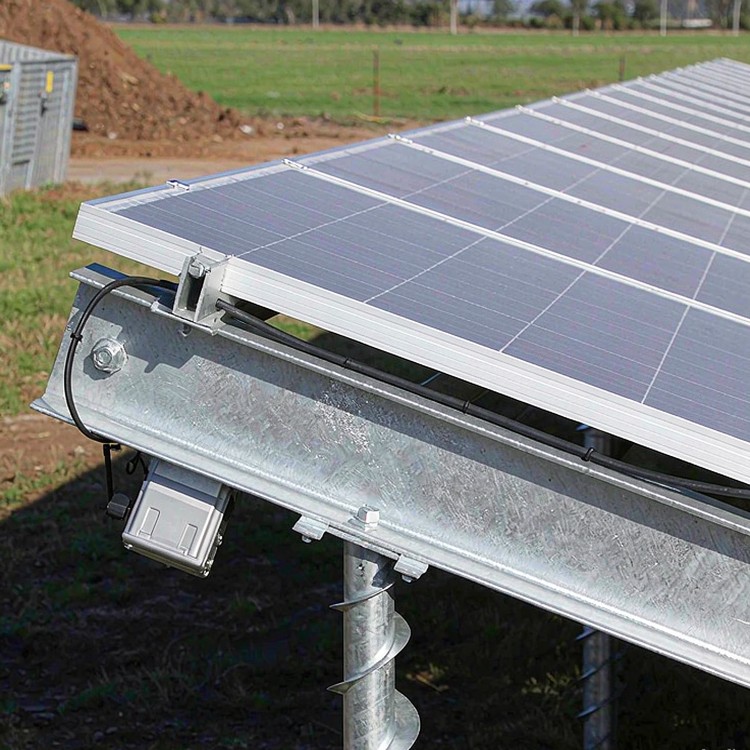
Selection guidance: correlate installation torque to capacity with a site test. Torque correlation is what makes screw piles verifiable, and a correlation assumed from a table rather than measured is not verification.
Wie wir es lösen
- Helix geometry selected against the site soil type, with capacity delivered by bearing on the helix rather than by shaft friction alone
- Torque-correlated installation, so every foundation carries an installation record that indicates its capacity
- Corrosion allowance and coating system specified by soil class, with the buried section treated separately from the above-ground structure
- Installation with compact equipment where access or surface protection demands it, without a piling rig
- Reversible design: foundations can be extracted at decommissioning and the ground reinstated to meet restoration obligations
- Extension shafts for deeper frost penetration or for bringing the connection above finished grade without changing the foundation
Jenseits der Struktur
- Ground disturbance limited to the screw footprint, preserving surface vegetation, drainage and any capping layer
- Installation records per foundation issued as part of the as-built set, supporting both warranty and future capacity assessment
Referenz-Benchmarks
Die folgenden Benchmarks sind öffentlich dokumentierte Branchenreferenzprojekte vergleichbarer Art und Größenordnung, die zur Veranschaulichung der Ingenieurpraxis dienen. Sie stellen nicht unsere Leistungsbilanz dar.
- A 40 MW landfill project in Italy using ground screws to avoid penetrating the cap, with foundations extracted and the surface reinstated at end of life.
- A 60 MW project in Japan where vibration limits near existing infrastructure ruled out driving, and torque-correlated screws provided per-foundation capacity records.
- A 25 MW community solar programme in the United States on shallow bedrock, where screws removed the refusal problem that had stopped a driven pile design.
Standards und Konformität
- Windlasten nach ASCE 7 / EN 1991 unter Berücksichtigung standortspezifischer Gelände- und Expositionsfaktoren
- Die Kompatibilität der IEC 61215 / IEC 61730 Modulschnittstelle wurde anhand Ihres Moduldatenblatts überprüft.
- Ausführungsklassen nach EN 1090 oder AISC für geschweißte und geschraubte Stahlkonstruktionen
- Feuerverzinkung nach ISO 1461, Zinkmasse abhängig von der Boden- und atmosphärischen Korrosivität
- ISO 9001-konformes Produktionsqualitätsmanagement mit Rückverfolgbarkeit auf Chargenebene
- CE-/EN-1090-Dokumentationspaket, sofern in den Zielmärkten erforderlich
Qualitätssicherung
Die Qualitätskontrolle erfolgt punktbasiert: Überprüfung des Materialeingangs, Prüfung der Schweißnähte und Bohrungspositionen während des Produktionsprozesses, Stichprobenprüfung der Beschichtungsdicke und Containerprüfung vor dem Versand. Jeder Kontrollpunkt generiert ein Dokument, das Ihr Qualitätsteam ablegen kann. Die Versandprüfung kann von Ihrem Prüfer oder einem externen Dienstleister durchgeführt werden.
Dokumentation, die Sie erhalten
Die Dokumentation ist genauso wichtig wie der Stahl selbst. Mit jeder Lieferung erhalten Sie Werksprüfzeugnisse mit Rückverfolgbarkeit zu den Chargennummern, Verzinkungsprotokolle pro Charge gemäß ISO 1461 oder Ihrem vorgegebenen Standard, Maßprüfberichte von den Vormontagevorrichtungen, Chargenrückverfolgbarkeit von Schrauben und Beschlägen, Bestandspläne für bauseitige Anpassungen sowie ein Garantiedokument mit Angaben zu abgedeckten Lastfällen, geplanter Lebensdauer und Vorgehensweise bei Reklamationen. Alle Daten sind indexiert, sodass Ihr Anlagenverzeichnis nicht vom Gedächtnis eines einzelnen Technikers abhängt.
Lebensdauer- und Wartungsplanung
Die Nutzungsdauer ist ein Planungsergebnis, keine Garantie. Zinkmasse, Beschichtungsklasse der Befestigungselemente, Entwässerungsdetails und Trennung unterschiedlicher Metalle werden entsprechend der Korrosivitätskategorie Ihres Standorts ausgewählt, und das voraussichtliche erste Wartungsintervall wird schriftlich festgehalten. In aggressiven Umgebungen optimieren wir das Beschichtungssystem bereits in der Planungsphase, was stets kostengünstiger ist als eine nachträgliche Nachrüstung.
Kosten- und kommerzielle Überlegungen
- Ground screws typically cost more per foundation than driven piles, with the gap driven by helix size, coating class and shaft length
- Installation speed is usually lower than driven piles in favourable soils, but higher where refusal would otherwise have stopped the rig
- Torque-correlated installation reduces verification cost, because per-foundation records replace an extensive separate test programme
- Reinstatement value is a real line item on leased or capped land, where extraction and surface restoration may be contractually required
- Lead time: 4-8 weeks for standard screw families, longer where a high hot-dip coating class or stainless components are specified
Häufig gestellte Fragen
When do ground screws make more sense than driven piles?
How is capacity verified for a screw pile?
What about corrosion of buried steel?
Can screws be installed without heavy equipment?
Can they be removed and reused?
Verwandte Leitfäden und Anwendungsseiten
Fahren Sie mit den Seiten fort, die Ihrem Projekttyp am ehesten entsprechen.
- Foundation Strategy by Project Scale – die Gruppenübersicht für dieses Skalenband
- Driven Pile Foundations for Solar Racking Systems
- Geotechnische Untersuchung für Solarprojekte
- Saline-Alkali, Tidal Flat & Salt-Pan Solar Projects
- Gobi, Gravel & Hardpan Solar Projects
- Wetland, Marsh & Mangrove Solar Projects
Was wir für ein Angebot benötigen
- Soil investigation data with resistivity and chemical test results for corrosivity class
- Design load per foundation, with governing uplift and compression cases stated separately
- Whether extraction or reinstatement is required at end of life
- Access constraints and the equipment you expect to use for installation
Sprechen Sie mit einem Statiker
Send the soil investigation and load case, and we will return a helix configuration, a torque target and a coating specification with the installation record structure the project will need.
 English
 Español
 Deutsch
 Português
 Français
 Italiano