




2 Engineering Disciplines Under This Hub
Marsh, Peat-Bog & Wetland PV Support
Flexible Support & Low-Impact Mounting for Marsh Wetland and Peat-Bog Sites
Mangrove-Coast & Coastal-Wetland PV
Mangrove-Coast PV Support & Floating Racking for Coastal Wetland Buffer Zones
Why Wetland / Marsh projects are demanding
Wetlands and marshes sit at the regulatory edge of PV: peat soils cannot carry conventional foundations, water levels move, and ecological constraints are strict. Feasible projects use low-pressure access, minimal-intrusion foundations and layouts that leave hydrology functioning exactly as it was.
Site challenges we engineer around:
Challenge 01
Ecological permits restrict access methods, working seasons and even noise
Challenge 02
Decomposing organics attack steel and concrete differentially
Challenge 03
Access: equipment must spread load or travel on temporary mats
Challenge 04
Peat and organic soils have minimal bearing; conventional piles sink or drift
How to choose the right page
- If the site is inland marsh or peat bog, start with the wetland support page
- If it is a mangrove or coastal wetland, start with the mangrove-coast page
- If permit conditions dominate your design, raise them at RFQ stage – they often decide the foundation type
Key technical parameters at a glance
Typical engineering envelopes for this segment; every project is recalculated against the destination-market code before fabrication:
| Parameter | Typical value / approach |
|---|---|
| Snow and ice | 0.4-1.5 kN/m2 ground snow band with unbalanced-load cases checked |
| Tilt envelope | 10-35 deg fixed-tilt window set by latitude and row-spacing study |
| Module interface | 30-35 mm framed modules, mid and end clamps per layout drawing |
| Fastening system | grade 8.8 bolts with flanged nuts and wedge-lock anti-loosening washers |
| Low impact | long screw piles minimize mounding in protected wetlands |
| Seasonal water | posts sized for seasonal water-level variation |
Engineering requirements and design basis
- Hydrology-preserving layout: pile lines parallel to flow, no bunding
- Corrosion and biogenic attack material selection
- Seasonal installation windows tied to ecology and water levels
- Deep piles through peat to mineral bearing, or floating systems where permits allow
What this hub covers
- Foundations for peat and soft organic soils with low bearing capacity
- Low-disturbance installation that respects permit conditions
- Mangrove-coast systems combining corrosion protection with ecological limits
- Working platforms and access without permanent ground damage

Which configuration fits your site
Three supply configurations cover most wetland / marsh procurement cases:
| Configuration | Structure and finish | Best for | Cost index |
|---|---|---|---|
| Economy line | Q235B main steel, hot-dip galvanized to ISO 1461 | marsh edges with seasonal water | 1.0 (baseline) |
| Standard line | Q355B main members, 85 um+ zinc, pre-assembled brackets | typical wetland / marsh tenders with standard code loads | +15-25% |
| Severe-site line | reinforced sections, duplex coating, sealed hardware | soft organic soils and protected habitats | +35-50% |
Engineered solution
- Mat-based installation methodology preserving site hydrology
- Ecological-window scheduling coordinated with permit conditions
- Material selection for biogenic and acidic attack
- Layout review against hydrology model before freeze
- Restoration and monitoring commitments built into the delivery package

Industry benchmarks
The reference points below are anonymized industry benchmarks drawn from comparable public projects of this type. They are not claims about projects delivered by us, and no client, developer or operator is identified.
- A 500 MW block of a high-altitude Yalong River valley PV complex in Sichuan at over 4,000 m, with hundreds of thousands of piles across alpine terrain. Benchmark for high-altitude batch piling and logistics.
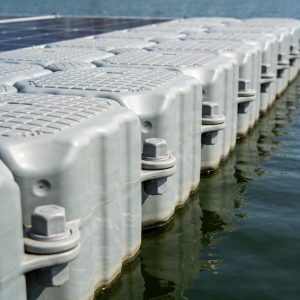
- A 2.8 kW wetland floating-PV experiment by a Spanish university measuring wetland ecology interactions, an early marsh floating reference.
Installation method and site productivity
Installation method is a cost line, not an afterthought. We ship structures engineered around the equipment you will actually have: pile-driving rigs with template jigs for soils that accept driven piles; screw-pile drives with torque monitoring where refusal or vibration rules out impact; precast ballast pads where penetration is prohibited; and bolt-only table assembly with 80 percent+ shop fabrication so site welding stays at zero. Crew productivity typically runs 40-80 tables per day per rig on prepared corridors, and our installation manual states the assumed crew size, equipment list and daily output so your construction schedule is built on numbers, not optimism.
Standards and compliance
- Wetland and water protection regulations (local; project-driven)
- ISO 12944 for aggressive organic-soil environments
- Deep-foundation acceptance testing (pull-out and lateral)
- IEC 62738 where utility-scale
- ISO 9001 production quality management; batch traceability
- CE / EN 1090 documentation where destination markets require
Budget drivers and lead time
- Deep piles through peat are the dominant cost; survey data before quotation avoids disputes
- Mat logistics add modest cost but prevent permit violations that stop projects
- Floating alternatives shift cost from foundations to mooring – price both routes
- Lead time: 10-16 weeks; ecological windows gate the schedule more than production
- Quotations state steel grade, zinc mass and coating system explicitly; Incoterms and container plans are quoted to your destination port
Comparing supplier quotations
Before signing, make the quotes apples-to-apples. Ask each bidder to confirm: design wind speed and terrain category used, snow or ice loads, seismic requirements if any; the geotechnical assumptions behind foundation pricing and who pays when soils disagree; the exact steel grade, coating standard and zinc mass; module clamping compatibility with your module datasheet revision; delivery terms – Incoterms, lead time ex-works versus to-port, partial-shipment flexibility; and warranty scope including fasteners and coatings, not just structure. Suppliers who answer these in writing are suppliers who have built before. We answer them by default, in the quotation, not after a chase.
Frequently asked questions
Can racking be built on peat at all?
How do environmental permits change the engineering?
Does corrosion get worse in wetlands?
What are your payment terms for first orders?
Can we get samples before committing to volume?
Ready to Start Your Wetland / marsh Project?
What to include in your RFQ
- Ground investigation covering peat depth and bearing strata
- Permit conditions on piling, drainage and access
- Whether the site has tidal or brackish influence
- Construction season restrictions
From RFQ to commissioning: how we work
Two things decide whether a racking order lands well: what was agreed before production, and what was documented during it. Before production we align on five inputs – structural design basis, foundation type per soil zone, corrosion protection class, module interface, and delivery sequence. During production every batch generates records you can hand to your lender or owner without translation: mill certificates, coating measurements, torque verification, packing counts. After delivery we stay in the loop – installation guidance, first-inspection support at handover, and a spare-parts recommendation sized to your site’s service life rather than a fixed catalogue list. Ask earlier customers how change requests were handled mid-production; that is the real test of a supplier.
Send your permit conditions and ground investigation – we will design within the constraints rather than around them.
Quality, warranty and delivery
Production follows ISO 9001 procedures with batch traceability from coil to container; galvanizing runs to ISO 1461 with zinc mass selected by your site corrosivity class. We publish our first-maintenance estimates in writing, and our warranty documentation names what is covered, for how long, and under which load cases.
Control points from intake to handover
| Stage | What is checked | You receive |
|---|---|---|
| Material intake | steel grade and zinc mass verified against mill certificates | mill certificates and intake report |
| Production | weld quality, hole positioning and coating thickness sampled per batch | batch traceability sheet and QC photos |
| Pre-shipment | container loading plan, bolt-kit counts and packing list reviewed | packing list and loading photos |
| Site handover | installation walkthrough with torque values confirmed | installation manual, torque table and warranty letter |
| Site-specific check | screw-pile torque logs confirm organic-layer penetration | project-specific method statement |
Documentation you receive
We document in the format procurement teams actually file. Standard set: technical proposal with design basis; issued-for-construction drawings; structural calculations signed by our engineering department, third-party endorsement arranged where required; material and coating certificates per batch; installation manual with step sequences, torque values and tolerance acceptance criteria; and packing lists reconciled against container numbers. Optional add-ons: wind-tunnel or code-based fatigue notes for extreme sites, seismic calculation packages, corrosion service-life projections by environment, and spare-parts schedules with recommended holding quantities. Tell us your owner’s documentation standard at RFQ stage and we quote to it rather than discovering it at delivery.
Service life and maintenance planning
The economics of mounting systems are decided at year eight, not at signing. Galvanizing weight, fastener coating class and edge protection determine whether the year-eight inspection finds tight hardware or rust streaks. We publish expected first-maintenance intervals by environment class and back them with batch coating records, so warranty conversations start from data. For sites with special exposure – fertilizer plants, livestock ammonia, coastal spray, geothermal soils – we adjust coating and drainage detailing at design stage. Module replacement cycles are planned too: clamp designs allow individual module swap without cutting rails, which keeps mid-life rework fast and cheap.
