



This page is one of several in our tea / cash crop segment. See the full range of structures, foundations and configurations on the Tea-Garden, Coffee, Orchard & Vineyard Agrivoltaic Racking hub page.
Why Tea / Cash Crop sites are demanding
Tea, coffee and specialty crops are the premium end of agrivoltaics: the crop’s quality depends on light, temperature and humidity that panels measurably change. Engineering here is light-ratio design, frost-protection effects, and harvest-access geometry – with the buyer usually an estate operator who will judge everything by cup and leaf quality.
Site challenges we engineer around:
Challenge 01
Tea and coffee quality responds to light spectra and intensity; wrong shade ratios damage value
Challenge 02
Frost events interact with panel geometry – panels can protect or worsen cold-air pooling
Challenge 03
Hand-plucking access needs clearance and ergonomic row layout, not machine envelopes
Challenge 04
Terraced estate terrain requires stepped, contour-following structures
Challenge 05
Wrong shade ratios damage leaf quality and estate revenue
Challenge 06
Frost events interact with panel geometry unpredictably
Challenge 07
Hand-plucking access needs ergonomic row design
Engineering requirements and design basis
- Contour-stepped structures for terraced estates
- Harvest-access geometry for hand crews with baskets and carts
- Microclimate instrumentation points agreed with the estate
- Light-ratio engineering: panel gap ratios, strip widths, dynamic tilt options
Selection guidance: Set the light-transmission target with the agronomist first; require frost-event review and hand-harvest clearance drawings before approval.
Engineered solution
- Crop-first light design service with estate agronomists at the table
- Frost-protection reviews where cold events drive losses
- Contour-adapted structures for terraced plantations
- Hand-harvest access layouts from delivered tea and coffee projects
- Quality-evidence program: microclimate data and yield reporting formats
On this specific application we additionally provide:
- Light-ratio engineering with the estate agronomist and published transmission targets
- Frost-interaction review for the specific valley and panel geometry
Installation method and site productivity
Field productivity decides whether a racking design is cheap or expensive. We engineer for the install crew: kit-based delivery so nothing is sorted on the ground; bolt-only connections with washers pre-fitted in the shop; pile heads that accept the table within a documented adjustment envelope instead of requiring rework; and module clamps that align without shimming. The installation manual includes planned crew sizes, equipment recommendations and realistic daily output figures by table type, plus tolerance acceptance criteria your site engineer can check with a tape and a level. Fewer site decisions mean faster blocks and a cleaner punch list.
Industry benchmarks
Benchmarks below are publicly documented industry reference projects of comparable type and scale, cited to illustrate engineering practice. They are not our delivery record; delivered references for your configuration are supplied with quotations.
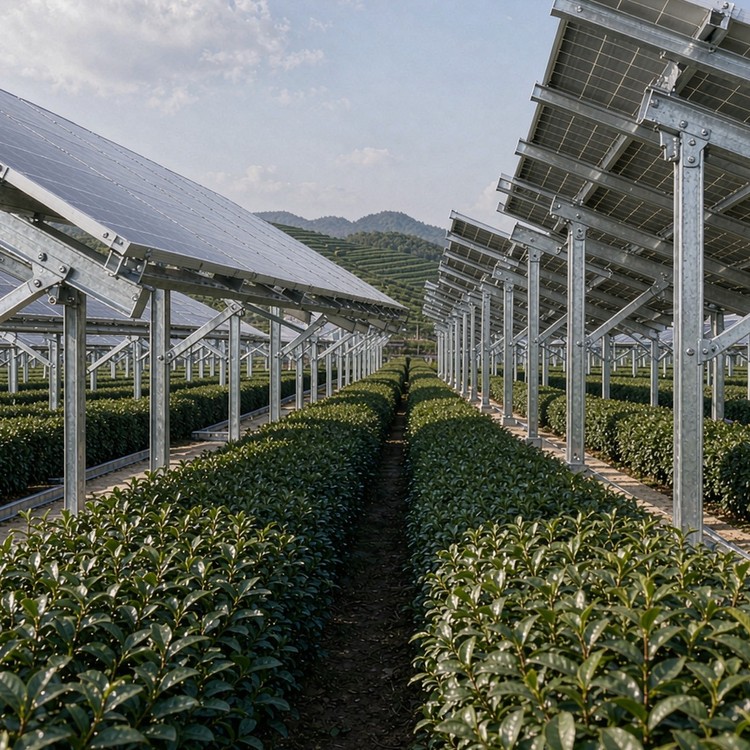
- A tea-PV plant in Shengzhou, Zhejiang on hilly tea gardens, using stepped foundations following contour terraces.
- A tea-PV project in Menghai, Yunnan with striped and partial arrays over tea rows, adjusting light and frost exposure for quality tea.
- A tea-PV project in Jintan, Changzhou over tea rows, cited for maintaining light-transmission ratios required for leaf quality.
Standards and compliance
- National agrivoltaic definitions and permit criteria where enacted
- EN 1991 / ASCE 7 structural loads
- ISO 1461 galvanizing for plantation environments
- PAR and microclimate measurement methodology
- ISO 9001 production quality management; batch traceability
- CE / EN 1090 documentation where destination markets require
Budget drivers and lead time
- Light-ratio engineering has negligible hardware cost and decisive crop-value impact
- Dynamic tilt adds cost; justify it with quality premiums, not yield alone
- Terraced estates carry 10-25 percent structure premium over open fields
- Lead time: 8-14 weeks; harvest calendars gate installation windows
- Quotations state steel grade, zinc mass and coating system explicitly; Incoterms and container plans are quoted to your destination port
Comparing supplier quotations
Quotations for the same site can differ 30 percent and both be honest – the difference hides in stated assumptions. When comparing bids, normalize five items: steel grade and section weights (lighter rails with tighter spacing is not always cheaper per megawatt once pile counts rise); zinc mass and coating system against your corrosivity class; foundation scope – piles only, or piles plus anchors, caps and grading hardware; connection hardware – bolt classes and whether torque values are specified; and logistics – container utilization, port of discharge and inland transport responsibility. A bid that states all five is comparable; a bid that omits them is a discount you will pay for later.
Frequently asked questions
What light ratio keeps tea quality?
Do panels help with frost?
How is hand-picking access designed?
More questions buyers ask
Do you allow third-party or customer inspections before shipment?
How are warranty claims handled in practice?
What to include in your RFQ
- Cultivar and light-response data
- Frost history for the site
- Harvest crew routine
From RFQ to commissioning: how we work
A typical engagement runs in five gates: (1) RFQ review – we check drawings, geotech reports and load assumptions before quoting, and flag gaps that would move cost later; (2) proposal – structural basis, bill of quantities, foundation options and Incoterms stated side by side; (3) engineering freeze – pile tests or pre-drilling trials where soils demand them, shop drawings signed off by both engineering teams; (4) production – batch QA documents issued per lot, pre-shipment inspection open to your inspector or a third party; (5) delivery and install support – container plans matched to EPC sequence, installation manuals, torque tables and commissioning guidance. Each gate produces a document you can file; buyers tell us the discipline matters more than the brochures.
Send documents to our engineering mailbox; a structure engineer replies within one working day – not a sales script, an engineering answer.
Quality, warranty and delivery
We control quality at three gates: incoming steel certification, pre-assembly dimensional checks on jigs, and post-galvanizing thickness verification per batch. Warranty terms are written against load cases and environments, not adjectives – ask us to walk your QA team through the documents before award.
Documentation you receive
We document in the format procurement teams actually file. Standard set: technical proposal with design basis; issued-for-construction drawings; structural calculations signed by our engineering department, third-party endorsement arranged where required; material and coating certificates per batch; installation manual with step sequences, torque values and tolerance acceptance criteria; and packing lists reconciled against container numbers. Optional add-ons: wind-tunnel or code-based fatigue notes for extreme sites, seismic calculation packages, corrosion service-life projections by environment, and spare-parts schedules with recommended holding quantities. Tell us your owner’s documentation standard at RFQ stage and we quote to it rather than discovering it at delivery.
Service life and maintenance planning
Service life claims deserve engineering behind them. Our structures are designed for a 25-30 year service window with a 10-year structure warranty, and the supporting logic is documented: load cases per applicable code, corrosion protection selected against site class, fatigue consideration at high-cycle connections, and tolerance ranges that keep trackers and tables within manufacturer limits over decades. Maintenance is inspection-led: defined intervals, defined checkpoints, defined acceptance values – supplied with the project documentation. When components eventually need replacement, part numbers and production batches are traceable, so spares match the original hardware rather than whatever the market carries that year.
Search terms this page is engineered for
tea-garden agrivoltaic racking, tea-solar integrated racking, tea plantation PV bracket, tea hill PV racking, solar bracket for tea garden, PV racking for terraced tea hill, flexible racking for tea hills.
Ready to Discuss Your Project?
Send the cultivar data – we will return a light-budget layout with frost review and harvest-ergonomic geometry the estate will accept.
