



This page is one of several in our tea / cash crop segment. See the full range of structures, foundations and configurations on the Tea-Garden, Coffee, Orchard & Vineyard Agrivoltaic Racking hub page.
Why Tea / Cash Crop sites are demanding
Tea, coffee and specialty crops are the premium end of agrivoltaics: the crop’s quality depends on light, temperature and humidity that panels measurably change. Engineering here is light-ratio design, frost-protection effects, and harvest-access geometry – with the buyer usually an estate operator who will judge everything by cup and leaf quality.
Site challenges we engineer around:
Challenge 01
Tea and coffee quality responds to light spectra and intensity; wrong shade ratios damage value
Challenge 02
Frost events interact with panel geometry – panels can protect or worsen cold-air pooling
Challenge 03
Hand-plucking access needs clearance and ergonomic row layout, not machine envelopes
Challenge 04
Terraced estate terrain requires stepped, contour-following structures
Challenge 05
Coffee quality responds sharply to shade spectra and density
Challenge 06
Mountain terraces and erosion-prone soils constrain structures
Challenge 07
Altitude adds UV, logistics and frost variables
Engineering requirements and design basis
- Light-ratio engineering: panel gap ratios, strip widths, dynamic tilt options
- Frost-event interaction modeling for the specific valley geometry
- Contour-stepped structures for terraced estates
- Harvest-access geometry for hand crews with baskets and carts
Selection guidance: Specify variety, altitude and terrace geometry; require shade-density options with expected quality impacts documented from comparable projects.
Engineered solution
- Dynamic agrivoltaic options for premium light management
- Crop-first light design service with estate agronomists at the table
- Frost-protection reviews where cold events drive losses
- Contour-adapted structures for terraced plantations
- Hand-harvest access layouts from delivered tea and coffee projects
On this specific application we additionally provide:
- Shade-density options tuned per coffee variety and altitude
- Terrace-adapted structures with erosion-control integration
Installation method and site productivity
A structure that fights the installer will cost you the savings it promised. Ours is designed to be installed by crews who have never seen the drawings before: identical parts across blocks, left-right symmetrical assemblies where possible, hardware kitted per table instead of per truckload, and torque tables that remove guesswork. Driven, screwed and ballasted foundation options are all supported with matching head details, and templates for pile driving are supplied or specified with the foundation design. Where terrain or access limits machines, we re-segment the tables at design stage so manual handling stays within safe limits. Commissioning support closes the loop.
Industry benchmarks
Benchmarks below are publicly documented industry reference projects of comparable type and scale, cited to illustrate engineering practice. They are not our delivery record; delivered references for your configuration are supplied with quotations.
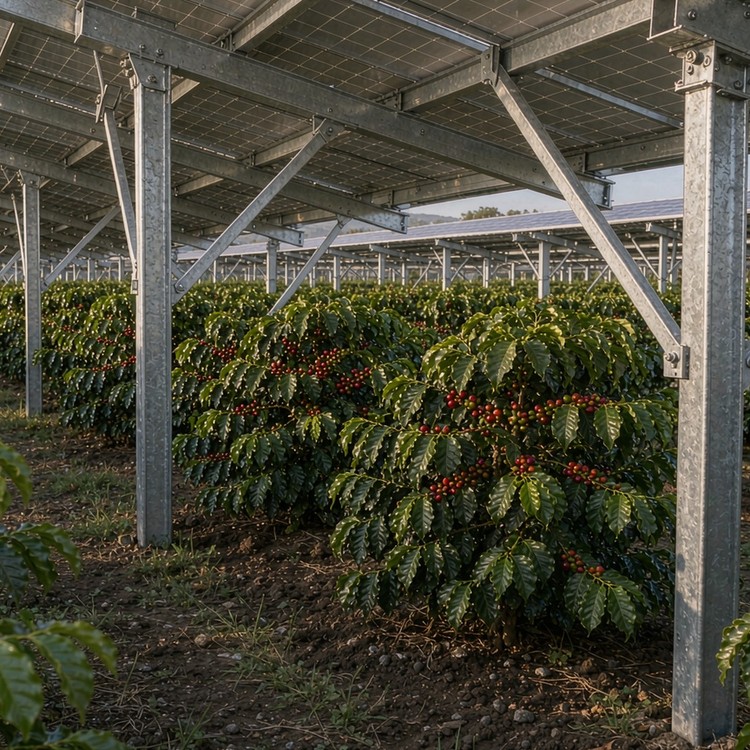
- A 160 MWac coffee-PV base in Pu’er, Yunnan, with about 28 percent flexible or elevated structures over coffee rows; reported investment around RMB 0.9 bn across media sources.
- A 30 MW-class coffee-PV project in Pu’er testing shade ratios for Arabica quality on red-soil mountain plots.
Standards and compliance
- National agrivoltaic definitions and permit criteria where enacted
- EN 1991 / ASCE 7 structural loads
- ISO 1461 galvanizing for plantation environments
- PAR and microclimate measurement methodology
- ISO 9001 production quality management; batch traceability
- CE / EN 1090 documentation where destination markets require
Budget drivers and lead time
- Light-ratio engineering has negligible hardware cost and decisive crop-value impact
- Dynamic tilt adds cost; justify it with quality premiums, not yield alone
- Terraced estates carry 10-25 percent structure premium over open fields
- Lead time: 8-14 weeks; harvest calendars gate installation windows
- Quotations state steel grade, zinc mass and coating system explicitly; Incoterms and container plans are quoted to your destination port
Comparing supplier quotations
A useful discipline: score quotations on completeness before price. A complete bid states the structural design basis, foundation assumptions, material and coating specifications, module interface details, QA documentation list, delivery schedule with Incoterms, and warranty terms with claim criteria. Missing items are not savings – they are decisions deferred to the most expensive moment, mid-installation. We issue quotations in this complete form as standard, and we will re-cost documented alternatives (heavier sections against fewer piles, higher zinc against shorter maintenance cycles) so your award decision trades real variables, not hidden ones. Ask competing bidders to do the same; the industry needs more comparable paper.
Frequently asked questions
How much shade does coffee want?
What about erosion on coffee terraces?
Do panels change coffee flavor?
More questions buyers ask
Can we get samples before committing to volume?
Do you allow third-party or customer inspections before shipment?
What to include in your RFQ
- Coffee variety, altitude and terrace data
- Quality targets and monitoring intentions
- Erosion and drainage conditions
From RFQ to commissioning: how we work
Two things decide whether a racking order lands well: what was agreed before production, and what was documented during it. Before production we align on five inputs – structural design basis, foundation type per soil zone, corrosion protection class, module interface, and delivery sequence. During production every batch generates records you can hand to your lender or owner without translation: mill certificates, coating measurements, torque verification, packing counts. After delivery we stay in the loop – installation guidance, first-inspection support at handover, and a spare-parts recommendation sized to your site’s service life rather than a fixed catalogue list. Ask earlier customers how change requests were handled mid-production; that is the real test of a supplier.
Send documents to our engineering mailbox; a structure engineer replies within one working day – not a sales script, an engineering answer.
Quality, warranty and delivery
Every batch ships with mill certificates, coating-thickness logs and bolt records; welds follow EN 1090 or AISC execution classes. Structure warranty runs to 10 years with a 25-30 year service design life, and spare-part packages are documented so year-12 repairs do not depend on year-1 memory.
Documentation you receive
The paper trail matters as much as the steel. With each delivery you receive: mill test certificates traceable to heat numbers; galvanizing records per batch against ISO 1461 or your specified standard; dimensional inspection reports from pre-assembly jigs; bolt and hardware lot traceability; as-built drawings when site adaptations were made; and a warranty document that names covered load cases, service design life and claim procedures. O&M documentation includes a recommended inspection interval by environment class and a first-maintenance estimate in writing. Everything is indexed, so your asset register does not depend on one engineer’s memory.
Service life and maintenance planning
Service life claims deserve engineering behind them. Our structures are designed for a 25-30 year service window with a 10-year structure warranty, and the supporting logic is documented: load cases per applicable code, corrosion protection selected against site class, fatigue consideration at high-cycle connections, and tolerance ranges that keep trackers and tables within manufacturer limits over decades. Maintenance is inspection-led: defined intervals, defined checkpoints, defined acceptance values – supplied with the project documentation. When components eventually need replacement, part numbers and production batches are traceable, so spares match the original hardware rather than whatever the market carries that year.
Search terms this page is engineered for
coffee-shade PV mounting, solar bracket for coffee shade.
Ready to Discuss Your Project?
Send variety and terrace data – we will return a shade-tuned layout with erosion-integrated structures and the quality-monitoring framework.
