
Por que isso é difícil?
Shading losses are frequently mis-estimated, and the errors come from the model rather than from the physics.
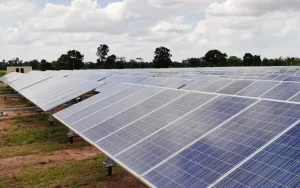
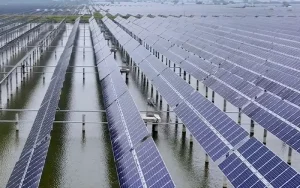
- Annual shading percentages hide the fact that losses are concentrated in the morning, evening and winter months, where energy value may be higher or lower than average
- Partial shading of a module string produces losses larger than the shaded area alone, because the string current is limited by the shaded cell
- Fixed-tilt and tracker require different models, since backtracking changes when and whether a row shades its neighbour
- Winter shading behaves differently from summer shading at the same site, and a model run on a single representative day will miss it
- Row pitch interacts with the terrain, because a slope changes the effective vertical separation between adjacent rows
- The non-linear cost of tightening rows means that small reductions in pitch produce disproportionately large losses past a certain point
Requisitos de engenharia
These are the inputs an inter-row shading analysis requires.
- Hourly irradiance and sun position data for the site, covering a full year rather than representative days
- Module electrical configuration, including string length and the bypass diode arrangement, since shading losses depend on it
- Structure type and geometry: fixed tilt angle or tracker rotation range, module dimensions and mounting height above grade
- Site topography, because slope changes the effective row-to-row separation and the shading geometry
- Ground coverage ratio target or land constraint that sets the allowable pitch range
- Energy price structure, so that shading losses are valued by the hour in which they occur

Selection guidance: model the module electrical configuration, not just the geometric shadow. The shadow is a geometry problem, but the loss is an electrical one, and it is usually larger.
Como resolvemos isso
- Hourly, full-year shading modelling that accounts for the electrical response of the module string rather than only the geometric shadow
- Structure-specific models: backtracking for trackers, tilt-dependent geometry for fixed-tilt arrays
- Terrain-adjusted geometry, so row pitch is evaluated against the actual ground profile rather than a flat plane
- Loss valued by time of day and season, so the row pitch reflects the value of the energy being lost
- Row pitch curve presented across a range, showing where tightening produces disproportionate loss and where widening stops earning
- Winter and summer cases reported separately, since the governing case is often the winter one at high latitude
Além da estrutura
- Row pitch recommendation with the module and tracker configuration stated, so the layout can be checked if either changes
- Layout review against cadastral boundaries, since the theoretical optimum pitch may not fit the available land parcel
Benchmarks de referência
Os benchmarks abaixo são projetos de referência da indústria, de tipo e escala comparáveis e documentados publicamente, citados para ilustrar a prática de engenharia. Eles não representam nosso histórico de entregas.
- A 180 MW project in Germany where full-year modelling showed winter row shading governing the pitch rather than the summer case.
- A 250 MW tracker project in the United States where backtracking removed most low-angle shading and allowed a tighter pitch than the fixed-tilt model had suggested.
- A 120 MW site in Italy on sloping ground where terrain-adjusted row separation changed the recommended pitch on part of the array.
Normas e Conformidade
- ASCE 7 / EN 1991 / AS-NZS 1170 casos de carga de vento com categorias de terreno específicas do local
- Requisitos estruturais do rastreador IEC 62727, onde as estruturas de rastreamento estão incluídas no escopo.
- Documentação de classe de fabricação e execução EN 1090-2 ou AISC 360
- Galvanização por imersão a quente ISO 1461, classificação de corrosividade ISO 9223 para acionamento da massa de zinco
- Sistema de qualidade ISO 9001:2015, sistema de gestão ambiental ISO 14001 sob consulta.
- Estudo aeroelástico em túnel de vento realizado por terceiros disponível para módulos de grande formato.
Garantia de Qualidade
O controle de qualidade é baseado em pontos de verificação: verificação da entrada de materiais, inspeção da posição de soldas e furos durante o processo, amostragem da espessura do revestimento e revisão do contêiner antes do embarque. Cada ponto de verificação gera um documento que sua equipe de qualidade pode arquivar, e a inspeção pré-embarque pode ser realizada pelo seu inspetor ou por uma empresa terceirizada.
Documentação que você receberá
A documentação é tão importante quanto o aço. A cada entrega, você recebe certificados de testes de fábrica rastreáveis por lote; registros de galvanização por lote, de acordo com a norma ISO 1461 ou a norma especificada por você; relatórios de inspeção dimensional de gabaritos de pré-montagem; rastreabilidade de lotes de parafusos e ferragens; desenhos "como construído" com as adaptações necessárias no local; e um documento de garantia que especifica os casos de carga cobertos, a vida útil de projeto e os procedimentos para reclamações. Tudo é indexado, portanto, seu registro de ativos não depende da memória de um único engenheiro.
Planejamento de Vida Útil e Manutenção
O planejamento de substituição faz parte do projeto: a geometria das braçadeiras permite a troca individual de módulos sem cortar os trilhos, as cabeças das estacas permitem o renivelamento após o assentamento e os pacotes de peças de reposição são dimensionados de acordo com a sua classe ambiental e capacidade. Isso mantém a manutenção durante a vida útil rápida, previsível e independente do catálogo de produtos do fornecedor original.
Custos e considerações comerciais
- Row pitch is one of the largest single levers on land area and therefore on land cost, roads, cabling and fencing
- Tight pitch reduces land and balance-of-system cost but increases shading losses, with the loss curve becoming steep past a certain point
- Module and string configuration affects the loss significantly, so a shading study run without the electrical model understates the penalty
- Tracker backtracking reduces low-angle losses and therefore supports tighter pitch, which is a cost benefit that a fixed-tilt model cannot show
- The study cost is small against the land area it determines, and it should be completed before the layout is frozen
Perguntas frequentes
How much energy does inter-row shading actually cost?
Why is the geometric shadow not enough?
Does backtracking remove the need for generous pitch?
How does slope affect row pitch?
What pitch should we start with?
Guias e páginas de aplicativos relacionados
Continue com as páginas mais próximas do seu tipo de projeto.
- Row Spacing, GCR & Capacity Density – a visão geral do grupo para esta escala
- Otimização GCR para matrizes de rastreadores
- Land Use, Acres per MW & Capacity Density
- Projetos de energia solar em escala de utilidade pública
- Projetos de energia solar para agricultura mecanizada e rotação de culturas
- Desert & Sand-Dune Solar Projects
O que precisamos para cotar
- Site coordinates and hourly irradiance data, or a location from which it can be derived
- Module and string configuration, including bypass diode arrangement
- Structure type, tilt or rotation range, and module mounting height
- Topographic survey of the developable area
Fale com um engenheiro estrutural.
Send the site location, module configuration and structure type, and we will return a row pitch curve showing the shading loss against the land saved, with the recommended pitch stated.
 English
 Español
 Deutsch
 Português
 Français
 Italiano