


Por que isso é difícil?
Driven piles fail in a small number of recognisable ways, and each one traces back to a decision taken before installation started.
- Soil profiles vary across a site far more than a single borehole suggests, so refusal can appear in one zone while adjacent zones drive freely
- Over-driving damages the pile head or the coating, and the damage is usually invisible until the structure is loaded
- Pile position and plumb tolerance determine whether the structure assembles without rework, because racking adjustment ranges are finite
- Pull-out and lateral capacity depend on soil friction, which changes with moisture content and cannot be verified after driving
- Coating damage at the ground line is the most common long-term durability failure on driven piles and the hardest to inspect
- Driving productivity sets the construction programme, so pile refusal is a schedule event rather than a technical inconvenience
Requisitos de engenharia
These are the inputs that decide driven pile section, depth and method.
- Geotechnical investigation with boreholes or cone penetration tests at a density reflecting the site’s variability, not a single central hole
- Soil classification and corrosivity testing, since both the design embedment and the coating class depend on them
- Design uplift, compression and lateral loads per pile, derived from the structural load case and foundation layout
- Pile section, wall thickness and steel grade selected against both design load and the driving stresses the method will impose
- Driving method and equipment: impact or vibratory, hammer energy, and the refusal criterion to be applied
- Verification protocol: static or dynamic load testing sample rate, and acceptance criteria for production piles
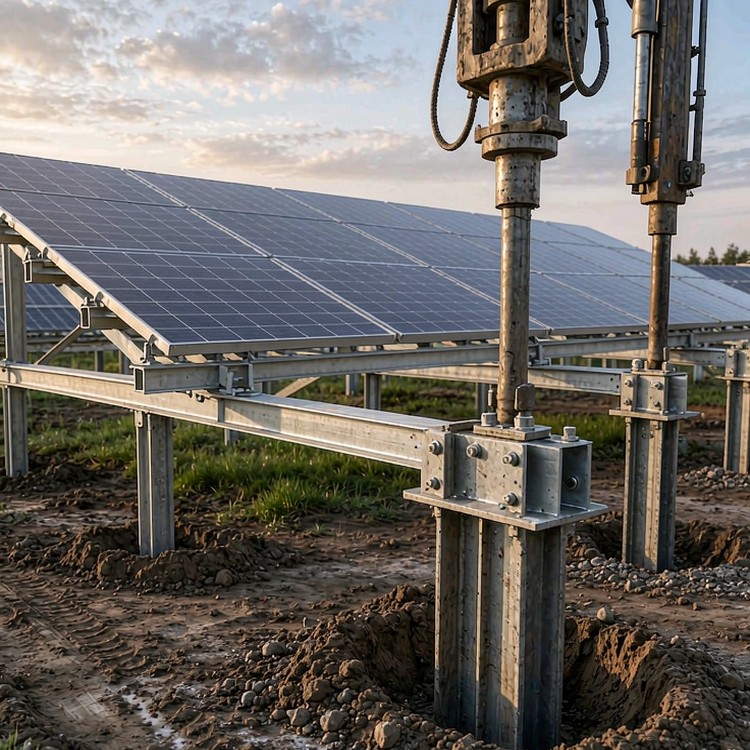
Selection guidance: fix the pile section from the geotechnical data and then choose the driving method to suit the soil. Choosing equipment first and designing the pile to survive it is how coating damage and refusal enter a project.
Como resolvemos isso
- Pile sections selected against both design load and driving stress, so the pile that carries the load also survives installation
- Embedment depth derived from site soil friction and bearing values, with zone-by-zone depths where the profile changes
- Driving method matched to the soil: impact for dense strata, vibratory where displacement is acceptable and speed matters
- Coating specification stepped by soil corrosivity, with additional protection at the ground line where abrasion concentrates
- Tolerance control through template jigs and position surveying, keeping pile heads inside the structure adjustment envelope
- Verification by testing a defined sample, with production acceptance criteria tied to logged driving records
Além da estrutura
- Driving records logged per pile, so refusal zones and over-driving are visible during installation rather than discovered at commissioning
- Pile head detailing that accommodates re-levelling after settlement, avoiding foundation rework in the first operating years
Benchmarks de referência
Os benchmarks abaixo são projetos de referência da indústria, de tipo e escala comparáveis e documentados publicamente, citados para ilustrar a prática de engenharia. Eles não representam nosso histórico de entregas.
- A 300 MW project in Chile where vibratory driving was selected after impact driving produced coating damage in the upper soil layer.
- A 180 MW site in Spain with variable calcarenite bands, where zone-specific embedment depths avoided a refusal problem that a single uniform depth would have created.
- A 250 MW project in the United States using dynamic load testing on a defined sample, replacing a larger static test programme without changing the design basis.
Normas e Conformidade
- Combinações de carga de vento ASCE 7 / EN 1991 e carga sísmica EN 1998 / IBC, quando aplicáveis.
- Níveis de teste de carga mecânica do módulo IEC 61215 compatíveis com a pressão de projeto do seu conjunto de matrizes.
- Classes de execução EN 1090-1/-2 ou AISC para componentes de aço estrutural
- Galvanização ISO 1461 com massa de zinco escalonada por categoria de corrosividade C2 a C5.
- Gestão da qualidade ISO 9001:2015 e qualificação documentada de fornecedores.
- Apoio da DNV ou equivalente para avaliação de viabilidade bancária de projetos financiados
Garantia de Qualidade
A documentação do lote é emitida por lote: certificados de fábrica rastreáveis aos números de lote, registros de galvanização com a espessura do revestimento medida, relatórios de inspeção dimensional de gabaritos de pré-montagem e rastreabilidade do lote de componentes. A garantia cobre casos de carga e classes de exposição ambiental específicos, portanto, as reclamações são resolvidas com base em dados, e não em negociação.
Documentação que você receberá
Cada remessa inclui um pacote de documentos alinhado ao seu registro de ativos: relatórios de testes de materiais certificados, registros de espessura de revestimento por lote, fichas de verificação de torque e pré-carga, listas de embalagem com números de contêineres e um conjunto de desenhos relevantes para a manutenção. Quando o mercado de destino exige certificação local ou documentos traduzidos, nós os preparamos com antecedência, em vez de no porto.
Planejamento de Vida Útil e Manutenção
Planeje a manutenção com base em indicadores mensuráveis, não em estimativas de calendário: inspeção visual anual de amostras de torque de fixação, condição do revestimento nas bordas de corte e zonas de contato com o solo; inspeção detalhada após o primeiro ano com condições climáticas extremas; e verificação de reaperto após o primeiro ciclo térmico em instalações de longa duração. Fornecemos a lista de verificação de inspeção e os critérios de aceitação juntamente com o manual de instalação.
Custos e considerações comerciais
- Pile steel is quoted per tonne, but the number that governs project cost is piles per day, which is a function of the soil rather than of the price
- Under-investing in geotechnical investigation is the most expensive saving on a driven pile project, because it converts a design problem into a construction problem
- Coating upgrades at the ground line are a small unit cost with a large effect on year-ten maintenance
- Dynamic load testing is substantially cheaper per pile than static testing and can be applied at higher sample rates for the same budget
- Refusal and re-driving are schedule costs, and a single day of pile rig downtime on a 200 MW site is material against the energisation date
Perguntas frequentes
How do you decide embedment depth?
Impact or vibratory driving?
How do we know the piles will hold?
What pile position tolerance can the structure accept?
Does pile driving damage the coating?
Guias e páginas de aplicativos relacionados
Continue com as páginas mais próximas do seu tipo de projeto.
O que precisamos para cotar
- Geotechnical investigation report including borehole logs, soil classification and corrosivity results
- Design uplift, compression and lateral load per pile, with the foundation layout
- Pile section, length and coating class currently assumed, if already defined
- Available driving equipment and any site access constraints that limit rig size
Fale com um engenheiro estrutural.
Send the geotechnical report and the foundation layout, and we will return a pile section recommendation, zone-by-zone embedment depths and a verification protocol sized to your site.
 English
 Español
 Deutsch
 Português
 Français
 Italiano