




Why This Is Difficult
Accessibility costs appear in the operating account rather than the capital account, which is why they are systematically under-designed.
- Module replacement is the most frequent maintenance task, and if it requires rail disassembly the cost per event rises substantially
- Torque verification requires physical access to connections, and connections buried under rails or between rows are expensive to reach
- Coating inspection requires visual and instrument access to the surfaces exposed to corrosion, particularly at the ground line and at cut edges
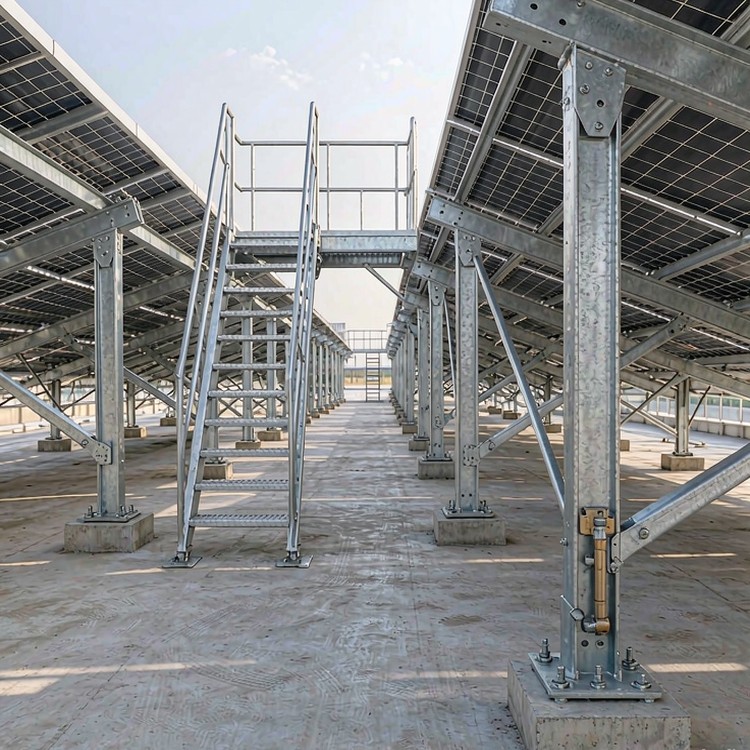
- Row pitch and array height determine whether maintenance can be carried out from the ground or requires platforms and harnesses
- Walkway provision and cable management affect both access and the risk of damage during maintenance
- Accessibility is almost free at design stage and expensive to retrofit, because retrofitting means working around an installed structure
Engineering Requirements
These are the inputs required to design for O&M accessibility.
- The maintenance tasks expected over the asset life, with their frequency and their access requirements stated individually
- Module replacement method intended, including whether replacement is expected to be possible without disassembling the structure
- Array height, row pitch and tilt or rotation range, since these determine whether tasks can be performed from ground level
- Connection detailing, including which connections require torque verification and how they will be reached
- Cable routing and walkway provision, so maintenance access and cable protection are designed together
- Site access for maintenance vehicles and equipment, including any restriction that limits the machinery available
Selection guidance: list the maintenance tasks before designing the layout. Accessibility requirements follow from the tasks, and a layout designed without them cannot be assessed for accessibility at all.
How We Solve It
- Module replacement possible without rail disassembly, through clamp geometry that allows individual module removal
- Connections positioned so torque verification can be completed with hand tools from an accessible working position
- Array height, row pitch and tilt selected with maintenance access considered, where the energy and cost effect is acceptable
- Walkways and cable management designed in, protecting cables from foot traffic and providing defined maintenance routes
- Coating and fastener inspection points identified, with the access required for each stated in the maintenance manual
- Maintenance manual issued with the structure, listing tasks, intervals, access requirements and acceptance criteria
Beyond the Structure
- Accessibility assessed across the fleet, so procedures and access equipment are common between sites
- Spares and tools specified to the maintenance tasks, so access equipment and replacement parts arrive together
Reference Benchmarks
Benchmarks below are publicly documented industry reference projects of comparable type and scale, cited to illustrate engineering practice. They are not our delivery record.
- A 200 MW owner-operator project in the United States where clamp geometry allowed individual module replacement without rail disassembly, reducing maintenance cost per event.
- A 150 MW project in Spain where walkway provision and cable routing were designed together, reducing cable damage during maintenance.
- A 250 MW portfolio in Australia where accessibility was assessed across sites, allowing common access equipment and procedures to serve the fleet.
Standards and Compliance
- ASCE 7 / EN 1991 wind and EN 1998 / IBC seismic load combinations where applicable
- IEC 61215 module mechanical load test levels matched to your array design pressure
- EN 1090-1/-2 or AISC execution classes for structural steel components
- ISO 1461 galvanizing with zinc mass stepped by corrosivity category C2 to C5
- ISO 9001:2015 quality management and documented supplier qualification
- DNV or equivalent bankability review support for financed projects
Quality Assurance
Quality control is checkpoint-based: material intake verification, in-process weld and hole-position inspection, coating thickness sampling and pre-shipment container review. Each checkpoint produces a document your quality team can file, and pre-shipment inspection is open to your inspector or a third party.
Documentation You Receive
The paper trail matters as much as the steel. With each delivery you receive mill test certificates traceable to heat numbers; galvanizing records per batch against ISO 1461 or your specified standard; dimensional inspection reports from pre-assembly jigs; bolt and hardware lot traceability; as-built drawings where site adaptations were made; and a warranty document naming covered load cases, service design life and claim procedures. Everything is indexed, so your asset register does not depend on one engineer’s memory.
Service Life and Maintenance Planning
Plan maintenance around measurable triggers, not calendar guesses: annual visual inspection of fastener torque samples, coating condition at cut edges and ground-contact zones; a detailed inspection after the first extreme weather year; and re-torque verification after the first thermal cycle on long runs. We supply the inspection checklist and acceptance criteria with the installation manual.
Cost and Commercial Considerations
- Accessibility designed in costs a small amount at capital stage and saves repeatedly across the asset life, which makes it one of the more favourable levelised cost levers
- Module replacement cost per event depends directly on whether the structure must be disassembled, and that is a design decision
- Torque verification across a fleet is a recurring labour cost that connection detailing either minimises or inflates
- Access equipment is cheaper when it is common across the fleet, which argues for accessibility designed to a portfolio standard
- Retrofit accessibility work must be carried out around an installed structure, and it is several times more expensive than designing it in
Frequently Asked Questions
Why does accessibility matter so much?
What are the key design features?
How do we specify accessibility?
Does accessibility conflict with cost optimisation?
What should the maintenance manual contain?
Related Guides and Application Pages
Continue with the pages closest to your project type.
What We Need to Quote
- Maintenance tasks expected over the asset life and their frequency
- Module replacement method intended and any requirement for individual module swap
- Array height, row pitch and tilt or rotation range currently planned
- Maintenance equipment available at site and any access restriction
Talk to a Structure Engineer
Send the maintenance tasks you expect and the array layout, and we will return an accessibility assessment with the design features required and the access provision stated per task.
