



3 Engineering Disciplines Under This Hub
Fishery-PV Complementary Racking Systems
Aquaculture & Fishery-PV Complementary Mounting — Fish Pond and Shrimp Farm Brackets
Reservoir Aqua-Voltaic Racking
Reservoir Aqua-Voltaic & Aqua-Solar Hybrid Pond Mounting
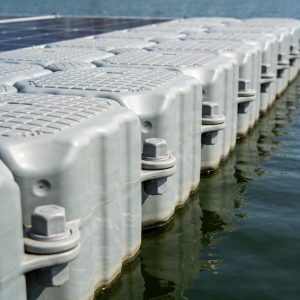
Floating Fishery-PV Systems
Floating PV for Fish Ponds, Fish Cages and Aquaculture Farms
Why Fishery-PV Complementary projects are demanding
Fishery-PV is China’s largest dual-use segment and is expanding across Asia: arrays over active aquaculture ponds where stock, feeding and harvesting continue under panels. The design work is three-way geometry – piles clear of aerators and nets, rows passable for daily operations, and corrosion protection matched to brackish water.
Site challenges we engineer around:
Challenge 01
Brackish and saline pond water attacks galvanizing and fasteners at accelerated rates
Challenge 02
Soft pond sediments give low lateral resistance; long piles are standard
Challenge 03
Different pond types (shrimp, crab, fish) need different clearance and row spacing
Challenge 04
Insurance and lenders require corrosion documentation and fish-safe materials
How to choose the right page
- If ponds stay in production underneath, start with the fishery-PV complementary page
- If the host water body is a reservoir, start with the aqua-voltaic page
- If the array floats, start with the floating fishery-PV page – the engineering changes completely
Key technical parameters at a glance
Typical engineering envelopes for this segment; every project is recalculated against the destination-market code before fabrication:
| Parameter | Typical value / approach |
|---|---|
| Structural design life | 25-year service design with a 10-year structural warranty frame |
| Steel grades | Q235B / Q355B, hot-dip galvanized to ISO 1461, average zinc 85 um or above |
| Design wind | site-specific 3-second gust, typically 33-42 m/s per EN 1991-1-4 or ASCE 7 |
| Snow and ice | 0.4-1.5 kN/m2 ground snow band with unbalanced-load cases checked |
| Water coverage | hot-dip steel posts driven from pond bottoms |
| Access | layout keeps boat lanes for aquaculture operations |
Engineering requirements and design basis
- Long-pile lateral design in soft sediments with pull-out verification
- Row spacing that keeps feed barges, nets and walkways functional
- Module-edge drip detailing to avoid concentrated saline discharge points
- Clearance engineering per pond type: aerator height, net frames, harvest equipment
What this hub covers
- Pond and over-water racking that keeps aquaculture operating
- Reservoir aqua-voltaic systems with water-level and access planning
- Floating fishery-PV structures with mooring and walkway design
- Corrosion and biofouling protection for permanent water contact

Which configuration fits your site
Three supply configurations cover most fishery-pv complementary procurement cases:
| Configuration | Structure and finish | Best for | Cost index |
|---|---|---|---|
| Economy line | Q235B main steel, hot-dip galvanized to ISO 1461 | aquaculture pond dykes | 1.0 (baseline) |
| Standard line | Q355B main members, 85 um+ zinc, pre-assembled brackets | typical fishery-pv complementary tenders with standard code loads | +15-25% |
| Severe-site line | reinforced sections, duplex coating, sealed hardware | full water coverage with boat access | +35-50% |
Engineered solution
- Long-pile foundation kits with tested lateral capacity for pond sediments
- Pond-type-specific clearance presets (fish, shrimp, crab) from delivered projects
- Batch material certificates for lender and insurer review
- O&M guidance that treats pond production as the primary land use
- Aquaculture-first layout service co-designed with pond operators before structure freeze

Industry benchmarks
The reference points below are anonymized industry benchmarks drawn from comparable public projects of this type. They are not claims about projects delivered by us, and no client, developer or operator is identified.
- A large fishery-PV base in Tianjin on coastal saline ponds, with long piles through soft marine clay and rows set for aeration and harvest access.
- A fishery-PV project in Danyang, Jiangsu on intensively farmed ponds, with pile spacing matched to feeder lines and netting systems.
- Two 200 MW fishery-PV plants in Binzhou on Yellow River delta saline ponds, typical of batch piling in soft silt under C4-C5 corrosion exposure.
- A 278 MW-class floating plant on a large reservoir in Madhya Pradesh, among Asia’s largest, with HDPE floats and moorings sized for monsoon reservoir dynamics.
- A 145 MWac (192 MWp) floating plant on a large reservoir in Indonesia with about 340,000 modules on roughly 2,100 anchor blocks in 100 m-deep water; 2023 commissioning made it Southeast Asia’s largest floating plant.
- An aquaculture research program in Egypt evaluated PV-powered pond aeration, with water-use and yield data for arid-zone fish farming.
Installation method and site productivity
A structure that fights the installer will cost you the savings it promised. Ours is designed to be installed by crews who have never seen the drawings before: identical parts across blocks, left-right symmetrical assemblies where possible, hardware kitted per table instead of per truckload, and torque tables that remove guesswork. Driven, screwed and ballasted foundation options are all supported with matching head details, and templates for pile driving are supplied or specified with the foundation design. Where terrain or access limits machines, we re-segment the tables at design stage so manual handling stays within safe limits. Commissioning support closes the loop.
Standards and compliance
- ISO 12944 C4/C5 corrosion methodology
- ISO 1461 galvanizing with enhanced zinc mass for pond environments
- Aquaculture-safety material declarations where lenders require
- Structural codes with soft-soil lateral provisions
- ISO 9001 production quality management; batch traceability
- CE / EN 1090 documentation where destination markets require
Budget drivers and lead time
- Corrosion packages add 8-15 percent but decide asset life on brackish ponds
- Long piles are the main cost variable; sediment data avoids both under- and over-design
- Layout optimization for pond operations has zero material cost and high production value
- Lead time: 8-12 weeks; pond renovation schedules often gate installation
- Quotations state steel grade, zinc mass and coating system explicitly; Incoterms and container plans are quoted to your destination port
Comparing supplier quotations
Before signing, make the quotes apples-to-apples. Ask each bidder to confirm: design wind speed and terrain category used, snow or ice loads, seismic requirements if any; the geotechnical assumptions behind foundation pricing and who pays when soils disagree; the exact steel grade, coating standard and zinc mass; module clamping compatibility with your module datasheet revision; delivery terms – Incoterms, lead time ex-works versus to-port, partial-shipment flexibility; and warranty scope including fasteners and coatings, not just structure. Suppliers who answer these in writing are suppliers who have built before. We answer them by default, in the quotation, not after a chase.
Frequently asked questions
Does shading harm the fish or the pond ecology?
What keeps a floating fishery array in position?
How is corrosion handled in permanent water contact?
Who owns the structural design – can we modify it?
How are change orders handled during production?
Ready to Start Your Fishery-pv complementary Project?
What to include in your RFQ
- Water body type, depth and annual level variation
- Aquaculture species, stocking density and permitted coverage ratio
- Bed conditions for mooring or anchoring
- O&M access expectations and boat availability
From RFQ to commissioning: how we work
Procurement runs smoother when both sides know the sequence. Our standard flow: RFQ received – acknowledged within one working day with a list of anything missing (geotech data, design wind speed, module model, terrain category); engineering review – typically three to five working days; quotation – itemized, with steel grade, zinc mass, coating system and Incoterms explicit; sample or pilot lot – available for new partners who want to verify fit and finish before volume; production and inspection – your QC team or a third party is welcome at pre-shipment; shipping – container optimization against your unloading equipment; installation – manuals, videos and a named contact through commissioning. The flow is boring on purpose: fewer surprises, faster approvals.
Send your pond or reservoir data and aquaculture plan – we will design coverage and structure around both businesses.
Quality, warranty and delivery
We control quality at three gates: incoming steel certification, pre-assembly dimensional checks on jigs, and post-galvanizing thickness verification per batch. Warranty terms are written against load cases and environments, not adjectives – ask us to walk your QA team through the documents before award.
Control points from intake to handover
| Stage | What is checked | You receive |
|---|---|---|
| Material intake | steel grade and zinc mass verified against mill certificates | mill certificates and intake report |
| Production | weld quality, hole positioning and coating thickness sampled per batch | batch traceability sheet and QC photos |
| Pre-shipment | container loading plan, bolt-kit counts and packing list reviewed | packing list and loading photos |
| Site handover | installation walkthrough with torque values confirmed | installation manual, torque table and warranty letter |
| Site-specific check | pond-bottom penetration tests on a dyke grid | project-specific method statement |
Documentation you receive
Every order ships with a documentation set built for audits, not for decoration: structural calculation notes stating load cases and standards used; foundation design basis mapped to your geotechnical report; material certificates for steel and fasteners; hot-dip galvanizing certificates with measured coating thickness per batch; assembly drawings with torque tables; and packing documentation matched to container manifests. For financed projects we add lender-format compliance statements, and for public tenders we respond to documentation schedules line by line. Documents are issued in English as standard; other languages by arrangement.
Service life and maintenance planning
Plan maintenance around measurable triggers, not calendar guesses. Annual visual inspection of fastener torque samples, coating condition at cut edges and ground-contact zones; a detailed inspection after the first extreme weather year – typhoon, sandstorm or heavy snow depending on your region; re-torque verification after the first thermal cycle on long tracker runs. We supply the inspection checklist and acceptance criteria with the installation manual, so your O&M team measures against the same numbers our factory used. Where structures sit in aggressive soils or salt zones we advise higher zinc mass and drainage detailing up front – cheaper than retrofits.
