


Perché questo è difficile
Physical testing earns its cost in two situations: when code coefficients are a poor fit for the geometry, and when the structure responds dynamically rather than statically.
- Code pressure coefficients are developed for generic geometries, so they are conservative for some configurations and unrepresentative for others
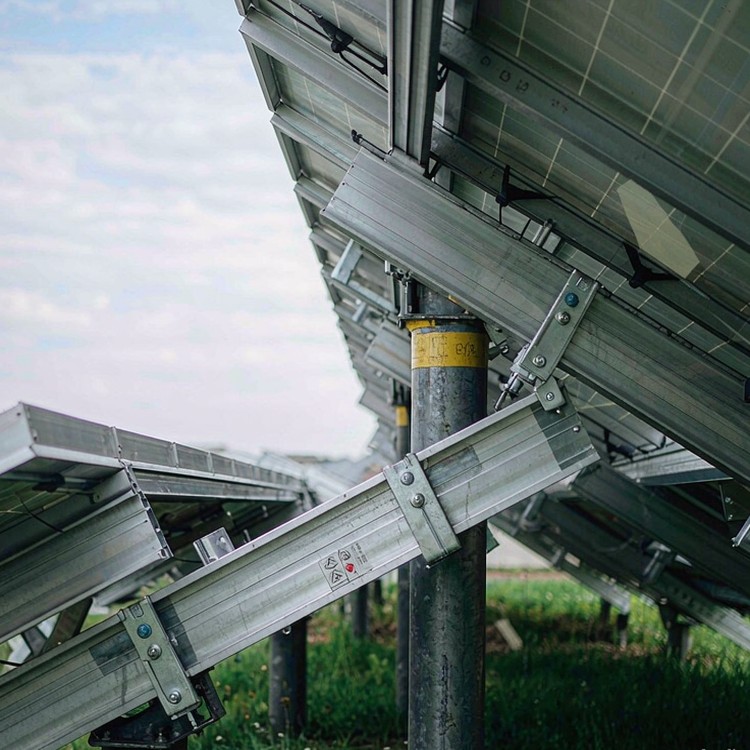
- Trackers present a large, low-stiffness surface that can respond dynamically, producing loads a static calculation does not predict
- Stow strategy, the angle at which the array is parked before high wind, is validated by testing rather than assumed from a data sheet
- Large-format modules reduce the number of attachment points relative to area, changing the load path and increasing deflection sensitivity
- Testing can recover tonnage in the interior of a large array, where conservative coefficients are applied over the greatest area
- Lenders and technical advisers increasingly request a testing report or an equivalent justification on tracker-based projects above a certain scale
Requisiti di ingegneria
These are the inputs and decisions involved in a wind tunnel programme.
- Array configuration and geometry for the model: module size, tilt range, row pitch, array height and the number of rows to be represented
- Site wind climate: basic wind speed, turbulence intensity and directional distribution, since the test matrix is built from these
- Terrain and topographic context, so the boundary layer in the tunnel represents the actual site
- Dynamic characteristics of the real structure, namely natural frequencies and damping, supplied by the structure engineer
- Stow strategy to be tested, including angle, wind speed trigger and wind direction coverage
- Required test outputs: static pressure coefficients, dynamic response, and the aeroelastic stability envelope
Selection guidance: agree the test matrix and the stow strategy before commissioning the study. A test conducted without a stow case to validate produces coefficients but no operational answer.
Come lo risolviamo
- Wind tunnel study scoped to the actual configuration, producing pressure coefficients that reflect the array rather than a generic geometry
- Aeroelastic testing for tracker and flexible structures, measuring dynamic response rather than inferring it from static coefficients
- Stow strategy validation, so the parking angle and the wind speed trigger are demonstrated rather than assumed
- Directional testing, since the worst case is frequently not the perpendicular wind but an oblique direction that produces torsion
- Results delivered in a form the structural engineer can apply directly, with a test report suitable for lender or third-party review
- Comparison against the code calculation, so recovered tonnage and the resulting saving are visible rather than claimed
Oltre la struttura
- Test data reused across a project family, so a second site with the same configuration and similar wind climate uses the same study
- A tested stow strategy also protects against field damage, which is a maintenance cost avoided rather than a capex cost recovered
Parametri di riferimento
I parametri di riferimento riportati di seguito sono progetti di settore di tipo e dimensioni comparabili, documentati pubblicamente e citati a scopo illustrativo delle migliori pratiche ingegneristiche. Non rappresentano il nostro storico di realizzazione.
- A 500 MW tracker portfolio where a wind tunnel study demonstrated a stow strategy that reduced structural demand and avoided a costly design revision.
- A 200 MW project using large-format modules where dynamic testing identified an oblique-wind response the static calculation had not shown as governing.
- A multi-site programme where one study covering a common configuration was applied across four sites with similar wind climates, spreading the cost.
Standard e conformità
- Carichi del vento ASCE 7 / EN 1991 risolti con fattori di terreno ed esposizione specifici del sito
- Compatibilità dell'interfaccia del modulo IEC 61215 / IEC 61730 verificata rispetto alla scheda tecnica del modulo.
- Classi di esecuzione EN 1090 o AISC per carpenteria metallica saldata e bullonata
- Zincatura a caldo secondo ISO 1461, massa di zinco specificata in base alla corrosività del suolo e dell'atmosfera.
- Gestione della qualità della produzione secondo la norma ISO 9001 con tracciabilità a livello di lotto.
- Documentazione CE/EN 1090 ove richiesta dai mercati di destinazione.
Garanzia di qualità
Ogni lotto viene spedito con certificati di produzione, registri dello spessore del rivestimento e documentazione relativa ai bulloni; le saldature sono conformi alle classi di esecuzione EN 1090 o AISC. La garanzia sulla struttura è di 10 anni, a fronte di una vita utile prevista di 25-30 anni, e i pacchetti di ricambi sono documentati in modo che le riparazioni al dodicesimo anno non dipendano dalla memoria del primo anno.
Documentazione che riceverai
La documentazione è pensata per le verifiche, non per essere meramente estetica: note di calcolo strutturale che indicano i casi di carico e gli standard utilizzati; base di progettazione delle fondazioni mappata sulla relazione geotecnica; certificati dei materiali per acciaio e elementi di fissaggio; certificati di zincatura con spessore del rivestimento misurato per lotto; disegni di assemblaggio con tabelle di coppia; e documentazione di imballaggio corrispondente ai manifesti dei container. Per i progetti finanziati aggiungiamo dichiarazioni di conformità nel formato richiesto dall'istituto di credito; per le gare d'appalto pubbliche rispondiamo ai capitolati di documentazione riga per riga.
Pianificazione della durata di servizio e della manutenzione
La durata di servizio è un risultato di progettazione, non una promessa. La massa di zinco, la classe di rivestimento dei dispositivi di fissaggio, i dettagli di drenaggio e l'isolamento tra metalli diversi vengono selezionati in base alla categoria di corrosività del sito e l'intervallo previsto per la prima manutenzione viene indicato per iscritto. Per ambienti aggressivi, in fase di progettazione, il sistema di rivestimento viene potenziato, il che è sempre più economico di un intervento successivo.
Considerazioni di costo e commerciali
- Wind tunnel studies are priced per test campaign, with cost driven by model complexity and the number of configurations tested
- The cost is usually recovered in recovered tonnage or avoided foundation depth on arrays of significant scale in marginal wind zones
- Additional configurations add incremental cost, so a well-defined test matrix is more economical than sequential single-case testing
- Dynamic testing costs more than static pressure measurement but is the only way to establish an aeroelastic envelope
- A validated stow strategy has operational value beyond capex, since it reduces storm damage risk and the associated outage and repair cost
Domande frequenti
When is wind tunnel testing worth the cost?
What is aeroelastic testing and why does it matter?
Does testing change the stow strategy?
Can results from one project be used on another?
What does the test report contain?
Guide correlate e pagine applicative
Proseguite con le pagine più pertinenti alla tipologia del vostro progetto.
- Structural Load, Wind & Snow Engineering – la panoramica del gruppo per questa fascia di scala
- Wind Load Calculation & Uplift Resistance for Solar Racking
- Snow Load Design for Solar Mounting Structures
- Harsh Environment Applications
- Progetti solari offshore, costieri e marini
- Progetti solari in montagna e su terreni scoscesi
Cosa dobbiamo preventivare
- Array configuration, module format and the tilt range to be considered
- Site wind climate data and the design wind speed requirement
- Structural natural frequencies and damping, or the structure design it will be applied to
- Intended stow strategy, or a request for the study to determine one
Rivolgiti a un ingegnere strutturale.
Send the array configuration and the site wind climate, and we will return a proposed test matrix, the coefficients it will produce and an estimate of the tonnage it could recover.
 English
 Español
 Deutsch
 Português
 Français
 Italiano