


Warum das schwierig ist
Physical testing earns its cost in two situations: when code coefficients are a poor fit for the geometry, and when the structure responds dynamically rather than statically.
- Code pressure coefficients are developed for generic geometries, so they are conservative for some configurations and unrepresentative for others
- Trackers present a large, low-stiffness surface that can respond dynamically, producing loads a static calculation does not predict
- Stow strategy, the angle at which the array is parked before high wind, is validated by testing rather than assumed from a data sheet
- Large-format modules reduce the number of attachment points relative to area, changing the load path and increasing deflection sensitivity
- Testing can recover tonnage in the interior of a large array, where conservative coefficients are applied over the greatest area
- Lenders and technical advisers increasingly request a testing report or an equivalent justification on tracker-based projects above a certain scale
Technische Anforderungen
These are the inputs and decisions involved in a wind tunnel programme.
- Array configuration and geometry for the model: module size, tilt range, row pitch, array height and the number of rows to be represented
- Site wind climate: basic wind speed, turbulence intensity and directional distribution, since the test matrix is built from these
- Terrain and topographic context, so the boundary layer in the tunnel represents the actual site
- Dynamic characteristics of the real structure, namely natural frequencies and damping, supplied by the structure engineer
- Stow strategy to be tested, including angle, wind speed trigger and wind direction coverage
- Required test outputs: static pressure coefficients, dynamic response, and the aeroelastic stability envelope
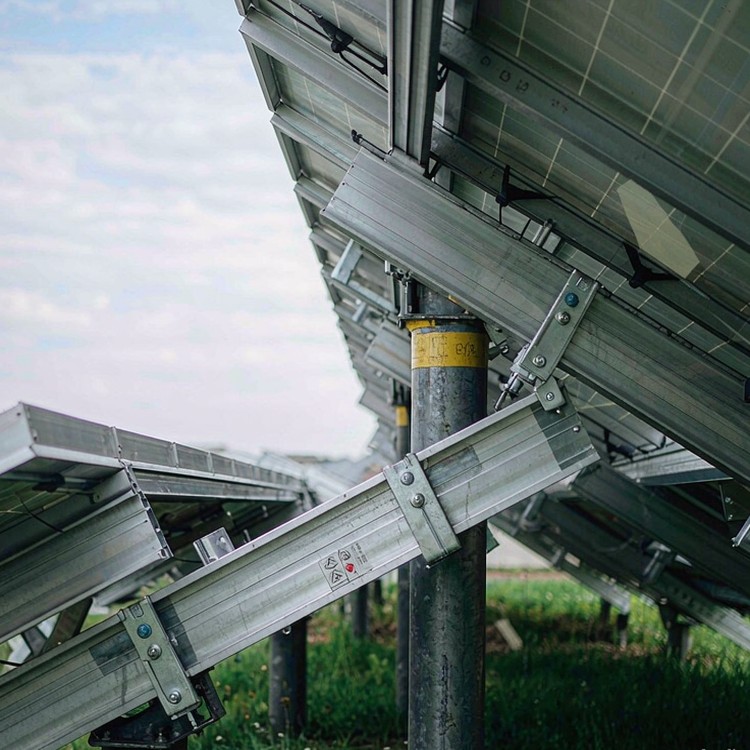
Selection guidance: agree the test matrix and the stow strategy before commissioning the study. A test conducted without a stow case to validate produces coefficients but no operational answer.
Wie wir es lösen
- Wind tunnel study scoped to the actual configuration, producing pressure coefficients that reflect the array rather than a generic geometry
- Aeroelastic testing for tracker and flexible structures, measuring dynamic response rather than inferring it from static coefficients
- Stow strategy validation, so the parking angle and the wind speed trigger are demonstrated rather than assumed
- Directional testing, since the worst case is frequently not the perpendicular wind but an oblique direction that produces torsion
- Results delivered in a form the structural engineer can apply directly, with a test report suitable for lender or third-party review
- Comparison against the code calculation, so recovered tonnage and the resulting saving are visible rather than claimed
Jenseits der Struktur
- Test data reused across a project family, so a second site with the same configuration and similar wind climate uses the same study
- A tested stow strategy also protects against field damage, which is a maintenance cost avoided rather than a capex cost recovered
Referenz-Benchmarks
Die folgenden Benchmarks sind öffentlich dokumentierte Branchenreferenzprojekte vergleichbarer Art und Größenordnung, die zur Veranschaulichung der Ingenieurpraxis dienen. Sie stellen nicht unsere Leistungsbilanz dar.
- A 500 MW tracker portfolio where a wind tunnel study demonstrated a stow strategy that reduced structural demand and avoided a costly design revision.
- A 200 MW project using large-format modules where dynamic testing identified an oblique-wind response the static calculation had not shown as governing.
- A multi-site programme where one study covering a common configuration was applied across four sites with similar wind climates, spreading the cost.
Standards und Konformität
- Windlasten nach ASCE 7 / EN 1991 unter Berücksichtigung standortspezifischer Gelände- und Expositionsfaktoren
- Die Kompatibilität der IEC 61215 / IEC 61730 Modulschnittstelle wurde anhand Ihres Moduldatenblatts überprüft.
- Ausführungsklassen nach EN 1090 oder AISC für geschweißte und geschraubte Stahlkonstruktionen
- Feuerverzinkung nach ISO 1461, Zinkmasse abhängig von der Boden- und atmosphärischen Korrosivität
- ISO 9001-konformes Produktionsqualitätsmanagement mit Rückverfolgbarkeit auf Chargenebene
- CE-/EN-1090-Dokumentationspaket, sofern in den Zielmärkten erforderlich
Qualitätssicherung
Jede Charge wird mit Werkszeugnissen, Schichtdickenprotokollen und Schraubenprotokollen ausgeliefert; die Schweißnähte entsprechen den Ausführungsklassen EN 1090 oder AISC. Die Gewährleistung auf die Struktur beträgt 10 Jahre bei einer geplanten Nutzungsdauer von 25–30 Jahren. Die Ersatzteilpakete sind so dokumentiert, dass Reparaturen im 12. Jahr nicht auf den Daten des ersten Jahres basieren.
Dokumentation, die Sie erhalten
Die Dokumentation dient Prüfungszwecken, nicht der Dekoration: Statische Berechnungshinweise mit Angabe der Lastfälle und verwendeten Normen; Fundamentberechnungsgrundlagen, die auf Ihren geotechnischen Bericht abgestimmt sind; Materialzertifikate für Stahl und Befestigungsmittel; Verzinkungszertifikate mit Angabe der Schichtdicke pro Charge; Montagezeichnungen mit Drehmomenttabellen; und Verpackungsdokumentation, die mit den Containermanifesten übereinstimmt. Bei finanzierten Projekten ergänzen wir die Dokumentation um Konformitätserklärungen im Format des Kreditgebers; bei öffentlichen Ausschreibungen erfüllen wir die Dokumentationsvorgaben Zeile für Zeile.
Lebensdauer- und Wartungsplanung
Die Nutzungsdauer ist ein Planungsergebnis, keine Garantie. Zinkmasse, Beschichtungsklasse der Befestigungselemente, Entwässerungsdetails und Trennung unterschiedlicher Metalle werden entsprechend der Korrosivitätskategorie Ihres Standorts ausgewählt, und das voraussichtliche erste Wartungsintervall wird schriftlich festgehalten. In aggressiven Umgebungen optimieren wir das Beschichtungssystem bereits in der Planungsphase, was stets kostengünstiger ist als eine nachträgliche Nachrüstung.
Kosten- und kommerzielle Überlegungen
- Wind tunnel studies are priced per test campaign, with cost driven by model complexity and the number of configurations tested
- The cost is usually recovered in recovered tonnage or avoided foundation depth on arrays of significant scale in marginal wind zones
- Additional configurations add incremental cost, so a well-defined test matrix is more economical than sequential single-case testing
- Dynamic testing costs more than static pressure measurement but is the only way to establish an aeroelastic envelope
- A validated stow strategy has operational value beyond capex, since it reduces storm damage risk and the associated outage and repair cost
Häufig gestellte Fragen
When is wind tunnel testing worth the cost?
What is aeroelastic testing and why does it matter?
Does testing change the stow strategy?
Can results from one project be used on another?
What does the test report contain?
Verwandte Leitfäden und Anwendungsseiten
Fahren Sie mit den Seiten fort, die Ihrem Projekttyp am ehesten entsprechen.
- Structural Load, Wind & Snow Engineering – die Gruppenübersicht für dieses Skalenband
- Windlastberechnung und Auftriebswiderstand für Solarmontagesysteme
- Snow Load Design for Solar Mounting Structures
- Anwendungen in rauen Umgebungen
- Offshore, Nearshore & Marine Solar Projects
- Solarenergieprojekte in den Bergen und Steilgebieten
Was wir für ein Angebot benötigen
- Array configuration, module format and the tilt range to be considered
- Site wind climate data and the design wind speed requirement
- Structural natural frequencies and damping, or the structure design it will be applied to
- Intended stow strategy, or a request for the study to determine one
Sprechen Sie mit einem Statiker
Send the array configuration and the site wind climate, and we will return a proposed test matrix, the coefficients it will produce and an estimate of the tonnage it could recover.
 English
 Español
 Deutsch
 Português
 Français
 Italiano