



This page is one of several in our fishery-pv complementary segment. See the full range of structures, foundations and configurations on the Fishery-PV Complementary Racking Systems hub page.
Why Fishery-PV Complementary sites are demanding
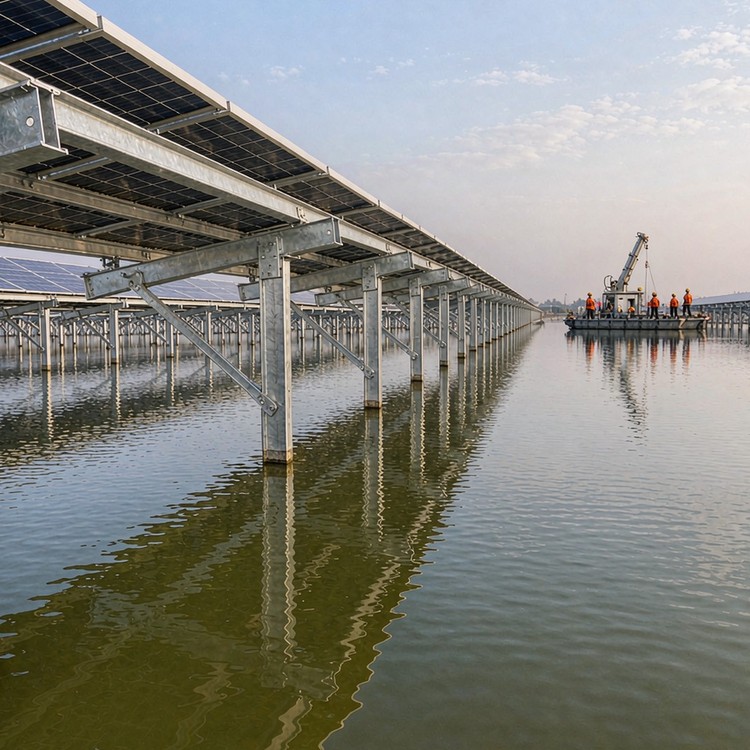
Fishery-PV is China’s largest dual-use segment and is expanding across Asia: arrays over active aquaculture ponds where stock, feeding and harvesting continue under panels. The design work is three-way geometry – piles clear of aerators and nets, rows passable for daily operations, and corrosion protection matched to brackish water.
Site challenges we engineer around:
Challenge 01
Brackish and saline pond water attacks galvanizing and fasteners at accelerated rates
Challenge 02
Soft pond sediments give low lateral resistance; long piles are standard
Challenge 03
Different pond types (shrimp, crab, fish) need different clearance and row spacing
Challenge 04
Insurance and lenders require corrosion documentation and fish-safe materials
Challenge 05
Daily pond operations cannot pause for construction or O&M
Challenge 06
Brackish water attacks standard galvanizing and fasteners
Challenge 07
Different species need different clearance and row geometry
Engineering requirements and design basis
- Clearance engineering per pond type: aerator height, net frames, harvest equipment
- Corrosion class selection for brackish exposure with documented coating systems
- Long-pile lateral design in soft sediments with pull-out verification
- Row spacing that keeps feed barges, nets and walkways functional
Selection guidance: Start from the pond operations calendar, not the module grid; specify corrosion class from measured salinity and put coating schedules in the contract.
Engineered solution
- O&M guidance that treats pond production as the primary land use
- Aquaculture-first layout service co-designed with pond operators before structure freeze
- Brackish corrosion package: duplex coatings, sealed fasteners, inspection plan
- Long-pile foundation kits with tested lateral capacity for pond sediments
- Pond-type-specific clearance presets (fish, shrimp, crab) from delivered projects
On this specific application we additionally provide:
- Operator-first layout process: feeding, aeration and harvest mapped before structure freeze
- Brackish corrosion package with batch certificates for lenders and insurers
Installation method and site productivity
A structure that fights the installer will cost you the savings it promised. Ours is designed to be installed by crews who have never seen the drawings before: identical parts across blocks, left-right symmetrical assemblies where possible, hardware kitted per table instead of per truckload, and torque tables that remove guesswork. Driven, screwed and ballasted foundation options are all supported with matching head details, and templates for pile driving are supplied or specified with the foundation design. Where terrain or access limits machines, we re-segment the tables at design stage so manual handling stays within safe limits. Commissioning support closes the loop.
Industry benchmarks
Benchmarks below are publicly documented industry reference projects of comparable type and scale, cited to illustrate engineering practice. They are not our delivery record; delivered references for your configuration are supplied with quotations.
- A large fishery-PV base in Tianjin on coastal saline ponds, with long piles through soft marine clay and rows set for aeration and harvest access.
- A fishery-PV project in Danyang, Jiangsu on intensively farmed ponds, with pile spacing matched to feeder lines and netting systems.
- Two 200 MW fishery-PV plants in Binzhou on Yellow River delta saline ponds, typical of batch piling in soft silt under C4-C5 corrosion exposure.
Standards and compliance
- ISO 12944 C4/C5 corrosion methodology
- ISO 1461 galvanizing with enhanced zinc mass for pond environments
- Aquaculture-safety material declarations where lenders require
- Structural codes with soft-soil lateral provisions
- ISO 9001 production quality management; batch traceability
- CE / EN 1090 documentation where destination markets require
Budget drivers and lead time
- Corrosion packages add 8-15 percent but decide asset life on brackish ponds
- Long piles are the main cost variable; sediment data avoids both under- and over-design
- Layout optimization for pond operations has zero material cost and high production value
- Lead time: 8-12 weeks; pond renovation schedules often gate installation
- Quotations state steel grade, zinc mass and coating system explicitly; Incoterms and container plans are quoted to your destination port
Comparing supplier quotations
The cheapest structure per tonne is rarely the cheapest per megawatt installed. Compare at installed-cost level: pile count and driving productivity on your soils; preassembly ratio and site welding (should be zero); crane and crew days implied by the table design; tolerance adjustment range – wider ranges absorb terrain error and cut rework; packaging density and container count; and the commissioning support included. Then compare at ten-year level: coating life to first maintenance, fastener replacement expectations, spare parts availability commitments, and whether warranty claims reference measurable criteria. We quote with these lines visible so your finance team sees the same picture your engineers do.
Frequently asked questions
How much clearance do fishpond arrays need?
What corrosion protection lasts in brackish ponds?
Can construction avoid disturbing the stock?
More questions buyers ask
How is the hardware packed for ocean freight?
Do you support installation training on site?
What to include in your RFQ
- Pond operations calendar and equipment list
- Salinity and sediment data
- Species and stocking cycles
From RFQ to commissioning: how we work
Procurement runs smoother when both sides know the sequence. Our standard flow: RFQ received – acknowledged within one working day with a list of anything missing (geotech data, design wind speed, module model, terrain category); engineering review – typically three to five working days; quotation – itemized, with steel grade, zinc mass, coating system and Incoterms explicit; sample or pilot lot – available for new partners who want to verify fit and finish before volume; production and inspection – your QC team or a third party is welcome at pre-shipment; shipping – container optimization against your unloading equipment; installation – manuals, videos and a named contact through commissioning. The flow is boring on purpose: fewer surprises, faster approvals.
Send documents to our engineering mailbox; a structure engineer replies within one working day – not a sales script, an engineering answer.
Quality, warranty and delivery
We control quality at three gates: incoming steel certification, pre-assembly dimensional checks on jigs, and post-galvanizing thickness verification per batch. Warranty terms are written against load cases and environments, not adjectives – ask us to walk your QA team through the documents before award.
Documentation you receive
The paper trail matters as much as the steel. With each delivery you receive: mill test certificates traceable to heat numbers; galvanizing records per batch against ISO 1461 or your specified standard; dimensional inspection reports from pre-assembly jigs; bolt and hardware lot traceability; as-built drawings when site adaptations were made; and a warranty document that names covered load cases, service design life and claim procedures. O&M documentation includes a recommended inspection interval by environment class and a first-maintenance estimate in writing. Everything is indexed, so your asset register does not depend on one engineer’s memory.
Service life and maintenance planning
Plan maintenance around measurable triggers, not calendar guesses. Annual visual inspection of fastener torque samples, coating condition at cut edges and ground-contact zones; a detailed inspection after the first extreme weather year – typhoon, sandstorm or heavy snow depending on your region; re-torque verification after the first thermal cycle on long tracker runs. We supply the inspection checklist and acceptance criteria with the installation manual, so your O&M team measures against the same numbers our factory used. Where structures sit in aggressive soils or salt zones we advise higher zinc mass and drainage detailing up front – cheaper than retrofits.
Search terms this page is engineered for
fishery-photovoltaic complementary support, fish-solar hybrid PV racking, aqua-voltaic mounting system, aquaculture PV bracket, fish pond solar mounting, shrimp farm photovoltaic racking, fishery solar co-use bracket, paddy-fish solar co-culture racking, fishery solar complementary system, aquatic farm solar racking, PV bracket for fishery complementary, fixed mount for fishery photovoltaic complementary, bracket for fish shrimp co culture.
Ready to Discuss Your Project?
Send the operations calendar – we will return a pond-first layout with clearance heights, corrosion spec and a phasing plan that keeps stock growing.
