




Why This Is Difficult
On a brownfield or landfill site the array design is downstream of an environmental constraint, and the constraint is not negotiable. Everything follows from what you are not allowed to disturb.
- Landfill caps are engineered containment systems, and any penetration risks both the cap integrity and the site’s environmental permit
- Settlement is expected and uneven, so foundations must tolerate differential movement without transferring load to the cap
- Contaminated ground restricts excavation and can require groundwater protection measures that constrain both foundations and cable routes
- Gas management infrastructure on landfill sites occupies surface area and imposes clearance and exclusion requirements
- Cable routing must avoid creating preferential pathways for water or gas migration, which rules out conventional trenching
- Permitting involves environmental regulators as well as planning authorities, and the schedule is driven by their review rather than by construction
Engineering Requirements
These are the design requirements that make a landfill or brownfield array permissible as well as buildable.
- Assessment of the cap or containment system, with the design confirmed as non-penetrating before any foundation position is fixed
- Ballasted or surface-mounted foundation design with a documented load-spreading layer and a stated maximum bearing pressure on the cap
- Differential settlement tolerance designed into the structure, with adjustment provisions rather than a rigid frame
- Cable routing designed with the environmental constraints, using above-ground ducts or channels that avoid creating migration pathways
- Coordination with landfill gas infrastructure, including clearance requirements and exclusion zones around wells and flares
- Environmental permitting documentation, including the construction method statement that the regulator will review
Selection guidance: confirm the containment constraints with the regulator before designing the foundation. On a capped site, the foundation design follows from the permit, not the other way round.
How We Solve It
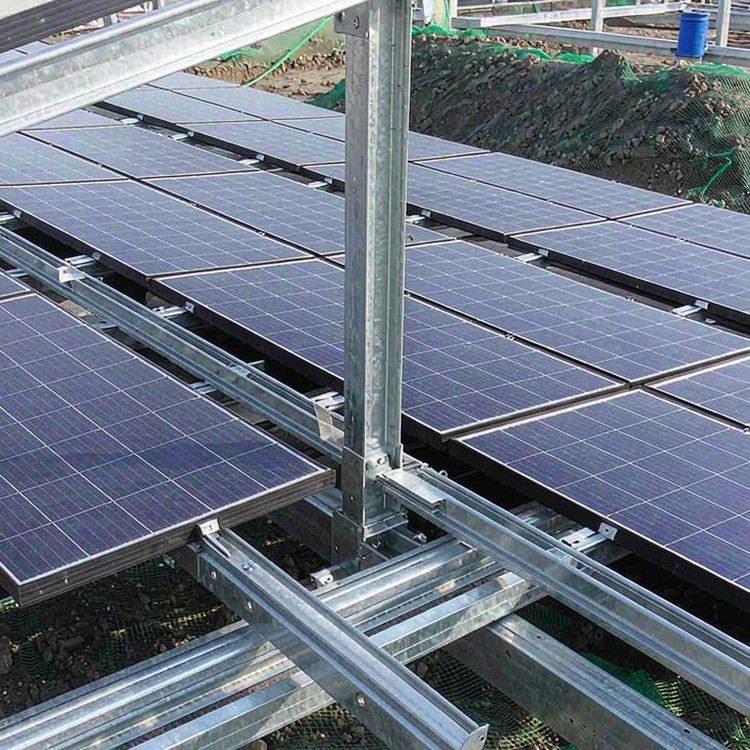
- Ballasted foundation systems with geotextile separation layers and load-spreading distribution, so no penetration occurs and bearing pressure stays within the cap’s allowance
- Settlement-tolerant structure with adjustment provisions at the foundation interface, so differential movement is absorbed rather than resisted
- Above-ground cable routing in ducted trays or channels, avoiding trenches that could create preferential pathways
- Layout coordinated with gas wells, flares and monitoring points, maintaining all required clearances and access
- Construction method statement prepared for environmental review, describing equipment, loading, and protection of the cap during installation
- Reversibility designed in, so the array can be removed at the end of its life without disturbing the containment system
Beyond the Structure
- Low-ground-pressure installation equipment specified in the method statement, protecting the cap during construction as well as operation
- Monitoring provisions agreed with the operator, so cap performance can continue to be verified after the array is installed
Reference Benchmarks
Benchmarks below are publicly documented industry reference projects of comparable type and scale, cited to illustrate engineering practice. They are not our delivery record.
- A 3 MW solar garden on a closed landfill in Italy, using ballasted foundations with a geotextile separation layer and above-ground cable routing.
- Former military and industrial brownfield sites in Germany where cleared ground and low-disturbance foundations made reuse economically viable.
- United States landfill-cap projects where environmental permitting, rather than construction, set the project schedule.
Standards and Compliance
- ASCE 7 / EN 1991 wind loads resolved with site-specific terrain and exposure factors
- IEC 61215 / IEC 61730 module interface compatibility verified against your module datasheet
- EN 1090 or AISC execution classes for welded and bolted steelwork
- Hot-dip galvanizing to ISO 1461, zinc mass specified by soil and atmospheric corrosivity
- ISO 9001 production quality management with batch-level traceability
- CE / EN 1090 documentation pack where destination markets require it
Quality Assurance
Every batch ships with mill certificates, coating-thickness logs and bolt records; welds follow EN 1090 or AISC execution classes. Structure warranty runs to 10 years against a 25-30 year service design life, and spare-part packages are documented so year-12 repairs do not depend on year-1 memory.
Documentation You Receive
Documentation is built for audits, not decoration: structural calculation notes stating load cases and standards used; foundation design basis mapped to your geotechnical report; material certificates for steel and fasteners; galvanizing certificates with measured coating thickness per batch; assembly drawings with torque tables; and packing documentation matched to container manifests. For financed projects we add lender-format compliance statements; for public tenders we respond to documentation schedules line by line.
Service Life and Maintenance Planning
Service life is a design output, not a promise. Zinc mass, fastener coating class, drainage detailing and dissimilar-metal isolation are selected against the corrosivity category of your site, and the expected first-maintenance interval is stated in writing. For aggressive environments we step the coating system up at design stage, which is always cheaper than a retrofit.
Cost and Commercial Considerations
- Ballasted foundations typically add 30-60 percent over driven piles, driven by the load-spreading and separation design
- Above-ground cable routing costs more than trenching and is usually unavoidable where excavation is restricted
- Environmental permitting effort is substantial and largely fixed, making it proportionally heavy on smaller projects
- Low-ground-pressure installation equipment raises construction cost but is usually a permit condition rather than a choice
- Lead time: permitting typically governs, with fabrication and delivery able to proceed in parallel once the design is agreed
Frequently Asked Questions
Can you install solar on a capped landfill without breaching the cap?
What about settlement?
How does permitting work on these sites?
Does solar interfere with landfill gas management?
What happens to the array at the end of its life?
Related Guides and Application Pages
Continue with the pages closest to your project type.
What We Need to Quote
- Environmental permit conditions and any containment or excavation restrictions
- Cap construction details or contamination report for the site
- Landfill gas infrastructure layout and required clearances
- Site access routes and any equipment weight restrictions
Talk to a Structure Engineer
Send your permit conditions and site data, and we will return a non-penetrating foundation design, a layout and a construction method statement outline.
