




This page is one of several in our forestry / silvopasture segment. See the full range of structures, foundations and configurations on the Forestry-PV & Understory Silvopasture Racking hub page.
Why Forestry / Silvopasture sites are demanding
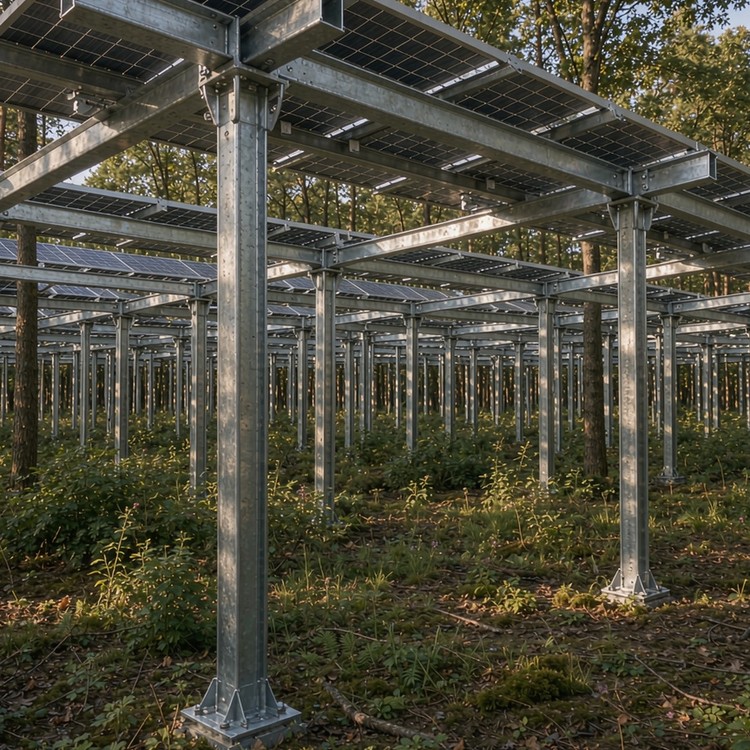
Forestry-PV covers reclaimed forest land, timber plantations and silvopasture blocks: arrays among or above trees where fire risk, root systems and shade geometry dominate. Successful designs treat vegetation management as an engineering input – clearances, fire breaks and root-aware foundations decided before steel is ordered.
Site challenges we engineer around:
Challenge 01
Shade from retained trees is dynamic over decades as canopies grow
Challenge 02
Regulatory limits on deforestation push designs that keep some canopy
Challenge 03
Access roads must double as fire breaks and maintenance routes
Challenge 04
Tree roots compete with foundations; felling and stump removal change soil behavior
Challenge 05
Selective clearing must preserve the timber business
Challenge 06
Tall equipment (harvesters, forwarders) sets clearance
Challenge 07
Canopy growth changes light conditions over time
Engineering requirements and design basis
- Selective-clearing layout that satisfies forestry permits
- Root-zone foundation planning: cut/fill strategy with root barriers where needed
- Fire-wise detailing: steel-only secondary components, ember-resistant cable routes
- Shade-modeling of retained canopy over 25 years
Selection guidance: Map machinery routes and harvest cycles first; require the clearing plan as a joint document between forestry and PV engineering.
Engineered solution
- Root-aware foundation kits with per-block soil strategy
- Canopy-retention layouts that meet forestry permit conditions
- Access and fire-break engineering combined in one corridor plan
- Long-horizon shade model informing row placement now
- Revegetation coordination with forestry operators
On this specific application we additionally provide:
- Selective-clearing layouts co-designed with the forestry operator
- High-clearance structures sized for forestry machinery
Installation method and site productivity
Ask how a structure installs before you compare its steel price. Our systems install with standard construction equipment – no proprietary tools, no site welding on the critical path. Piles are driven or screwed with industry-standard rigs and template jigs hold embedment tolerance; tables arrive preassembled in kits sequenced to your stacking plan; torque-controlled bolting with supplied torque values replaces welded connections; and rail adjustment ranges absorb the terrain error that grading leaves behind. We provide installation drawings, a step-by-step manual, torque and tolerance acceptance tables, and remote support during your install window. On request, an installation supervisor trains your crew on the first blocks.
Industry benchmarks
Benchmarks below are publicly documented industry reference projects of comparable type and scale, cited to illustrate engineering practice. They are not our delivery record; delivered references for your configuration are supplied with quotations.
- A PV-silkworm-mulberry composite on karst rocky-desert slopes in Guanling, Guizhou, anchoring arrays into thin soils over dolomite while revegetating with mulberry.
Standards and compliance
- Forestry and fire codes (regional; project-driven)
- EN 1991 / ASCE 7 loads
- ISO 1461 galvanizing; ember-exposure material choices in fire zones
- Electrical codes with vegetation-clearance provisions
- ISO 9001 production quality management; batch traceability
- CE / EN 1090 documentation where destination markets require
Budget drivers and lead time
- Stump removal and root management are hidden cost lines; survey before quoting
- Fire-wise upgrades are percentage-cheap on hardware, decisive on insurability
- Retaining canopy reduces yield; the trade belongs in the business case, not the layout default
- Lead time: 8-14 weeks; clearing permits often gate schedules
- Quotations state steel grade, zinc mass and coating system explicitly; Incoterms and container plans are quoted to your destination port
Comparing supplier quotations
A useful discipline: score quotations on completeness before price. A complete bid states the structural design basis, foundation assumptions, material and coating specifications, module interface details, QA documentation list, delivery schedule with Incoterms, and warranty terms with claim criteria. Missing items are not savings – they are decisions deferred to the most expensive moment, mid-installation. We issue quotations in this complete form as standard, and we will re-cost documented alternatives (heavier sections against fewer piles, higher zinc against shorter maintenance cycles) so your award decision trades real variables, not hidden ones. Ask competing bidders to do the same; the industry needs more comparable paper.
Frequently asked questions
Can arrays work inside productive woodland?
What clearance do forestry machines need?
Does canopy growth kill the yield?
More questions buyers ask
In which languages is the documentation provided?
Who owns the structural design – can we modify it?
What to include in your RFQ
- Forest stand data and harvest plan
- Machinery specifications
- Zone availability for clearing
From RFQ to commissioning: how we work
We structure every order around five checkpoints. First, technical screening: your drawings, soil data and wind or snow parameters are reviewed by a structure engineer, not a salesperson, and assumptions are written down before any number is quoted. Second, a costed proposal that separates structure, foundation hardware and optional items so you can compare bids line by line. Third, design freeze: shop drawings, connection details and coating specifications agreed in writing, with third-party review arranged when your owner or lender requires it. Fourth, controlled production with per-batch records – steel mill certificates, galvanizing thickness logs, bolt lot traceability. Fifth, logistics and installation support: sequencing to your EPC program, packing lists that match container plans, and a named engineer reachable during your install window.
Send documents to our engineering mailbox; a structure engineer replies within one working day – not a sales script, an engineering answer.
Quality, warranty and delivery
Production follows ISO 9001 procedures with batch traceability from coil to container; galvanizing runs to ISO 1461 with zinc mass selected by your site corrosivity class. We publish our first-maintenance estimates in writing, and our warranty documentation names what is covered, for how long, and under which load cases.
Documentation you receive
Buyers comparing suppliers should compare document depth, because claims are easy and records are not. We provide: design basis documents that name standards, load cases and safety factors explicitly; batch-level quality records (steel, galvanizing, fasteners) retained for the warranty period; installation and maintenance manuals written for site crews, not marketing; warranty terms that specify what is covered, for how long, and the claim process; and end-of-project dossiers suitable for handover to your O&M contractor. For multi-project buyers we keep a document history per site, so year-eight extensions reference year-one assumptions instead of starting from zero.
Service life and maintenance planning
Service life claims deserve engineering behind them. Our structures are designed for a 25-30 year service window with a 10-year structure warranty, and the supporting logic is documented: load cases per applicable code, corrosion protection selected against site class, fatigue consideration at high-cycle connections, and tolerance ranges that keep trackers and tables within manufacturer limits over decades. Maintenance is inspection-led: defined intervals, defined checkpoints, defined acceptance values – supplied with the project documentation. When components eventually need replacement, part numbers and production batches are traceable, so spares match the original hardware rather than whatever the market carries that year.
Search terms this page is engineered for
forest understory PV bracket, timber-solar co-management racking, tree-solar hybrid mounting, shade-tolerant silvo-voltaic racking, logging road PV bracket, forest edge solar racking, solar mounting for timber solar, PV bracket for woodland agri, flexible racking for forest.
Ready to Discuss Your Project?
Send stand and machinery data – we will return a selective-clearing layout with high-clearance structures and the light trajectory modeled.
