




This page is one of several in our plains / flat terrain segment. See the full range of structures, foundations and configurations on the Solar Racking Systems for Plains & Flat-Terrain PV Plants hub page.
Why Plains / Flat Terrain sites are demanding
Plains and flat-terrain sites host the majority of the world’s utility-scale PV capacity because layout efficiency, piling productivity and O&M access are all at their best on level ground. The engineering challenge is different but real: long wind fetch, variable soil layers, flood levels and sheer scale make foundation selection and batch delivery the decisive cost items.
Site challenges we engineer around:
Challenge 01
Soil strata can change every few hundred meters, so a single pile design never fits the whole site
Challenge 02
High groundwater or seasonal perched water reduces effective embedment and complicates pile driving
Challenge 03
Flood-prone flats require column extension, scour checks and electrical routing above design water level
Challenge 04
Batch logistics: hundreds of thousands of piles and brackets must arrive in EPC sequence, not alphabetically
Challenge 05
Every supplier quotes a different standard, making comparison guesswork
Challenge 06
Field welding creeps into bids and quietly destroys corrosion warranties
Challenge 07
Small plants get treated as second-class customers for engineering support
Engineering requirements and design basis
- Tolerance strategy: pile head position, plumbness and height adjustment ranges matched to tracker or table tolerances
- Corrosion class selection by soil resistivity and coating life-to-first-maintenance target
- Geotech-to-pile mapping: each foundation type assigned to borehole zones, with pre-drilling options for refusal
- Pull-out and lateral tests on site before the design is frozen, not after
Selection guidance: Choose tilt from five published SKUs, confirm wind and snow class against your site, and lock coating class by environment. Any deviation beyond the SKUs belongs on the engineered-products page, not here.
Engineered solution
- Foundation decision table: driven piles for uniform soils, screw piles for refusal risk, ballast where penetration is prohibited
- Preassembled table modules with 80 percent+ shop fabrication, zero site welding, bolt-only assembly
- Batch QA with mill certificates, coating thickness logs and per-batch torque verification
- Pile-driving guidance on site: crew training, template jigs and acceptance criteria agreed before mobilization
- Structure warranty and spare-part packaging sized for a 30-year service window
On this specific application we additionally provide:
- Five standard tilt SKUs with published load tables for fast selection
- Bolt-only modular tables shipped in preassembled bundles
Installation method and site productivity
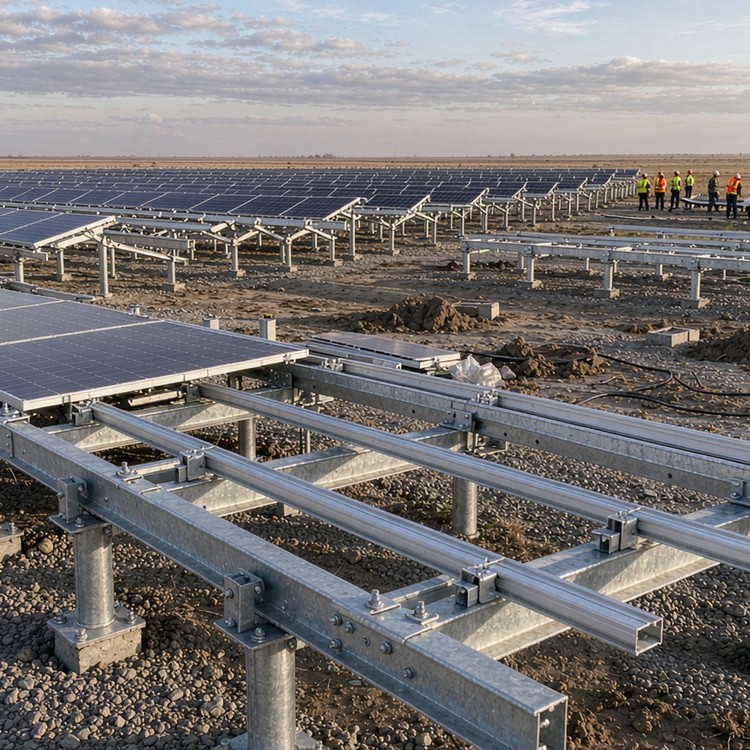
Installation method is a cost line, not an afterthought. We ship structures engineered around the equipment you will actually have: pile-driving rigs with template jigs for soils that accept driven piles; screw-pile drives with torque monitoring where refusal or vibration rules out impact; precast ballast pads where penetration is prohibited; and bolt-only table assembly with 80 percent+ shop fabrication so site welding stays at zero. Crew productivity typically runs 40-80 tables per day per rig on prepared corridors, and our installation manual states the assumed crew size, equipment list and daily output so your construction schedule is built on numbers, not optimism.
Industry benchmarks
Benchmarks below are publicly documented industry reference projects of comparable type and scale, cited to illustrate engineering practice. They are not our delivery record; delivered references for your configuration are supplied with quotations.
- A PV plant in Brandenburg, Germany on former military training land, a brownfield-reuse reference with cleared ground and low-disturbance foundations.
Standards and compliance
- ASCE 7 / EN 1991 wind loads with site-specific terrain factors
- IEC 61215 / IEC 61730 for module interface compatibility
- EN 1090 or AISC execution classes for welded and bolted steelwork
- Hot-dip galvanizing to ISO 1461 with zinc mass specified by soil corrosivity
- ISO 9001 production quality management; batch traceability
- CE / EN 1090 documentation where destination markets require
Budget drivers and lead time
- Foundation choice typically moves total racking cost by 15-30 percent, more than rail gauge tuning ever will
- Steel price and hot-dip galvanizing weight are the two dominant variables; quotes should state both explicitly
- Pile length steps (2.0 / 2.5 / 3.0 m) are priced discretely – confirm refusal assumptions before contract
- Lead time: 4-8 weeks for standard fixed tables, 8-14 weeks for trackers, plus ocean freight to port of entry
- Quotations state steel grade, zinc mass and coating system explicitly; Incoterms and container plans are quoted to your destination port
Comparing supplier quotations
Before signing, make the quotes apples-to-apples. Ask each bidder to confirm: design wind speed and terrain category used, snow or ice loads, seismic requirements if any; the geotechnical assumptions behind foundation pricing and who pays when soils disagree; the exact steel grade, coating standard and zinc mass; module clamping compatibility with your module datasheet revision; delivery terms – Incoterms, lead time ex-works versus to-port, partial-shipment flexibility; and warranty scope including fasteners and coatings, not just structure. Suppliers who answer these in writing are suppliers who have built before. We answer them by default, in the quotation, not after a chase.
Frequently asked questions
Can standard SKUs really cover a 20 MW flat site?
What does preassembly actually save on site?
Is the same SKU set used in coastal environments?
More questions buyers ask
Do you support installation training on site?
What information do you need to keep a quotation valid?
What to include in your RFQ
- Site area, DC size target and grid connection point
- Local wind and snow values or code reference
- Module datasheet and preferred tilt
From RFQ to commissioning: how we work
We structure every order around five checkpoints. First, technical screening: your drawings, soil data and wind or snow parameters are reviewed by a structure engineer, not a salesperson, and assumptions are written down before any number is quoted. Second, a costed proposal that separates structure, foundation hardware and optional items so you can compare bids line by line. Third, design freeze: shop drawings, connection details and coating specifications agreed in writing, with third-party review arranged when your owner or lender requires it. Fourth, controlled production with per-batch records – steel mill certificates, galvanizing thickness logs, bolt lot traceability. Fifth, logistics and installation support: sequencing to your EPC program, packing lists that match container plans, and a named engineer reachable during your install window.
Send documents to our engineering mailbox; a structure engineer replies within one working day – not a sales script, an engineering answer.
Quality, warranty and delivery
Every batch ships with mill certificates, coating-thickness logs and bolt records; welds follow EN 1090 or AISC execution classes. Structure warranty runs to 10 years with a 25-30 year service design life, and spare-part packages are documented so year-12 repairs do not depend on year-1 memory.
Documentation you receive
Buyers comparing suppliers should compare document depth, because claims are easy and records are not. We provide: design basis documents that name standards, load cases and safety factors explicitly; batch-level quality records (steel, galvanizing, fasteners) retained for the warranty period; installation and maintenance manuals written for site crews, not marketing; warranty terms that specify what is covered, for how long, and the claim process; and end-of-project dossiers suitable for handover to your O&M contractor. For multi-project buyers we keep a document history per site, so year-eight extensions reference year-one assumptions instead of starting from zero.
Service life and maintenance planning
Plan maintenance around measurable triggers, not calendar guesses. Annual visual inspection of fastener torque samples, coating condition at cut edges and ground-contact zones; a detailed inspection after the first extreme weather year – typhoon, sandstorm or heavy snow depending on your region; re-torque verification after the first thermal cycle on long tracker runs. We supply the inspection checklist and acceptance criteria with the installation manual, so your O&M team measures against the same numbers our factory used. Where structures sit in aggressive soils or salt zones we advise higher zinc mass and drainage detailing up front – cheaper than retrofits.
Search terms this page is engineered for
PV racking for flat terrain, flat ground photovoltaic mounting system, level site solar racking, open-field PV bracket, utility-scale PV mounting for plains, level ground tracker system.
Ready to Discuss Your Project?
Tell us your DC size and location wind class – we will reply with the matching SKU, budget number and batch plan the same week.
