




This page is one of several in our regional & long-tail segment. See the full range of structures, foundations and configurations on the PV Racking for Regional Markets & Long-Tail Requirements hub page.
Why Regional & Long-tail sites are demanding
Sub-Saharan Africa spreads from Sahel sand to tropical slopes: strong resource, weak logistics, off-grid and utility segments side by side. Foundation simplicity, transport efficiency and rugged spares strategy decide project economics.
Site challenges we engineer around:
Challenge 01
Remote sites make logistics and spares the real constraints
Challenge 02
Sandy Sahel profiles versus laterite tropical soils need different kits
Challenge 03
Off-grid and mini-grid projects need simple, robust structures
Challenge 04
Skilled-labor scarcity favors preassembly
Challenge 05
Financing requires donor-grade documentation
Challenge 06
Logistics dominate project economics
Challenge 07
Skilled-labor scarcity favors preassembly
Challenge 08
Financing demands documentation depth
Engineering requirements and design basis
- Coating-class transparency in quotations
- Warranty terms structured around load cases and environments
- Foundation decision framework applied per site class
- Tilt-pitch optimization with wind and land trade documented
Selection guidance: Weight logistics in the RFQ: container efficiency, preassembly ratio, spares strategy. Remote projects are won on these lines.
Engineered solution
- Warranty documentation aligned to standards
- Engineering support for tender clarifications
- Comparable-quote framework: same line items, same assumptions, comparable numbers
- Foundation kits per soil class with test gates
- Component specifications with material certificates
On this specific application we additionally provide:
- Transport-efficient preassembled kits with remote-site spares packages
- Donor-format documentation and simple-to-build design
Regional delivery notes:
- Industry benchmarks: Thar-desert utility plants and desert-control programs provide transferable analogs for Sahel conditions
- Positioning: preassembled, transport-efficient kits with spares packages for remote O&M
Installation method and site productivity
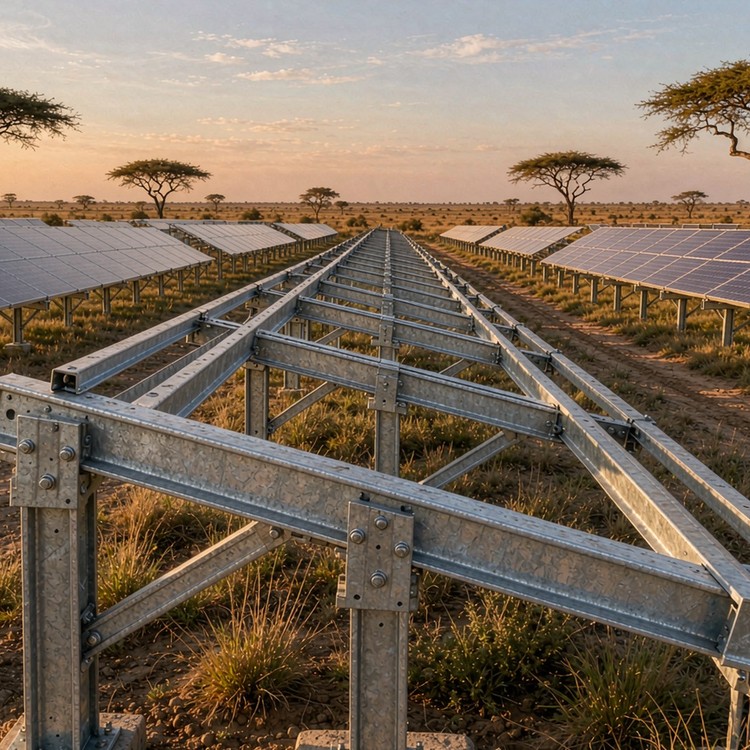
Ask how a structure installs before you compare its steel price. Our systems install with standard construction equipment – no proprietary tools, no site welding on the critical path. Piles are driven or screwed with industry-standard rigs and template jigs hold embedment tolerance; tables arrive preassembled in kits sequenced to your stacking plan; torque-controlled bolting with supplied torque values replaces welded connections; and rail adjustment ranges absorb the terrain error that grading leaves behind. We provide installation drawings, a step-by-step manual, torque and tolerance acceptance tables, and remote support during your install window. On request, an installation supervisor trains your crew on the first blocks.
Industry benchmarks
Benchmarks below are publicly documented industry reference projects of comparable type and scale, cited to illustrate engineering practice. They are not our delivery record; delivered references for your configuration are supplied with quotations.
- A 540 MW PV plus roughly 1,140 MWh storage complex in the Northern Cape, on arid gravel plains with trackers and deep piles near calcrete layers.
Standards and compliance
- EN 1991 / ASCE 7 wind and snow
- ISO 1461 / ISO 12944 corrosion systems
- EN 1090 execution classes
- IEC 61215 / 61730 interfaces
- ISO 9001 production quality management; batch traceability
- CE / EN 1090 documentation where destination markets require
Budget drivers and lead time
- Quotes differ 20-40 percent on assumptions, not steel – normalize before comparing
- Foundation and coating lines reveal supplier quality fastest
- Preassembly and batch logistics affect field labor more than unit price
- Lead time: 4-10 weeks typical
- Quotations state steel grade, zinc mass and coating system explicitly; Incoterms and container plans are quoted to your destination port
Comparing supplier quotations
The cheapest structure per tonne is rarely the cheapest per megawatt installed. Compare at installed-cost level: pile count and driving productivity on your soils; preassembly ratio and site welding (should be zero); crane and crew days implied by the table design; tolerance adjustment range – wider ranges absorb terrain error and cut rework; packaging density and container count; and the commissioning support included. Then compare at ten-year level: coating life to first maintenance, fastener replacement expectations, spare parts availability commitments, and whether warranty claims reference measurable criteria. We quote with these lines visible so your finance team sees the same picture your engineers do.
Frequently asked questions
What makes kits transport-efficient?
How is remote O&M supported?
What do donors audit?
More questions buyers ask
In which languages is the documentation provided?
Who owns the structural design – can we modify it?
What to include in your RFQ
- Site logistics context
- Labor availability
- Financing requirements
From RFQ to commissioning: how we work
Two things decide whether a racking order lands well: what was agreed before production, and what was documented during it. Before production we align on five inputs – structural design basis, foundation type per soil zone, corrosion protection class, module interface, and delivery sequence. During production every batch generates records you can hand to your lender or owner without translation: mill certificates, coating measurements, torque verification, packing counts. After delivery we stay in the loop – installation guidance, first-inspection support at handover, and a spare-parts recommendation sized to your site’s service life rather than a fixed catalogue list. Ask earlier customers how change requests were handled mid-production; that is the real test of a supplier.
Send documents to our engineering mailbox; a structure engineer replies within one working day – not a sales script, an engineering answer.
Quality, warranty and delivery
We control quality at three gates: incoming steel certification, pre-assembly dimensional checks on jigs, and post-galvanizing thickness verification per batch. Warranty terms are written against load cases and environments, not adjectives – ask us to walk your QA team through the documents before award.
Documentation you receive
Every order ships with a documentation set built for audits, not for decoration: structural calculation notes stating load cases and standards used; foundation design basis mapped to your geotechnical report; material certificates for steel and fasteners; hot-dip galvanizing certificates with measured coating thickness per batch; assembly drawings with torque tables; and packing documentation matched to container manifests. For financed projects we add lender-format compliance statements, and for public tenders we respond to documentation schedules line by line. Documents are issued in English as standard; other languages by arrangement.
Service life and maintenance planning
The economics of mounting systems are decided at year eight, not at signing. Galvanizing weight, fastener coating class and edge protection determine whether the year-eight inspection finds tight hardware or rust streaks. We publish expected first-maintenance intervals by environment class and back them with batch coating records, so warranty conversations start from data. For sites with special exposure – fertilizer plants, livestock ammonia, coastal spray, geothermal soils – we adjust coating and drainage detailing at design stage. Module replacement cycles are planned too: clamp designs allow individual module swap without cutting rails, which keeps mid-life rework fast and cheap.
Search terms this page is engineered for
solar bracket for South Africa karoo, PV racking for Kenya solar project, PV support for Kenya solar project, PV racking for Democratic Republic of the Congo solar project, PV support for Democratic Republic of the Congo solar project, PV support for Republic of the Congo solar project, PV racking for Republic of the Congo solar project, PV support for Ethiopia solar project, PV racking for Ethiopia solar project, PV support for Namibia solar project, PV racking for Namibia solar project, PV support for Senegal solar project, PV racking for Senegal solar project, PV support for South Africa solar project, PV racking for South Africa solar project, PV support for Ghana solar project, PV racking for Ghana solar project, PV support for Uganda solar project, PV racking for Uganda solar project, PV support for Zambia solar project, PV racking for Zambia solar project.
Ready to Discuss Your Project?
Send the logistics context – we will return the kit-based proposal with container counts, spares packages and lender-format documentation.
