



This page is one of several in our flexible (general) segment. See the full range of structures, foundations and configurations on the General Flexible PV Racking & Long-Span Systems hub page.
Why Flexible (General) sites are demanding
The flexible-racking general family covers the cross-site logic: when spans make sense, how cable systems are engineered, what anchors require and how modules tolerate deflection. It exists so buyers can judge any specific flexible proposal against a sound general framework.
Site challenges we engineer around:
Challenge 01
Module-frame compatibility with deflection is assumed
Challenge 02
Vibration and aeroelastics are ignored until problems appear
Challenge 03
Inspection regimes are absent from offers
Challenge 04
Pretension and deflection limits are claimed without analysis
Challenge 05
Dynamics analysis separates real engineers from assemblers
Challenge 06
Major anchors carry concentrated forces
Challenge 07
Construction sequencing can overload designs
Engineering requirements and design basis
- Anchor design with pull-out testing
- Vibration monitoring protocols
- Hybrid column-span solutions
- Nonlinear cable analysis with wind dynamics
Selection guidance: Require dynamics documentation and construction-stage engineering as contract scope – final-state design alone is not enough at this tier.
Engineered solution
- Inspection and re-tensioning programs
- Hybrid solutions where columns are partly allowed
- Reference plants with operating history
- Engineered span documentation as standard scope
- Anchor kits with test protocols
On this specific application we additionally provide:
- Specialist dynamics analysis with construction-stage engineering
- Major-anchor programs: design, testing, monitoring
Installation method and site productivity
Installation method is a cost line, not an afterthought. We ship structures engineered around the equipment you will actually have: pile-driving rigs with template jigs for soils that accept driven piles; screw-pile drives with torque monitoring where refusal or vibration rules out impact; precast ballast pads where penetration is prohibited; and bolt-only table assembly with 80 percent+ shop fabrication so site welding stays at zero. Crew productivity typically runs 40-80 tables per day per rig on prepared corridors, and our installation manual states the assumed crew size, equipment list and daily output so your construction schedule is built on numbers, not optimism.
Industry benchmarks
Benchmarks below are publicly documented industry reference projects of comparable type and scale, cited to illustrate engineering practice. They are not our delivery record; delivered references for your configuration are supplied with quotations.
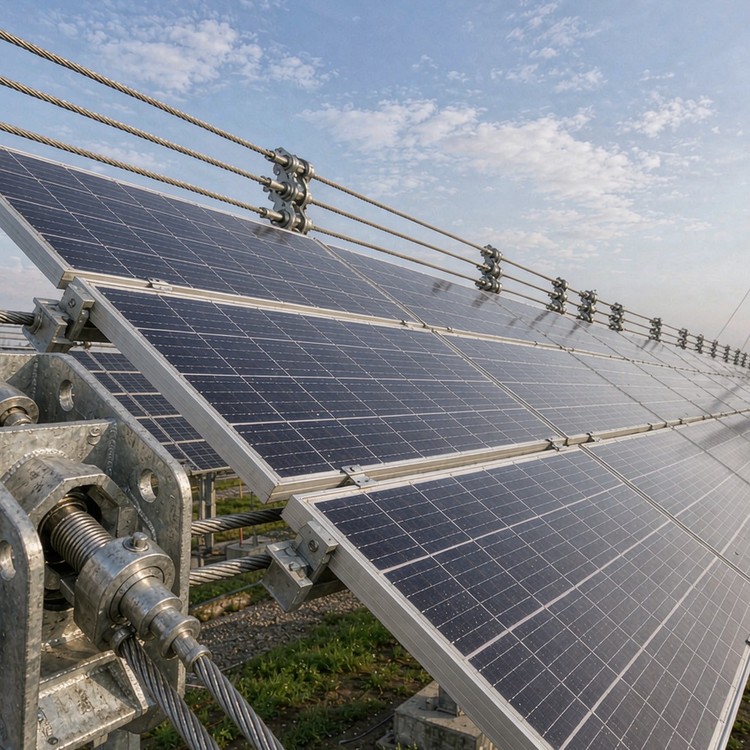
- A 100 m-span flexible PV demo in Enping, Guangdong (191.3 x 100 m) with 6-8 m clearance, typhoon-class design winds and about 12 mu per MWp, aligned to IEC TS 63619 discussions.
Standards and compliance
- EN 1993-1-11 cable structures
- IEC TS 63619 context
- Anchor testing standards
- Dynamic structural provisions
- ISO 9001 production quality management; batch traceability
- CE / EN 1090 documentation where destination markets require
Budget drivers and lead time
- 2-3x fixed per MW is the honest range; anchors are the hidden half
- Deflection engineering protects module warranties – do not skip it
- Inspection programs are contractual, not optional
- Lead time: 12-20 weeks
- Quotations state steel grade, zinc mass and coating system explicitly; Incoterms and container plans are quoted to your destination port
Comparing supplier quotations
Quotations for the same site can differ 30 percent and both be honest – the difference hides in stated assumptions. When comparing bids, normalize five items: steel grade and section weights (lighter rails with tighter spacing is not always cheaper per megawatt once pile counts rise); zinc mass and coating system against your corrosivity class; foundation scope – piles only, or piles plus anchors, caps and grading hardware; connection hardware – bolt classes and whether torque values are specified; and logistics – container utilization, port of discharge and inland transport responsibility. A bid that states all five is comparable; a bid that omits them is a discount you will pay for later.
Frequently asked questions
What analysis do long spans need?
How big do anchors get?
Why does construction sequencing matter?
More questions buyers ask
Do you allow third-party or customer inspections before shipment?
How are warranty claims handled in practice?
What to include in your RFQ
- Crossing geometry
- Geotechnical data at anchors
- Wind climate data
From RFQ to commissioning: how we work
Procurement runs smoother when both sides know the sequence. Our standard flow: RFQ received – acknowledged within one working day with a list of anything missing (geotech data, design wind speed, module model, terrain category); engineering review – typically three to five working days; quotation – itemized, with steel grade, zinc mass, coating system and Incoterms explicit; sample or pilot lot – available for new partners who want to verify fit and finish before volume; production and inspection – your QC team or a third party is welcome at pre-shipment; shipping – container optimization against your unloading equipment; installation – manuals, videos and a named contact through commissioning. The flow is boring on purpose: fewer surprises, faster approvals.
Send documents to our engineering mailbox; a structure engineer replies within one working day – not a sales script, an engineering answer.
Quality, warranty and delivery
We control quality at three gates: incoming steel certification, pre-assembly dimensional checks on jigs, and post-galvanizing thickness verification per batch. Warranty terms are written against load cases and environments, not adjectives – ask us to walk your QA team through the documents before award.
Documentation you receive
We document in the format procurement teams actually file. Standard set: technical proposal with design basis; issued-for-construction drawings; structural calculations signed by our engineering department, third-party endorsement arranged where required; material and coating certificates per batch; installation manual with step sequences, torque values and tolerance acceptance criteria; and packing lists reconciled against container numbers. Optional add-ons: wind-tunnel or code-based fatigue notes for extreme sites, seismic calculation packages, corrosion service-life projections by environment, and spare-parts schedules with recommended holding quantities. Tell us your owner’s documentation standard at RFQ stage and we quote to it rather than discovering it at delivery.
Service life and maintenance planning
Service life claims deserve engineering behind them. Our structures are designed for a 25-30 year service window with a 10-year structure warranty, and the supporting logic is documented: load cases per applicable code, corrosion protection selected against site class, fatigue consideration at high-cycle connections, and tolerance ranges that keep trackers and tables within manufacturer limits over decades. Maintenance is inspection-led: defined intervals, defined checkpoints, defined acceptance values – supplied with the project documentation. When components eventually need replacement, part numbers and production batches are traceable, so spares match the original hardware rather than whatever the market carries that year.
Search terms this page is engineered for
long span flexible PV, tension cable PV mounting, sag cable PV bracket, lightweight flexible PV mounting.
Ready to Discuss Your Project?
Send the crossing geometry – we will return the long-span concept with dynamics scope, anchor program and construction sequencing.
