



This page is one of several in our flexible segment. See the full range of structures, foundations and configurations on the Flexible PV Racking Systems & Long-Span Structures hub page.
Why Flexible sites are demanding
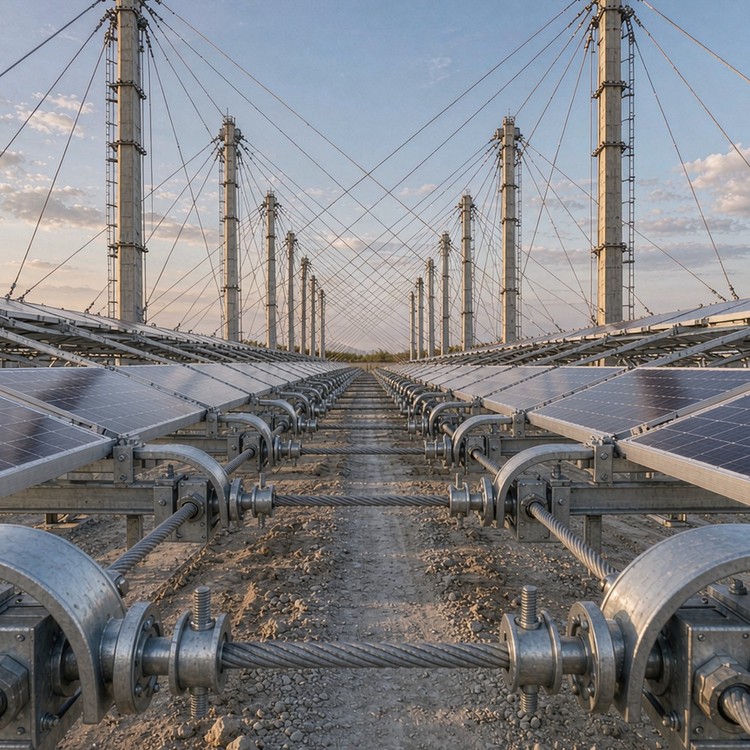
Flexible PV racking spans obstacles where columns cannot stand: reservoirs, gullies, landfill caps, industrial ponds. Pre-tensioned cables or membranes carry modules across 30-100 m openings. The physics are unforgiving – pretension, vibration and stiffness interact with module frames – so flexible systems live or die on structural engineering depth.
Site challenges we engineer around:
Challenge 01
Vibration and aeroelastic response under wind needs verified analysis, not rules of thumb
Challenge 02
Anchor forces are large and concentrated; foundations become major structures
Challenge 03
Clearance and safety zones under spans raise regulatory questions
Challenge 04
Long-term pretension loss and cable fatigue need inspection regimes
Challenge 05
Cable-net dynamics need genuine specialist analysis
Challenge 06
Anchor forces concentrate into major foundations
Challenge 07
Construction engineering (tensioning sequence) is as important as design
Engineering requirements and design basis
- Vibration monitoring and inspection protocols
- Span-specific solutions: cable-net, rigid-frame hybrid, membrane variants
- Nonlinear structural analysis of cable systems including wind dynamics
- Module-frame compatibility: deflection limits and load paths verified with module makers
Selection guidance: Demand construction-stage engineering – tensioning sequence, staged analysis – not just final-state design. Long-span projects fail in installation, not on paper.
Engineered solution
- Hybrid solutions where partial columns are allowed
- References from delivered long-span plants
- Engineered span packages with full structural documentation
- Module-maker-verified load paths and deflection limits
- Anchor and foundation kits with test protocols
On this specific application we additionally provide:
- Specialist cable-net analysis with dynamics and construction sequencing
- Major-anchor engineering with test programs and monitoring
Installation method and site productivity
Ask how a structure installs before you compare its steel price. Our systems install with standard construction equipment – no proprietary tools, no site welding on the critical path. Piles are driven or screwed with industry-standard rigs and template jigs hold embedment tolerance; tables arrive preassembled in kits sequenced to your stacking plan; torque-controlled bolting with supplied torque values replaces welded connections; and rail adjustment ranges absorb the terrain error that grading leaves behind. We provide installation drawings, a step-by-step manual, torque and tolerance acceptance tables, and remote support during your install window. On request, an installation supervisor trains your crew on the first blocks.
Industry benchmarks
Benchmarks below are publicly documented industry reference projects of comparable type and scale, cited to illustrate engineering practice. They are not our delivery record; delivered references for your configuration are supplied with quotations.
- A 100 m-span flexible PV demo in Enping, Guangdong (191.3 x 100 m) with 6-8 m clearance, typhoon-class design winds and about 12 mu per MWp, aligned to IEC TS 63619 discussions.
- A PV project on a reservoir within a provincial water-transfer scheme in Guizhou, using drawdown-zone foundations that tolerate seasonal water-level swings.
Standards and compliance
- Cable-structure engineering practice (EN 1993-1-11 or equivalent)
- IEC TS 63619 discussions informing flexible-PV practice
- Anchor testing and geotechnical verification
- Local structural codes with dynamic provisions
- ISO 9001 production quality management; batch traceability
- CE / EN 1090 documentation where destination markets require
Budget drivers and lead time
- Flexible systems cost 2-3x fixed per MW but unlock land that cannot take columns
- Anchor foundations are the hidden half of the budget
- Inspection programs are contractual opex; budget them honestly
- Lead time: 12-20 weeks; structural analysis gates fabrication
- Quotations state steel grade, zinc mass and coating system explicitly; Incoterms and container plans are quoted to your destination port
Comparing supplier quotations
Quotations for the same site can differ 30 percent and both be honest – the difference hides in stated assumptions. When comparing bids, normalize five items: steel grade and section weights (lighter rails with tighter spacing is not always cheaper per megawatt once pile counts rise); zinc mass and coating system against your corrosivity class; foundation scope – piles only, or piles plus anchors, caps and grading hardware; connection hardware – bolt classes and whether torque values are specified; and logistics – container utilization, port of discharge and inland transport responsibility. A bid that states all five is comparable; a bid that omits them is a discount you will pay for later.
Frequently asked questions
What makes cable-net different from simple spans?
How are anchor forces managed?
Can construction really break the design?
More questions buyers ask
In which languages is the documentation provided?
Who owns the structural design – can we modify it?
What to include in your RFQ
- Crossing geometry and site constraints
- Anchor zone geotechnical data
- Module and clearance requirements
From RFQ to commissioning: how we work
Two things decide whether a racking order lands well: what was agreed before production, and what was documented during it. Before production we align on five inputs – structural design basis, foundation type per soil zone, corrosion protection class, module interface, and delivery sequence. During production every batch generates records you can hand to your lender or owner without translation: mill certificates, coating measurements, torque verification, packing counts. After delivery we stay in the loop – installation guidance, first-inspection support at handover, and a spare-parts recommendation sized to your site’s service life rather than a fixed catalogue list. Ask earlier customers how change requests were handled mid-production; that is the real test of a supplier.
Send documents to our engineering mailbox; a structure engineer replies within one working day – not a sales script, an engineering answer.
Quality, warranty and delivery
Production follows ISO 9001 procedures with batch traceability from coil to container; galvanizing runs to ISO 1461 with zinc mass selected by your site corrosivity class. We publish our first-maintenance estimates in writing, and our warranty documentation names what is covered, for how long, and under which load cases.
Documentation you receive
Buyers comparing suppliers should compare document depth, because claims are easy and records are not. We provide: design basis documents that name standards, load cases and safety factors explicitly; batch-level quality records (steel, galvanizing, fasteners) retained for the warranty period; installation and maintenance manuals written for site crews, not marketing; warranty terms that specify what is covered, for how long, and the claim process; and end-of-project dossiers suitable for handover to your O&M contractor. For multi-project buyers we keep a document history per site, so year-eight extensions reference year-one assumptions instead of starting from zero.
Service life and maintenance planning
Plan maintenance around measurable triggers, not calendar guesses. Annual visual inspection of fastener torque samples, coating condition at cut edges and ground-contact zones; a detailed inspection after the first extreme weather year – typhoon, sandstorm or heavy snow depending on your region; re-torque verification after the first thermal cycle on long tracker runs. We supply the inspection checklist and acceptance criteria with the installation manual, so your O&M team measures against the same numbers our factory used. Where structures sit in aggressive soils or salt zones we advise higher zinc mass and drainage detailing up front – cheaper than retrofits.
Search terms this page is engineered for
long span flexible racking, cable net PV bracket.
Ready to Discuss Your Project?
Send the crossing data – we will return the cable-net concept with construction sequencing and anchor engineering scope for your flagship span.
