




This page is one of several in our fixed (general) segment. See the full range of structures, foundations and configurations on the General Fixed Racking Solutions for Ground-Mount PV hub page.
Why Fixed (General) sites are demanding
The fixed-racking general family covers the workhorse questions buyers ask across all sites: which foundation, which tilt, which rail system, and what the quoting variables really are. These pages answer them with one engineering logic applied across contexts, so a buyer can compare like with like.
Site challenges we engineer around:
Challenge 01
Component-level equivalence (clamps, rails, fasteners) is hard to compare
Challenge 02
Corrosion assumptions vary silently between quotes
Challenge 03
Warranty scope differs on what is covered, for how long, under what load cases
Challenge 04
Foundation choice is quoted inconsistently across suppliers, hiding real cost
Challenge 05
Quote assumptions differ more than prices
Challenge 06
Foundation logic is site-specific but rarely shown
Challenge 07
Coating classes hide inside lump sums
Engineering requirements and design basis
- Warranty terms structured around load cases and environments
- Foundation decision framework applied per site class
- Tilt-pitch optimization with wind and land trade documented
- Component equivalence tables: clamp types, rail sections, fastener classes
Selection guidance: Demand assumption transparency in every quote – foundation type, coating class, preassembly ratio – and compare on those lines first.
Engineered solution
- Engineering support for tender clarifications
- Comparable-quote framework: same line items, same assumptions, comparable numbers
- Foundation kits per soil class with test gates
- Component specifications with material certificates
- Corrosion options priced explicitly by class
On this specific application we additionally provide:
- Normalized quote framework: same line items, same assumptions, comparable numbers
- Foundation logic documented per soil class with test gates
Installation method and site productivity
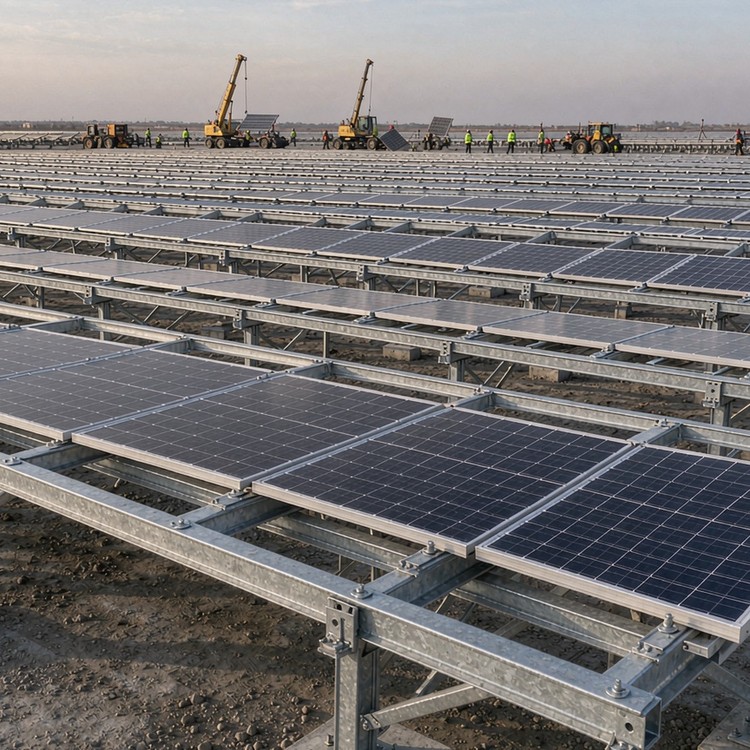
A structure that fights the installer will cost you the savings it promised. Ours is designed to be installed by crews who have never seen the drawings before: identical parts across blocks, left-right symmetrical assemblies where possible, hardware kitted per table instead of per truckload, and torque tables that remove guesswork. Driven, screwed and ballasted foundation options are all supported with matching head details, and templates for pile driving are supplied or specified with the foundation design. Where terrain or access limits machines, we re-segment the tables at design stage so manual handling stays within safe limits. Commissioning support closes the loop.
Industry benchmarks
Benchmarks below are publicly documented industry reference projects of comparable type and scale, cited to illustrate engineering practice. They are not our delivery record; delivered references for your configuration are supplied with quotations.
- A PV plant in Brandenburg, Germany on former military training land, a brownfield-reuse reference with cleared ground and low-disturbance foundations.
- A 1.5 GW desert plant in Saudi Arabia delivered on sandy terrain with driven piles and roughly 3.5 million modules. It proves that pile-and-structure supplied as one package can compress multi-hundred-MW schedules.
Standards and compliance
- EN 1991 / ASCE 7 wind and snow
- ISO 1461 / ISO 12944 corrosion systems
- EN 1090 execution classes
- IEC 61215 / 61730 interfaces
- ISO 9001 production quality management; batch traceability
- CE / EN 1090 documentation where destination markets require
Budget drivers and lead time
- Quotes differ 20-40 percent on assumptions, not steel – normalize before comparing
- Foundation and coating lines reveal supplier quality fastest
- Preassembly and batch logistics affect field labor more than unit price
- Lead time: 4-10 weeks typical
- Quotations state steel grade, zinc mass and coating system explicitly; Incoterms and container plans are quoted to your destination port
Comparing supplier quotations
Quotations for the same site can differ 30 percent and both be honest – the difference hides in stated assumptions. When comparing bids, normalize five items: steel grade and section weights (lighter rails with tighter spacing is not always cheaper per megawatt once pile counts rise); zinc mass and coating system against your corrosivity class; foundation scope – piles only, or piles plus anchors, caps and grading hardware; connection hardware – bolt classes and whether torque values are specified; and logistics – container utilization, port of discharge and inland transport responsibility. A bid that states all five is comparable; a bid that omits them is a discount you will pay for later.
Frequently asked questions
What single question reveals quote quality fastest?
How do I know the preassembly claim is real?
Does this framework work outside my country?
More questions buyers ask
What are your payment terms for first orders?
Can we get samples before committing to volume?
What to include in your RFQ
- Site basics: soil, wind, corrosion class
- Module and layout intent
- Volume and schedule
From RFQ to commissioning: how we work
A typical engagement runs in five gates: (1) RFQ review – we check drawings, geotech reports and load assumptions before quoting, and flag gaps that would move cost later; (2) proposal – structural basis, bill of quantities, foundation options and Incoterms stated side by side; (3) engineering freeze – pile tests or pre-drilling trials where soils demand them, shop drawings signed off by both engineering teams; (4) production – batch QA documents issued per lot, pre-shipment inspection open to your inspector or a third party; (5) delivery and install support – container plans matched to EPC sequence, installation manuals, torque tables and commissioning guidance. Each gate produces a document you can file; buyers tell us the discipline matters more than the brochures.
Send documents to our engineering mailbox; a structure engineer replies within one working day – not a sales script, an engineering answer.
Quality, warranty and delivery
We control quality at three gates: incoming steel certification, pre-assembly dimensional checks on jigs, and post-galvanizing thickness verification per batch. Warranty terms are written against load cases and environments, not adjectives – ask us to walk your QA team through the documents before award.
Documentation you receive
Buyers comparing suppliers should compare document depth, because claims are easy and records are not. We provide: design basis documents that name standards, load cases and safety factors explicitly; batch-level quality records (steel, galvanizing, fasteners) retained for the warranty period; installation and maintenance manuals written for site crews, not marketing; warranty terms that specify what is covered, for how long, and the claim process; and end-of-project dossiers suitable for handover to your O&M contractor. For multi-project buyers we keep a document history per site, so year-eight extensions reference year-one assumptions instead of starting from zero.
Service life and maintenance planning
Racking is a thirty-year decision, and the first maintenance event is where cheap hardware shows its cost. We design coating systems from your site’s corrosivity class – C2 for dry inland zones, C3-C4 for most coastal and agricultural areas, C5 toward heavy industrial and marine exposure – and we state the expected time to first maintenance in writing. Bolt selection follows the same logic: coated high-strength fasteners with controlled torque, because mixed hardware is the most common early-corrosion finding in field inspections. A spare-parts kit sized to your environment ships with the order.
Search terms this page is engineered for
PV mounting bracket for flat ground, ground mounted solar racking system, photovoltaic racking for level land, solar panel support for plain area, fixed PV structure for open field, south oriented fixed racking.
Ready to Discuss Your Project?
Send the site basics – we will return a normalized quote with the assumption sheet that makes comparison honest.
