




Pourquoi c'est difficile
Without a standard, every site re-opens decisions that were already settled, and the cost of that repetition is larger than most programmes expect.
- Each new site otherwise triggers a fresh design cycle, consuming engineering capacity the programme cannot spare
- Multiple structure families multiply spares, tooling and installation procedures across the operating fleet
- Site-specific designs make performance comparison impossible, so the programme cannot learn from its own sites
- Module revisions and code updates arrive mid-programme and should be absorbed once, in a parameter, rather than once per site
- O&M crews move between sites, so a common structure family lets one procedure and one spares kit serve the whole fleet
- Lenders and owners increasingly expect a documented standard, because it simplifies asset management and future divestment
Exigences d'ingénierie
These are the elements that make a multi-site standardisation programme work.
- A defined parameter set capturing genuine site variation: wind speed and terrain, seismic, soil class, coating class and module format
- One structural family with documented fixed and variable elements, so engineers know which parts may change and which may not
- A configuration matrix mapping each site to its parameter values, maintained as a live document rather than a set of drawings
- A change control procedure that handles mid-programme module or code updates through the parameter set rather than site by site
- Common fastener and clamp families across the programme, sized to a single spares list with defined stock levels
- A documentation template issued per site from one master, so as-built sets are directly comparable across the fleet
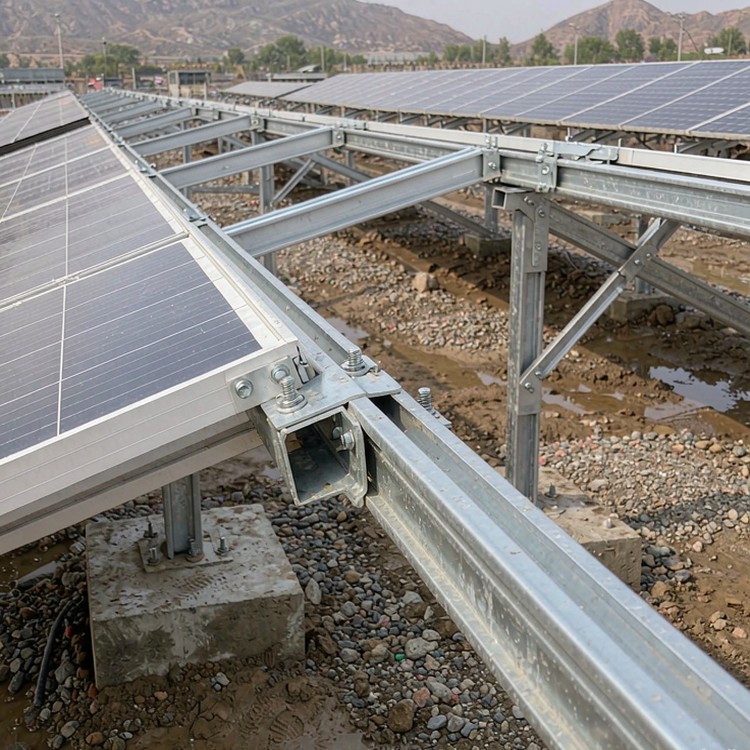
Selection guidance: define the parameter set before the second site is designed. Standardisation adopted after three sites have been built independently usually cannot recover the engineering already spent.
Comment nous résolvons le problème
- One structural family across the programme, with variation expressed as parameters rather than as separate designs
- A configuration matrix maintained centrally, so any site’s parameter values can be retrieved and re-used for the next one
- Common fastener, clamp and bracket families, reducing the fleet spares list to a single document with defined stock levels
- Change control through the parameter set, so a module revision or code update is absorbed once and applied everywhere
- One documentation template for every site, making as-built sets directly comparable and audit-friendly
- A shared installation procedure, so crews trained on one site are productive on the next without retraining
Au-delà de la structure
- Engineering effort reallocated from repeating settled design work to the sites that genuinely differ
- A programme-level drawing register, so the current approved revision is unambiguous at every site simultaneously
Points de référence
Les projets de référence ci-dessous, de type et d'envergure comparables et documentés publiquement, sont cités à titre d'illustration des pratiques d'ingénierie. Ils ne constituent pas un historique de réalisations.
- A 12-site, 400 MW programme across three countries standardised on one structure family, with wind, seismic, soil and coating carried as parameters and no site-level redesign.
- An owner-operator fleet in the United States using a single clamp and fastener family across six utility-scale sites, holding one spares kit instead of six.
- A programme in Southeast Asia where a mid-programme module frame change was absorbed through the parameter set, affecting clamp position only and requiring no structural redesign.
Normes et conformité
- Cas de charge neige et glace EN 1991-1-3 / ASCE 7 adaptés à votre période de retour nominale
- Compatibilité avec les normes IEC 61215 et IEC 61730 pour la zone de serrage des modules et le cadre
- Classes d'exécution de la charpente métallique EN 1090 / AISC avec dossiers de qualification des procédures de soudage
- galvanisation ISO 1461, systèmes de peinture ISO 12944 avec revêtement duplex spécifié
- Gestion de la qualité de la production selon la norme ISO 9001, traçabilité des lots par numéro de coulée
- Assistance en matière de code du bâtiment local et de documentation relative aux permis pour votre juridiction
Assurance qualité
Every batch ships with mill certificates, coating-thickness logs and bolt records; welds follow EN 1090 or AISC execution classes. Structure warranty runs to 10 years against a 25-30 year service design life, and spare-part packages are documented so year-12 repairs do not depend on year-1 memory.
Documents que vous recevez
La documentation est conçue pour les audits, et non pour la décoration : notes de calcul de structure indiquant les cas de charge et les normes utilisées ; base de conception des fondations alignée sur votre rapport géotechnique ; certificats de matériaux pour l’acier et la visserie ; certificats de galvanisation avec l’épaisseur de revêtement mesurée par lot ; plans d’assemblage avec tableaux de couples de serrage ; et documentation d’emballage correspondant aux manifestes des conteneurs. Pour les projets financés, nous ajoutons des déclarations de conformité au format des organismes prêteurs ; pour les appels d’offres publics, nous répondons aux cahiers des charges documentaires point par point.
Planification de la durée de vie et de la maintenance
La rentabilité des systèmes de montage est déterminée à la huitième année, et non à la signature du contrat. Le poids de la galvanisation, la classe de revêtement des fixations et la protection des bords déterminent si l'inspection de la huitième année révèle des fixations bien serrées ou des traces de rouille. Nous publions les intervalles de première maintenance prévus par classe environnementale et les étayons par des données de revêtement par lot, ce qui permet de fonder les discussions relatives à la garantie sur des données concrètes.
Considérations relatives aux coûts et au commerce
- Standardisation usually carries a small unit-price premium at the first site because tooling and documentation are amortised over a single project
- The return appears across later sites as reduced engineering hours, lower design review cost and shorter approval cycles
- Fleet spares cost falls materially, because stock levels are set for one family rather than accumulated site by site
- Training and installation cost per site falls after the first, since procedure and crew knowledge transfer directly
- The largest avoided cost is rarely quantified in a quotation: engineering hours released from redesign work, which is the scarcest resource in a parallel-site programme
Foire aux questions
Does standardisation mean every site gets the same structure?
How many sites justify a standard?
What breaks a standardisation programme?
Can you supply the same structure family to sites in different countries?
How is the fleet spares list kept current?
Guides et pages d'application associés
Poursuivez avec les pages les plus proches de votre type de projet.
Ce que nous devons citer
- Site list with location, capacity and target energisation date for each
- Wind speed, terrain category, seismic parameters and soil class per site where known
- Module model and frame details, including any revision expected during the programme
- Countries of installation and any market-specific certification requirements
Parlez à un ingénieur en structure
Send the site list with what is known about each site’s conditions, and we will return a parameter set, a configuration matrix template and a programme-level quantities estimate.
 English
 Español
 Deutsch
 Português
 Français
 Italiano