



Por qué esto es difícil
The engineering is conventional ground-mount. The difficulty is that the site was not designed to host a solar plant, and the operating plant cannot be interrupted while one is built around it.
- Available land is interrupted by roads, pipe racks, conveyors and stockyards, producing an irregular array rather than clean rectangular blocks
- Buried services are the single largest source of construction delay on industrial sites, and the drawings are frequently incomplete
- The load profile does not match solar generation, so the array is sized and oriented for self-consumption value rather than maximum energy
- Phasing means the first stage has to be designed for later stages, or every expansion becomes a partial rebuild
- Installation is constrained by permit regimes, shutdown windows and the need to keep logistics routes open
Requisitos de ingeniería
These are the design inputs that decide whether a captive plant builds on schedule and stays expandable.
- Service detection across the array footprint, combined with a review of process drawings, before any foundation position is fixed
- Foundation types selected against site constraints: driven piles where access allows, screw piles or ballasted bases where vibration or excavation is restricted
- Corrosion class assessed from actual site conditions, including any stack emissions, dust or chemical storage nearby
- Phasing plan with reserved tie-in points, matched rail families and continuation details for later stages
- Layout optimised against the site’s load profile and tariff, so the array serves consumption rather than maximising generation
- Access envelopes preserved through the array for maintenance vehicles, fire access and crane lifting paths
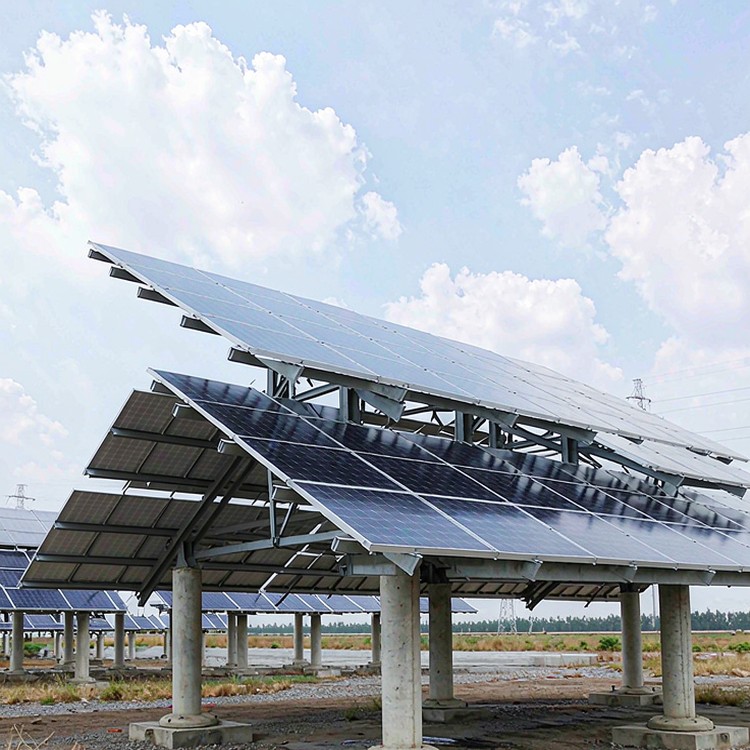
Selection guidance: survey services and fix the phasing plan before the layout. Both are cheap to define at design stage and expensive to discover during construction.
Cómo lo resolvemos
- Foundation selection driven by site constraints, including low-vibration and no-excavation options for live plants
- Layout produced from a surveyed service map, so no foundation position is left to discovery
- Phasing built into the drawing set, with reserved tie-in points and matched rail families so stages two and three connect without rework
- Corrosion system stepped for real site emissions rather than a generic inland-industrial default
- Installation sequencing planned around shutdown windows and permit constraints, with material staged to avoid blocking site logistics
- Load-profile-driven layout that sizes the array to consumption and the tariff rather than to available land
Más allá de la estructura
- Cable route planning along existing service corridors to reduce trenching and avoid crossing buried infrastructure
- Reserved land and grid connection capacity identified on the drawing set for future stages and battery provision
Puntos de referencia
Los ejemplos que se muestran a continuación son proyectos de referencia del sector, documentados públicamente y de tipo y escala similares, que se citan para ilustrar la práctica de la ingeniería. No constituyen nuestro historial de proyectos.
- A 12 MW captive plant for a cement works in Vietnam, built in three stages with arrays routed around conveyor lines and a raw-mill dust plume.
- A 6 MW self-consumption plant at a steel rolling mill in Turkey, using screw foundations within 15 m of live production halls to avoid vibration.
- An 8 MW phased installation at an automotive plant in Mexico, where stage-one foundations and cable routes were reserved for a stage-two build that followed 18 months later.
Normas y cumplimiento
- Combinaciones de cargas de viento ASCE 7 / EN 1991 y sísmicas EN 1998 / IBC, cuando corresponda.
- Niveles de prueba de carga mecánica del módulo IEC 61215 adaptados a la presión de diseño de su matriz.
- Clases de ejecución EN 1090-1/-2 o AISC para componentes de acero estructural
- Galvanizado ISO 1461 con masa de zinc escalonada según la categoría de corrosividad C2 a C5.
- Gestión de calidad ISO 9001:2015 y cualificación documentada de proveedores.
- Respaldo de DNV o equivalente en la revisión de viabilidad financiera para proyectos financiados.
Seguro de calidad
La documentación de cada lote se emite individualmente: certificados de fábrica con trazabilidad a los números de colada, registros de galvanizado con el espesor del recubrimiento medido, informes de inspección dimensional de las plantillas de preensamblaje y trazabilidad de los lotes de componentes. La garantía cubre los casos de carga y las clases de exposición ambiental especificados, por lo que las reclamaciones se resuelven en función de los datos, en lugar de mediante negociación.
Documentación que usted recibe
Cada envío incluye un paquete de documentos alineado con su registro de activos: informes certificados de pruebas de materiales, registros de espesor de recubrimiento por lote, hojas de verificación de torque y precarga, listas de empaque con números de contenedor y un conjunto de planos relevantes para el mantenimiento. Si el mercado de destino requiere certificación local o documentos traducidos, los preparamos con anticipación en lugar de en el puerto.
Planificación de la vida útil y el mantenimiento
Plan maintenance around measurable triggers, not calendar guesses: annual visual inspection of fastener torque samples, coating condition at cut edges and ground-contact zones; a detailed inspection after the first extreme weather year; and re-torque verification after the first thermal cycle on long runs. We supply the inspection checklist and acceptance criteria with the installation manual.
Costos y consideraciones comerciales
- Service detection and clearance survey is a small fixed cost that prevents the largest category of site delay
- Low-vibration foundation methods add 12-22 percent on structure and avoid production interruption costs that dwarf the premium
- Coating upgrades for aggressive atmospheres add 8-15 percent and typically double the interval to first maintenance
- Phasing provisions cost under 3 percent when designed in and far more when retrofitted after stage one is built
- Lead time: 4-8 weeks for standard fixed structures, with survey and permitting usually on the critical path
Preguntas frecuentes
Can you design around buried services we have not fully mapped?
How do you avoid stopping production during installation?
Should the array be sized to the load or to the available land?
What if we later add a battery or a second stage?
How does site dust and vibration affect structure life?
Guías y páginas de aplicación relacionadas
Continúa con las páginas más cercanas al tipo de tu proyecto.
- Alimentación eléctrica industrial montada en tierra y cautiva – la descripción general del grupo para esta banda de escala
- Estructuras de soporte para paneles solares en instalaciones de la industria siderúrgica, cementera y pesada.
- Estructuras de montaje para paneles solares en plantas de tratamiento y servicios de agua.
- Proyectos solares en terrenos industriales abandonados, recuperados y posteriores a la minería
- Proyectos solares para plantas de tratamiento de aguas residuales
- Proyectos agrovoltaicos y de tierras de cultivo de doble uso
Lo que necesitamos citar
- Site layout showing process infrastructure, roads and any known buried services
- Target capacity per phase and the intended build sequence
- Geotechnical information and any vibration or excavation restrictions
- The site’s load profile and the tariff the plant is displacing
Hable con un ingeniero estructural.
Send the site layout and any service drawings, and we will return a phased structure plan with foundation options and a costed supply package.
 English
 Español
 Deutsch
 Português
 Français
 Italiano