






Warum das schwierig ist
Freight cost on racking is driven by the ratio of volume to weight, and the ratio is set by component geometry.
- Steel rail and beam sections are volume-limited rather than weight-limited, so container utilisation is usually governed by packing arrangement rather than by mass
- Rail length drives container choice, since a rail that fits a 40 foot container in one length avoids joined sections and wasted void space
- Pre-assembly improves site productivity but reduces packing density, so the level has to be selected against both freight and labour cost
- Packaging protects coatings in transit, and over-packaging costs container space while under-packaging costs coating repairs on site
- Mixed loads containing a full bill of materials for one array block unload faster on site but pack less densely than segregated component shipments
- Destination port handling, inland transport and site storage all scale with container count, so the effect of packing density extends well beyond the sea freight line
Technische Anforderungen
These are the inputs that determine container loading density for a racking package.
- Full component list with dimensions, weights and the longest item in the package
- Pre-assembly level intended, since factory assembly and packing density trade against each other
- Container type and any restriction on internal dimensions, particularly for high-cube or open-top units
- Destination port, inland transport mode and any weight limit on the final leg
- Site storage capacity and the delivery cadence planned, since density affects how much material arrives at once
- Coating and packaging requirement, including any client specification for protection in transit
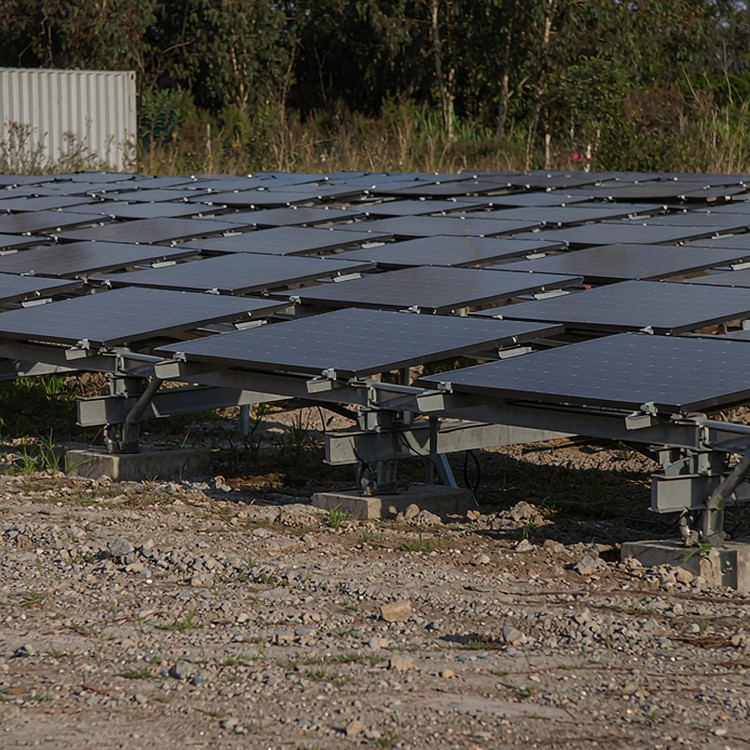
Selection guidance: decide the pre-assembly level before optimising packing. Packing density and site labour are interdependent, and optimising one without the other produces a quotation that is efficient in the wrong place.
Wie wir es lösen
- Rail and beam lengths selected to fit standard container internal dimensions in a single piece, eliminating joints and void space
- Nesting and stacking geometry designed for the component family, so packing density comes from arrangement rather than from force
- Pre-assembly level chosen against both freight density and site labour, with the trade-off quantified rather than assumed
- Packaging specification matched to transit risk: sufficient protection for coatings and edges without consuming container volume unnecessarily
- Loading plans issued per container with component lists, so receiving and inventory control at site does not depend on opening every unit
- Delivery packaging grouped by installation sequence, so containers unload to the work front rather than into a laydown area
Jenseits der Struktur
- Container count per megawatt stated in the quotation, making freight comparable between bidders rather than hidden in delivery terms
- Loading plans revised when the bill of materials changes, so late design changes do not silently increase freight cost
Referenz-Benchmarks
Die folgenden Benchmarks sind öffentlich dokumentierte Branchenreferenzprojekte vergleichbarer Art und Größenordnung, die zur Veranschaulichung der Ingenieurpraxis dienen. Sie stellen nicht unsere Leistungsbilanz dar.
- A 300 MW project in the Middle East where rail lengths were set to standard container dimensions, avoiding joined sections and reducing container count per megawatt.
- A 150 MW project in Chile where a partial pre-assembly level was selected after quantifying the freight density loss against the site labour saving.
- A 200 MW programme in Australia where installation-sequence packing allowed containers to be unloaded directly to work fronts, cutting laydown storage.
Standards und Konformität
- ASCE 7 / EN 1991 Windlastkombinationen und EN 1998 / IBC Erdbebenlastkombinationen, sofern anwendbar
- Die mechanischen Belastungstestpegel gemäß IEC 61215 sind auf den Auslegungsdruck Ihres Arrays abgestimmt.
- Ausführungsklassen nach EN 1090-1/-2 oder AISC für Bauteile aus Stahl
- ISO 1461 Verzinken mit Zinkmasse, gestaffelt nach Korrosivitätskategorie C2 bis C5
- Qualitätsmanagement nach ISO 9001:2015 und dokumentierte Lieferantenqualifizierung
- Unterstützung durch DNV oder eine gleichwertige Bankfähigkeitsprüfung für finanzierte Projekte
Qualitätssicherung
Die Chargendokumentation wird chargenweise ausgestellt: Werkszeugnisse mit Rückverfolgbarkeit zu den Chargennummern, Verzinkungsprotokolle mit gemessener Schichtdicke, Maßprüfberichte von den Vormontagevorrichtungen und Chargenrückverfolgbarkeit der Hardware. Die Garantie deckt bestimmte Lastfälle und Umwelteinwirkungsklassen ab, sodass Ansprüche anhand von Daten und nicht durch Verhandlungen reguliert werden.
Dokumentation, die Sie erhalten
Jede Sendung enthält ein auf Ihr Anlagenverzeichnis abgestimmtes Dokumentenpaket: zertifizierte Materialprüfberichte, Aufzeichnungen zur Beschichtungsdicke pro Charge, Prüfprotokolle für Drehmoment und Vorspannung, Packlisten mit Containernummern und einen Satz wartungsrelevanter Zeichnungen. Falls der Zielmarkt lokale Zertifizierungen oder Übersetzungen von Dokumenten erfordert, erstellen wir diese im Voraus und nicht erst im Hafen.
Lebensdauer- und Wartungsplanung
Die Wartung sollte anhand messbarer Kriterien und nicht anhand von Schätzungen im Kalender erfolgen: jährliche Sichtprüfung der Anzugsmomente von Befestigungselementen, Zustand der Beschichtung an Schnittkanten und Erdungskontaktstellen; eine detaillierte Prüfung nach dem ersten Jahr mit extremen Witterungsbedingungen; und Überprüfung des Anzugsmoments nach dem ersten Temperaturzyklus bei langen Strecken. Die Prüfcheckliste und die Abnahmekriterien stellen wir zusammen mit der Installationsanleitung zur Verfügung.
Kosten- und kommerzielle Überlegungen
- Freight per megawatt is driven by containers per megawatt, so packing density is a direct cost lever rather than a logistics detail
- Pre-assembly reduces site labour and increases freight volume, and the net effect depends on the relative cost of the two in the destination market
- Packaging material cost is small relative to the coating repair cost it prevents, but excessive packaging costs container space
- Inland transport and port handling scale with container count, so the savings from good packing density continue after the sea leg
- Site storage and double handling are often invisible in a quotation and visible in the construction budget, which is why delivery grouping matters
Häufig gestellte Fragen
How much does container packing affect cost?
Is pre-assembly worth the freight cost?
How is loading planned?
Can coating damage in transit be avoided?
What if the design changes after the loading plan is issued?
Verwandte Leitfäden und Anwendungsseiten
Fahren Sie mit den Seiten fort, die Ihrem Projekttyp am ehesten entsprechen.
Was wir für ein Angebot benötigen
- Full component list with dimensions and weights, including the longest item
- Intended pre-assembly level and any site labour considerations
- Destination port, inland transport mode and final-leg weight limits
- Site storage capacity and the delivery cadence planned
Sprechen Sie mit einem Statiker
Send the component list and the destination, and we will return a loading plan with containers per megawatt, a packaging specification and a delivery grouping matched to your construction sequence.
 English
 Español
 Deutsch
 Português
 Français
 Italiano