




This page is one of several in our corrosion / anti-wind / anti-snow segment. See the full range of structures, foundations and configurations on the Corrosion-Resistant, Wind-Resistant & Snow-Rated Racking hub page.
Why Corrosion / Anti-wind / Anti-snow sites are demanding
Corrosion, wind and snow are not scenarios of location but of exposure: any site can carry one of them to an extreme. This pack covers the material and structural upgrades – coating systems, wind-typhoon packages, snow-rated geometries – that decide whether hardware reaches year 25 looking like year 10.
Site challenges we engineer around:
Challenge 01
C5 and C5-M environments consume standard galvanizing in under a decade
Challenge 02
Typhoon and cyclone zones demand load paths and stow strategies beyond standard codes
Challenge 03
Heavy snow plus sliding-ice events load structures and endanger equipment below
Challenge 04
UV and thermal cycling age polymers and sealants unevenly across climates
Challenge 05
Coating specs hide behind brand names without system documentation
Challenge 06
Fastener classes are underspecified at connection nodes
Challenge 07
First-maintenance timing is promised, never documented
Engineering requirements and design basis
- Typhoon load paths: clamps, rails, connections verified against survival wind speeds
- Snow-load geometry: tilt, slide management, ice-shedding clearances
- UV-stabilized polymers and sealant selection per climate
- Material certificates and first-maintenance estimates supplied upfront
Selection guidance: Ask for the coating system specification by ISO 12944 class, batch thickness logs and the first-maintenance estimate in writing – three documents that make corrosion auditable.
Engineered solution
- Upgrade path planning for hardware already in service
- Exposure-first material packages: coastal, typhoon, alpine variants of the same product line
- Typhoon-rated structural documentation with survival wind criteria
- Snow and ice packages with slide management detailing
- Batch material certificates for owner and insurer QA
On this specific application we additionally provide:
- Zone-mapped coating schedules per ISO 12944 with batch certificates
- Fastener class specifications matched to exposure, including stainless at critical nodes
Installation method and site productivity
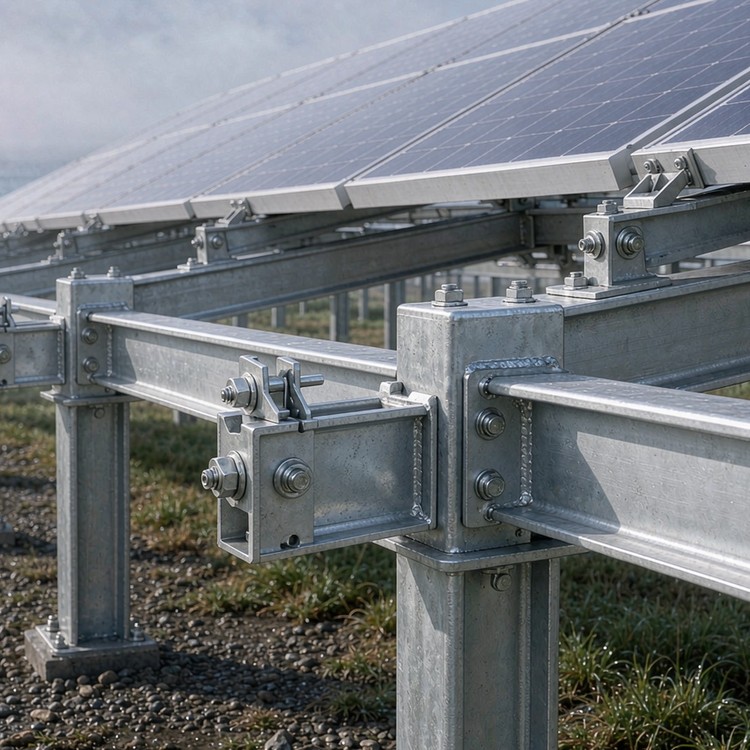
Installation method is a cost line, not an afterthought. We ship structures engineered around the equipment you will actually have: pile-driving rigs with template jigs for soils that accept driven piles; screw-pile drives with torque monitoring where refusal or vibration rules out impact; precast ballast pads where penetration is prohibited; and bolt-only table assembly with 80 percent+ shop fabrication so site welding stays at zero. Crew productivity typically runs 40-80 tables per day per rig on prepared corridors, and our installation manual states the assumed crew size, equipment list and daily output so your construction schedule is built on numbers, not optimism.
Industry benchmarks
Benchmarks below are publicly documented industry reference projects of comparable type and scale, cited to illustrate engineering practice. They are not our delivery record; delivered references for your configuration are supplied with quotations.
- A 200 MW fishery-PV project in Binzhou, Shandong on coastal saline ponds, with pile rows spaced so harvesting nets keep working. Cited for brackish-water corrosion class and aquaculture-passable layouts.
- A 16 MW PV project on salt-pan ponds at Zhangpu, Fujian, on highly corrosive brine soils. Shows the coating and material upgrades required for salt-making ponds.
Standards and compliance
- ISO 12944 / ISO 9223 corrosion classification and coatings
- ISO 1461 galvanizing with zinc mass by environment
- Typhoon codes (GB 50009, ASCE 7 hurricane provisions)
- Snow-load codes with drifting and ice provisions
- ISO 9001 production quality management; batch traceability
- CE / EN 1090 documentation where destination markets require
Budget drivers and lead time
- Corrosion upgrades add 8-18 percent; repaint cycles cost multiples over 25 years
- Typhoon packages are insurance priced as steel – cheap relative to one storm loss
- Snow-slide detailing prevents module damage claims that dwarf its cost
- Lead time: standard 4-8 weeks; marine-grade coatings add 2-4 weeks
- Quotations state steel grade, zinc mass and coating system explicitly; Incoterms and container plans are quoted to your destination port
Comparing supplier quotations
The cheapest structure per tonne is rarely the cheapest per megawatt installed. Compare at installed-cost level: pile count and driving productivity on your soils; preassembly ratio and site welding (should be zero); crane and crew days implied by the table design; tolerance adjustment range – wider ranges absorb terrain error and cut rework; packaging density and container count; and the commissioning support included. Then compare at ten-year level: coating life to first maintenance, fastener replacement expectations, spare parts availability commitments, and whether warranty claims reference measurable criteria. We quote with these lines visible so your finance team sees the same picture your engineers do.
Frequently asked questions
How do I compare coating quality between suppliers?
Where is stainless worth the cost?
What is a realistic first-maintenance estimate?
More questions buyers ask
Do you support installation training on site?
What information do you need to keep a quotation valid?
What to include in your RFQ
- Site corrosivity class or chemistry data
- Structure exposure zones (atmospheric/splash/immersion)
- Maintenance access plan
From RFQ to commissioning: how we work
We structure every order around five checkpoints. First, technical screening: your drawings, soil data and wind or snow parameters are reviewed by a structure engineer, not a salesperson, and assumptions are written down before any number is quoted. Second, a costed proposal that separates structure, foundation hardware and optional items so you can compare bids line by line. Third, design freeze: shop drawings, connection details and coating specifications agreed in writing, with third-party review arranged when your owner or lender requires it. Fourth, controlled production with per-batch records – steel mill certificates, galvanizing thickness logs, bolt lot traceability. Fifth, logistics and installation support: sequencing to your EPC program, packing lists that match container plans, and a named engineer reachable during your install window.
Send documents to our engineering mailbox; a structure engineer replies within one working day – not a sales script, an engineering answer.
Quality, warranty and delivery
We control quality at three gates: incoming steel certification, pre-assembly dimensional checks on jigs, and post-galvanizing thickness verification per batch. Warranty terms are written against load cases and environments, not adjectives – ask us to walk your QA team through the documents before award.
Documentation you receive
The paper trail matters as much as the steel. With each delivery you receive: mill test certificates traceable to heat numbers; galvanizing records per batch against ISO 1461 or your specified standard; dimensional inspection reports from pre-assembly jigs; bolt and hardware lot traceability; as-built drawings when site adaptations were made; and a warranty document that names covered load cases, service design life and claim procedures. O&M documentation includes a recommended inspection interval by environment class and a first-maintenance estimate in writing. Everything is indexed, so your asset register does not depend on one engineer’s memory.
Service life and maintenance planning
The economics of mounting systems are decided at year eight, not at signing. Galvanizing weight, fastener coating class and edge protection determine whether the year-eight inspection finds tight hardware or rust streaks. We publish expected first-maintenance intervals by environment class and back them with batch coating records, so warranty conversations start from data. For sites with special exposure – fertilizer plants, livestock ammonia, coastal spray, geothermal soils – we adjust coating and drainage detailing at design stage. Module replacement cycles are planned too: clamp designs allow individual module swap without cutting rails, which keeps mid-life rework fast and cheap.
Search terms this page is engineered for
corrosion-resistant PV racking, anti-corrosion solar bracket, HDG steel PV racking, Magnelis coating PV bracket, salt spray resistant bracket, hot-dip galvanized solar bracket.
Ready to Discuss Your Project?
Send the corrosivity data – we will return the zone-mapped coating schedule with batch-certificate commitments and a first-maintenance estimate you can audit.
