
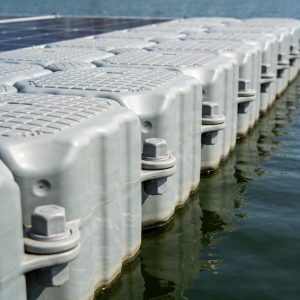



This page is one of several in our wastewater treatment segment. See the full range of structures, foundations and configurations on the PV Racking for Wastewater Treatment Plants & Treatment Ponds hub page.
Why Wastewater Treatment sites are demanding
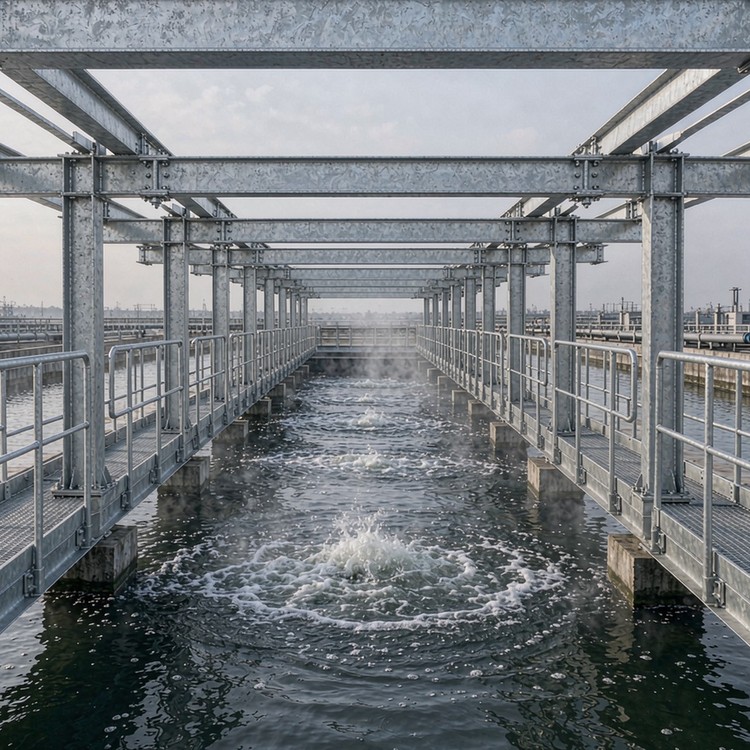
Wastewater-treatment plants are ideal distributed PV hosts: steady daytime loads, existing electrical infrastructure, and underused pond and basin surfaces. The engineering is canopy design over live infrastructure – maintenance access for scraper bridges and aerators, corrosive atmospheres near works, and zero interference with treatment operations.
Site challenges we engineer around:
Challenge 01
H2S and corrosive off-gas attack coatings and fasteners near headworks
Challenge 02
Retrofit loads on existing structures need verification, not assumptions
Challenge 03
Plant operations continue: construction must not interrupt treatment
Challenge 04
Utilities demand storm-water and safety compliance around basins
Challenge 05
Aeration equipment needs service access under and around arrays
Challenge 06
Humid, gas-laden air accelerates corrosion above the waterline
Challenge 07
Retrofit loads on basin walls need verification
Engineering requirements and design basis
- Corrosion selection for H2S and chloride environments per zone
- Structural verification of existing walls and slabs for canopy loads
- Phased installation keeping treatment trains online
- Safety engineering around open water: edge protection, rescue provisions
Selection guidance: Require structural verification of existing basin walls for retrofit loads, and machinery service drawings as design inputs before span layouts freeze.
Engineered solution
- Zone-based corrosion packages matched to gas exposure maps
- Existing-structure load verification service for retrofits
- Phased construction plans that keep permit limits on effluent
- Safety and edge-protection packages around basins
- Utility-side metering and interconnection coordination
On this specific application we additionally provide:
- Machinery-aware span layouts with service access engineered in
- Existing-structure verification and reinforcement packages where walls take loads
Installation method and site productivity
A structure that fights the installer will cost you the savings it promised. Ours is designed to be installed by crews who have never seen the drawings before: identical parts across blocks, left-right symmetrical assemblies where possible, hardware kitted per table instead of per truckload, and torque tables that remove guesswork. Driven, screwed and ballasted foundation options are all supported with matching head details, and templates for pile driving are supplied or specified with the foundation design. Where terrain or access limits machines, we re-segment the tables at design stage so manual handling stays within safe limits. Commissioning support closes the loop.
Industry benchmarks
Benchmarks below are publicly documented industry reference projects of comparable type and scale, cited to illustrate engineering practice. They are not our delivery record; delivered references for your configuration are supplied with quotations.
- A PV-storage project at a water-environment center in Huzhou, Zhejiang, pairing treatment-pond canopies with storage for demand management.
- PV on an industrial WWTP in Yancheng, Jiangsu handling high-salinity effluent zones; coating class selected for corrosive off-gas environments.
Standards and compliance
- ISO 12944 C4-C5 for gas-exposed zones
- Local water-utility construction and safety codes
- EN 1991 / ASCE 7 loads; retrofit structural verification practice
- Electrical codes for distributed generation interconnection
- ISO 9001 production quality management; batch traceability
- CE / EN 1090 documentation where destination markets require
Budget drivers and lead time
- Canopy over basins costs 2-3x ground-mount per MW but uses land the utility already owns
- Corrosion zoning prevents both overspend and early failure
- Existing-structure verification is small money that avoids redesign later
- Lead time: 8-14 weeks; treatment-plant windows gate construction phases
- Quotations state steel grade, zinc mass and coating system explicitly; Incoterms and container plans are quoted to your destination port
Comparing supplier quotations
Before signing, make the quotes apples-to-apples. Ask each bidder to confirm: design wind speed and terrain category used, snow or ice loads, seismic requirements if any; the geotechnical assumptions behind foundation pricing and who pays when soils disagree; the exact steel grade, coating standard and zinc mass; module clamping compatibility with your module datasheet revision; delivery terms – Incoterms, lead time ex-works versus to-port, partial-shipment flexibility; and warranty scope including fasteners and coatings, not just structure. Suppliers who answer these in writing are suppliers who have built before. We answer them by default, in the quotation, not after a chase.
Frequently asked questions
How do canopies coexist with aerator maintenance?
What corrodes fastest here?
Can basin walls carry the canopy loads?
More questions buyers ask
Can we get samples before committing to volume?
Do you allow third-party or customer inspections before shipment?
What to include in your RFQ
- Basin machinery and maintenance drawings
- Existing structure documentation
- Gas and humidity exposure data
From RFQ to commissioning: how we work
Two things decide whether a racking order lands well: what was agreed before production, and what was documented during it. Before production we align on five inputs – structural design basis, foundation type per soil zone, corrosion protection class, module interface, and delivery sequence. During production every batch generates records you can hand to your lender or owner without translation: mill certificates, coating measurements, torque verification, packing counts. After delivery we stay in the loop – installation guidance, first-inspection support at handover, and a spare-parts recommendation sized to your site’s service life rather than a fixed catalogue list. Ask earlier customers how change requests were handled mid-production; that is the real test of a supplier.
Send documents to our engineering mailbox; a structure engineer replies within one working day – not a sales script, an engineering answer.
Quality, warranty and delivery
Every batch ships with mill certificates, coating-thickness logs and bolt records; welds follow EN 1090 or AISC execution classes. Structure warranty runs to 10 years with a 25-30 year service design life, and spare-part packages are documented so year-12 repairs do not depend on year-1 memory.
Documentation you receive
We document in the format procurement teams actually file. Standard set: technical proposal with design basis; issued-for-construction drawings; structural calculations signed by our engineering department, third-party endorsement arranged where required; material and coating certificates per batch; installation manual with step sequences, torque values and tolerance acceptance criteria; and packing lists reconciled against container numbers. Optional add-ons: wind-tunnel or code-based fatigue notes for extreme sites, seismic calculation packages, corrosion service-life projections by environment, and spare-parts schedules with recommended holding quantities. Tell us your owner’s documentation standard at RFQ stage and we quote to it rather than discovering it at delivery.
Service life and maintenance planning
Plan maintenance around measurable triggers, not calendar guesses. Annual visual inspection of fastener torque samples, coating condition at cut edges and ground-contact zones; a detailed inspection after the first extreme weather year – typhoon, sandstorm or heavy snow depending on your region; re-torque verification after the first thermal cycle on long tracker runs. We supply the inspection checklist and acceptance criteria with the installation manual, so your O&M team measures against the same numbers our factory used. Where structures sit in aggressive soils or salt zones we advise higher zinc mass and drainage detailing up front – cheaper than retrofits.
Search terms this page is engineered for
sludge tank PV racking, aeration tank solar bracket, water treatment agrivoltaic, PV mounting for wastewater aeration tank, PV racking for water purification tank, floating PV for wastewater lagoon.
Ready to Discuss Your Project?
Send the machinery drawings – we will return machinery-aware span layouts with wall-verification results and zone corrosion schedules.
