




This page is one of several in our gobi / gravel segment. See the full range of structures, foundations and configurations on the PV Racking for Gobi, Gravel & Hardpan Sites hub page.
Why Gobi / Gravel sites are demanding
Gobi and gravel sites are the pragmatic middle of desert PV: strong wind, coarse soils that refuse driven piles, but firm bearing and low biological attack. The engineering task is foundation strategy on hardpan, wind design for exposed gravel plains, and interfaces with co-located wind farms where sites are shared.
Site challenges we engineer around:
Challenge 01
Wind-solar hybrid sites must coordinate array shading and wake zones with turbine layout
Challenge 02
Water for compaction or concrete is scarce; foundations must be dry-installed
Challenge 03
Long spans between towns make O&M spares strategy a design input, not an afterthought
Challenge 04
Gravel and hardpan refuse driven piles; pre-drilling or screw piles become mandatory
Challenge 05
Hardpan layers defeat driven piles across wide zones
Challenge 06
Concrete supply for ballast is logistically painful on remote gravel plains
Challenge 07
Lateral capacity in loose gravel needs verification, not assumption
Engineering requirements and design basis
- Wind-speed-up assessment over flat gravel fetch
- Hybrid-site layout coordination: wake, shading and cable-routing interplay
- Dry-install foundation methods with torque-monitored verification
- Galvanizing plus abrasion coating selected for wind-driven grit
Selection guidance: Require torque-verification records per pile and test values per zone. Gravel sites are where testing discipline pays for itself fastest.
Engineered solution
- Gravel-site foundation kits with torque-monitored screw piles and pre-drill options
- Exposed-plain wind design with documented local speed-up factors
- Wind-solar hybrid layout review service before structure freeze
- Dry-installation methodology – no concrete, no water trucks
- Spare-part and tooling packages sized for remote O&M
On this specific application we additionally provide:
- Torque-monitored screw piles with pre-drill packages for hardpan bands
- Pull-out and lateral test protocols included as delivery scope
Installation method and site productivity
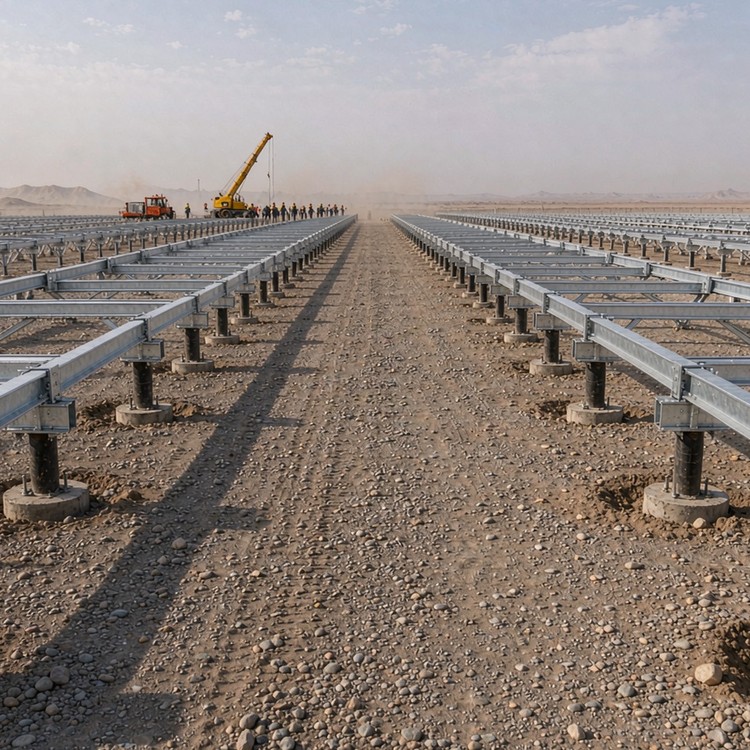
Ask how a structure installs before you compare its steel price. Our systems install with standard construction equipment – no proprietary tools, no site welding on the critical path. Piles are driven or screwed with industry-standard rigs and template jigs hold embedment tolerance; tables arrive preassembled in kits sequenced to your stacking plan; torque-controlled bolting with supplied torque values replaces welded connections; and rail adjustment ranges absorb the terrain error that grading leaves behind. We provide installation drawings, a step-by-step manual, torque and tolerance acceptance tables, and remote support during your install window. On request, an installation supervisor trains your crew on the first blocks.
Industry benchmarks
Benchmarks below are publicly documented industry reference projects of comparable type and scale, cited to illustrate engineering practice. They are not our delivery record; delivered references for your configuration are supplied with quotations.
- A 300 MW project on Gobi gravel near Gaotai, Gansu, using screw piles and preassembled fixed structures to avoid concrete on hardpan. A practical cost reference for gravel-site foundations.
- A 500 MW plant on Gobi gravel at Jinchang demonstrating large-batch screw-pile installation and wind design for open gobi exposure.
- A hydrogen-linked PV project on loess plateau land near Lanzhou, pairing fixed racking with power routed toward electrolysis. Reference where PV output profiles are matched to hydrogen loads.
Standards and compliance
- ASCE 7 / EN 1991 wind with terrain exposure category D or equivalent
- ISO 1461 galvanizing plus abrasion-grade topcoats where mapped
- Torque-verification procedures for screw piles (site-specific method statements)
- IEC 62738 structural siting guidance
- ISO 9001 production quality management; batch traceability
- CE / EN 1090 documentation where destination markets require
Budget drivers and lead time
- Screw piles in gravel cost more per point than driven piles but remove pre-drill risk
- Hybrid-site layout coordination prevents costly rework after turbine micro-siting changes
- Abrasion coatings add 3-6 percent; remote-site spares packaging is small money, big uptime
- Lead time: 6-12 weeks; gravel sites allow long production runs of standard tables
- Quotations state steel grade, zinc mass and coating system explicitly; Incoterms and container plans are quoted to your destination port
Comparing supplier quotations
Before signing, make the quotes apples-to-apples. Ask each bidder to confirm: design wind speed and terrain category used, snow or ice loads, seismic requirements if any; the geotechnical assumptions behind foundation pricing and who pays when soils disagree; the exact steel grade, coating standard and zinc mass; module clamping compatibility with your module datasheet revision; delivery terms – Incoterms, lead time ex-works versus to-port, partial-shipment flexibility; and warranty scope including fasteners and coatings, not just structure. Suppliers who answer these in writing are suppliers who have built before. We answer them by default, in the quotation, not after a chase.
Frequently asked questions
Why screw piles instead of driven on gravel?
What if hardpan is thicker than expected in places?
Can ballast replace piling here?
More questions buyers ask
What are your payment terms for first orders?
Can we get samples before committing to volume?
What to include in your RFQ
- Gravel depth and hardpan data from bores
- Distance to concrete supply (for ballast comparison)
- Design wind class for the plain
From RFQ to commissioning: how we work
We structure every order around five checkpoints. First, technical screening: your drawings, soil data and wind or snow parameters are reviewed by a structure engineer, not a salesperson, and assumptions are written down before any number is quoted. Second, a costed proposal that separates structure, foundation hardware and optional items so you can compare bids line by line. Third, design freeze: shop drawings, connection details and coating specifications agreed in writing, with third-party review arranged when your owner or lender requires it. Fourth, controlled production with per-batch records – steel mill certificates, galvanizing thickness logs, bolt lot traceability. Fifth, logistics and installation support: sequencing to your EPC program, packing lists that match container plans, and a named engineer reachable during your install window.
Send documents to our engineering mailbox; a structure engineer replies within one working day – not a sales script, an engineering answer.
Quality, warranty and delivery
We control quality at three gates: incoming steel certification, pre-assembly dimensional checks on jigs, and post-galvanizing thickness verification per batch. Warranty terms are written against load cases and environments, not adjectives – ask us to walk your QA team through the documents before award.
Documentation you receive
Every order ships with a documentation set built for audits, not for decoration: structural calculation notes stating load cases and standards used; foundation design basis mapped to your geotechnical report; material certificates for steel and fasteners; hot-dip galvanizing certificates with measured coating thickness per batch; assembly drawings with torque tables; and packing documentation matched to container manifests. For financed projects we add lender-format compliance statements, and for public tenders we respond to documentation schedules line by line. Documents are issued in English as standard; other languages by arrangement.
Service life and maintenance planning
Plan maintenance around measurable triggers, not calendar guesses. Annual visual inspection of fastener torque samples, coating condition at cut edges and ground-contact zones; a detailed inspection after the first extreme weather year – typhoon, sandstorm or heavy snow depending on your region; re-torque verification after the first thermal cycle on long tracker runs. We supply the inspection checklist and acceptance criteria with the installation manual, so your O&M team measures against the same numbers our factory used. Where structures sit in aggressive soils or salt zones we advise higher zinc mass and drainage detailing up front – cheaper than retrofits.
Search terms this page is engineered for
gravel site solar racking, rocky ground PV bracket, hardpan PV mounting, PV bracket for Gobi gravel site, PV support for Gobi gravel plain.
Ready to Discuss Your Project?
Send bore data – we will return screw-pile pricing with torque specs, pre-drill scope and the test plan that locks capacity.
