



1 Engineering Disciplines Under This Hub
Inland Floating PV Systems
HDPE Float PV Systems for Reservoirs, Inland Lakes & Hydropower Reservoirs
Why Water Surface / Floating projects are demanding
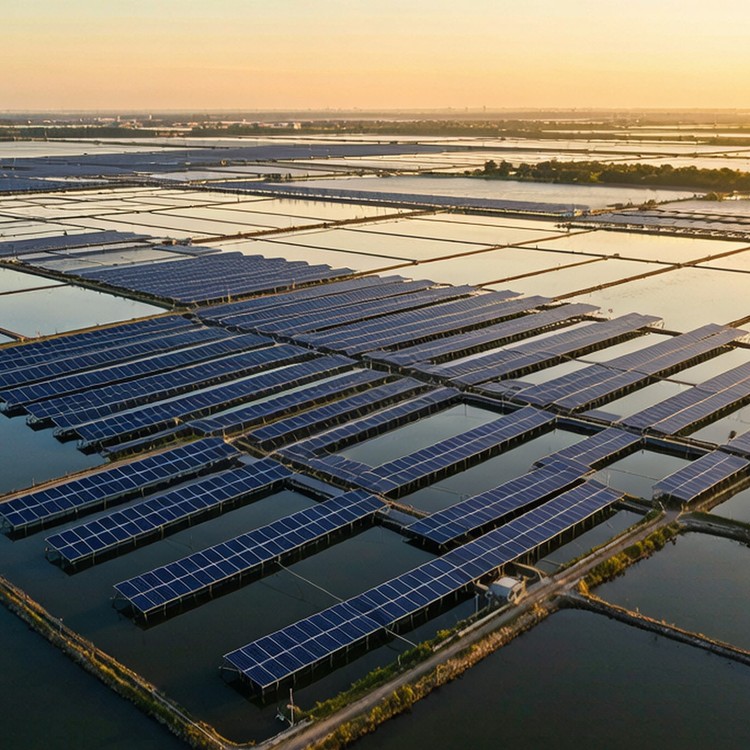
Inland floating PV is the workhorse of water-surface solar: reservoirs, irrigation lakes and subsidence waters hosting MW-to-GW scale floats. The engineering is float-mooring-inverter as one system – anchoring against water-level swings, wave and wind loads, and water-quality constraints that many drinking-water reservoirs impose.
Site challenges we engineer around:
Challenge 01
Electrical safety over water: floating DC architecture and insulation monitoring
Challenge 02
Water level swings of tens of meters on some reservoirs stress moorings and cables
Challenge 03
Wave climate plus wind drive float-rack fatigue over 25 years
Challenge 04
Drinking-water reservoirs restrict materials, coatings and even maintenance chemicals
How to choose the right page
- If the host water body is a reservoir or lake with significant level variation, mooring design is the first question – send the operating range with your RFQ
- If it is a smaller pond with stable level, a simpler anchored or bottom-resting configuration usually applies
- If the water is brackish or the site is coastal, raise it early – the corrosion class and mooring loads change entirely
Key technical parameters at a glance
Typical engineering envelopes for this segment; every project is recalculated against the destination-market code before fabrication:
| Parameter | Typical value / approach |
|---|---|
| Fastening system | grade 8.8 bolts with flanged nuts and wedge-lock anti-loosening washers |
| Foundation options | ground screw, driven pile, rammed pile or ballast selected by soil report |
| Structural design life | 25-year service design with a 10-year structural warranty frame |
| Steel grades | Q235B / Q355B, hot-dip galvanized to ISO 1461, average zinc 85 um or above |
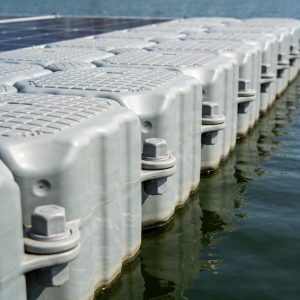
| Float system | HDPE floats with catenary anchor lines |
| Drawdown | anchors sized for large water-level drawdown and chop |
Engineering requirements and design basis
- Floating inverter and cable architecture with insulation monitoring
- Moorings sized for level range, wave height and wind with safety factors per marine practice
- HDPE float and steel or Ali rack system matched to module loads
- Anchor types per bed condition: deadweight, driven, helical or rock anchors
What this hub covers
- Pontoon and float structures for reservoirs, lakes and ponds
- Mooring and anchoring design for varying water levels and wind fetch
- Walkway, access and electrical routing across floating platforms
- Corrosion and biofouling protection for permanent immersion

Which configuration fits your site
Three supply configurations cover most water surface / floating procurement cases:
| Configuration | Structure and finish | Best for | Cost index |
|---|---|---|---|
| Economy line | Q235B main steel, hot-dip galvanized to ISO 1461 | inland reservoirs with steady levels | 1.0 (baseline) |
| Standard line | Q355B main members, 85 um+ zinc, pre-assembled brackets | typical water surface / floating tenders with standard code loads | +15-25% |
| Severe-site line | reinforced sections, duplex coating, sealed hardware | large drawdown and wave chop | +35-50% |
Engineered solution
- Potable-reservoir material compliance packages
- Deep-water anchoring designs with geotechnical verification
- Typhoon or storm stow strategies where relevant
- O&M: boat access, cleaning logistics and dive-inspection programs
- System-level supply: floats, racks, moorings and electrical architecture from one responsible party
Industry benchmarks
The reference points below are anonymized industry benchmarks drawn from comparable public projects of this type. They are not claims about projects delivered by us, and no client, developer or operator is identified.
- A 145 MWac (192 MWp) floating plant on a large reservoir in Indonesia with about 340,000 modules on roughly 2,100 anchor blocks in 100 m-deep water; 2023 commissioning made it Southeast Asia’s largest floating plant.
- A wind-solar base in Anhui placing hundreds of MW of floating PV on subsidence lakes, demonstrating float-mooring systems across former mining water bodies.
- A 13.7 MW floating plant on a reservoir near Tokyo, engineered to typhoon-class winds and seismic criteria, Japan’s early large floating reference.
- A fishery-PV microgrid on Chishan Island in Yuanjiang, Hunan combining pond PV with islanded storage for local loads.
Installation method and site productivity
A structure that fights the installer will cost you the savings it promised. Ours is designed to be installed by crews who have never seen the drawings before: identical parts across blocks, left-right symmetrical assemblies where possible, hardware kitted per table instead of per truckload, and torque tables that remove guesswork. Driven, screwed and ballasted foundation options are all supported with matching head details, and templates for pile driving are supplied or specified with the foundation design. Where terrain or access limits machines, we re-segment the tables at design stage so manual handling stays within safe limits. Commissioning support closes the loop.
Standards and compliance
- IEC TS 63619 (floating PV) and marine mooring practice
- ISO 12944 Im2 coatings for splash and immersion zones
- Potable-water material approvals where reservoirs are drinking sources
- National grid and floating-plant electrical codes
- ISO 9001 production quality management; batch traceability
- CE / EN 1090 documentation where destination markets require
Budget drivers and lead time
- Mooring and anchoring run 10-20 percent of plant cost; bathymetry data prevents blowouts
- Potable-water compliance can restrict coating choices – spec early
- Float warranty terms matter: 25-year claims on polymer are the real risk transfer
- Lead time: 14-24 weeks; float production is the pacing item at GW scale
- Quotations state steel grade, zinc mass and coating system explicitly; Incoterms and container plans are quoted to your destination port
Comparing supplier quotations
Before signing, make the quotes apples-to-apples. Ask each bidder to confirm: design wind speed and terrain category used, snow or ice loads, seismic requirements if any; the geotechnical assumptions behind foundation pricing and who pays when soils disagree; the exact steel grade, coating standard and zinc mass; module clamping compatibility with your module datasheet revision; delivery terms – Incoterms, lead time ex-works versus to-port, partial-shipment flexibility; and warranty scope including fasteners and coatings, not just structure. Suppliers who answer these in writing are suppliers who have built before. We answer them by default, in the quotation, not after a chase.
Frequently asked questions
What is the hardest part of a floating PV project?
How much water-level variation can floating PV handle?
Does floating PV reduce evaporation measurably?
What information do you need to keep a quotation valid?
What are your payment terms for first orders?
Ready to Start Your Water surface / floating Project?
What to include in your RFQ
- Water body type, depth and operating level range
- Wind fetch, design wind speed and wave height
- Bed conditions and any anchoring restrictions from the operator
- Permitted coverage ratio and environmental conditions
- Access method for O&M and electrical export point
From RFQ to commissioning: how we work
Two things decide whether a racking order lands well: what was agreed before production, and what was documented during it. Before production we align on five inputs – structural design basis, foundation type per soil zone, corrosion protection class, module interface, and delivery sequence. During production every batch generates records you can hand to your lender or owner without translation: mill certificates, coating measurements, torque verification, packing counts. After delivery we stay in the loop – installation guidance, first-inspection support at handover, and a spare-parts recommendation sized to your site’s service life rather than a fixed catalogue list. Ask earlier customers how change requests were handled mid-production; that is the real test of a supplier.
Send your water-level and wind data – we will return a mooring concept, coverage assessment and a costed floating package.
Quality, warranty and delivery
We control quality at three gates: incoming steel certification, pre-assembly dimensional checks on jigs, and post-galvanizing thickness verification per batch. Warranty terms are written against load cases and environments, not adjectives – ask us to walk your QA team through the documents before award.
Control points from intake to handover
| Stage | What is checked | You receive |
|---|---|---|
| Material intake | steel grade and zinc mass verified against mill certificates | mill certificates and intake report |
| Production | weld quality, hole positioning and coating thickness sampled per batch | batch traceability sheet and QC photos |
| Pre-shipment | container loading plan, bolt-kit counts and packing list reviewed | packing list and loading photos |
| Site handover | installation walkthrough with torque values confirmed | installation manual, torque table and warranty letter |
| Site-specific check | float welds and anchor-line tension verified in water | project-specific method statement |
Documentation you receive
Buyers comparing suppliers should compare document depth, because claims are easy and records are not. We provide: design basis documents that name standards, load cases and safety factors explicitly; batch-level quality records (steel, galvanizing, fasteners) retained for the warranty period; installation and maintenance manuals written for site crews, not marketing; warranty terms that specify what is covered, for how long, and the claim process; and end-of-project dossiers suitable for handover to your O&M contractor. For multi-project buyers we keep a document history per site, so year-eight extensions reference year-one assumptions instead of starting from zero.
Service life and maintenance planning
Plan maintenance around measurable triggers, not calendar guesses. Annual visual inspection of fastener torque samples, coating condition at cut edges and ground-contact zones; a detailed inspection after the first extreme weather year – typhoon, sandstorm or heavy snow depending on your region; re-torque verification after the first thermal cycle on long tracker runs. We supply the inspection checklist and acceptance criteria with the installation manual, so your O&M team measures against the same numbers our factory used. Where structures sit in aggressive soils or salt zones we advise higher zinc mass and drainage detailing up front – cheaper than retrofits.
