




2 Engineering Disciplines Under This Hub
Mechanized Farmland PV Mounting
Farmland & Arable-Land PV Racking for Mechanized Farming
Seasonal-Crop & Rotational Farm PV
Seasonal-Crop, Grain-Field and Vegetable-Farm Solar Racking
Why Farmland projects are demanding
Mechanized farmland is agrivoltaics under the hardest constraint: the machines decide. Wide headers, sprayer booms and irrigation pivots define clearance, row pitch and headland geometry. Arrays must serve the farm first – or the farm rejects the project – so engineering starts from the equipment list, not the module datasheet.
Site challenges we engineer around:
Challenge 01
Crop rotation changes yearly, so fixed shading patterns must stay tolerable across rotations
Challenge 02
Combine headers and sprayer booms set clearance heights well above generic agrivoltaic minimums
Challenge 03
Center-pivot irrigation sweeps full circles; posts inside the sweep radius are simply impossible
Challenge 04
Headlands need turning space; rows that block turns cost the farm real hours
How to choose the right page
- If machinery envelopes dominate the layout, start with the mechanized farmland page
- If crop rotation changes shading tolerance year to year, start with the rotational farm page
- If centre-pivot irrigation is present, flag it immediately – it constrains post positions absolutely
Key technical parameters at a glance
Typical engineering envelopes for this segment; every project is recalculated against the destination-market code before fabrication:
| Parameter | Typical value / approach |
|---|---|
| Tilt envelope | 10-35 deg fixed-tilt window set by latitude and row-spacing study |
| Module interface | 30-35 mm framed modules, mid and end clamps per layout drawing |
| Fastening system | grade 8.8 bolts with flanged nuts and wedge-lock anti-loosening washers |
| Foundation options | ground screw, driven pile, rammed pile or ballast selected by soil report |
| Machinery span | tall portal frames span traffic lanes of large implements |
| Turn clearance | headland rows set back for turning radii |
Engineering requirements and design basis
- Irrigation-compatible layout: no posts within pivot tracks or channel lines
- Low-compaction installation: tracked equipment, fixed corridors, soil-protection mats
- Shading-tolerant crop planning coordinated with agronomists
- Machine-envelope audit: every implement measured for height, width and turn radius
What this hub covers
- Machine-envelope-driven clearance and row-pitch engineering
- Centre-pivot compatible layouts with no posts inside the sweep
- Compaction-controlled installation with designated corridors
- Rotation-tolerant shading design reviewed with agronomists

Which configuration fits your site
Three supply configurations cover most farmland procurement cases:
| Configuration | Structure and finish | Best for | Cost index |
|---|---|---|---|
| Economy line | Q235B main steel, hot-dip galvanized to ISO 1461 | grain belts with large implements | 1.0 (baseline) |
| Standard line | Q355B main members, 85 um+ zinc, pre-assembled brackets | typical farmland tenders with standard code loads | +15-25% |
| Severe-site line | reinforced sections, duplex coating, sealed hardware | wide machinery clearance above crops | +35-50% |
Engineered solution
- Equipment-first layout engineering with the machinery list as a design input
- Pivot-compatible block layouts for irrigated farms
- Compaction-control installation method with designated corridors
- Rotation-tolerant shading design with agronomist-reviewed light budgets
- Headland and turn-space preservation built into table segmentation
Industry benchmarks
The reference points below are anonymized industry benchmarks drawn from comparable public projects of this type. They are not claims about projects delivered by us, and no client, developer or operator is identified.
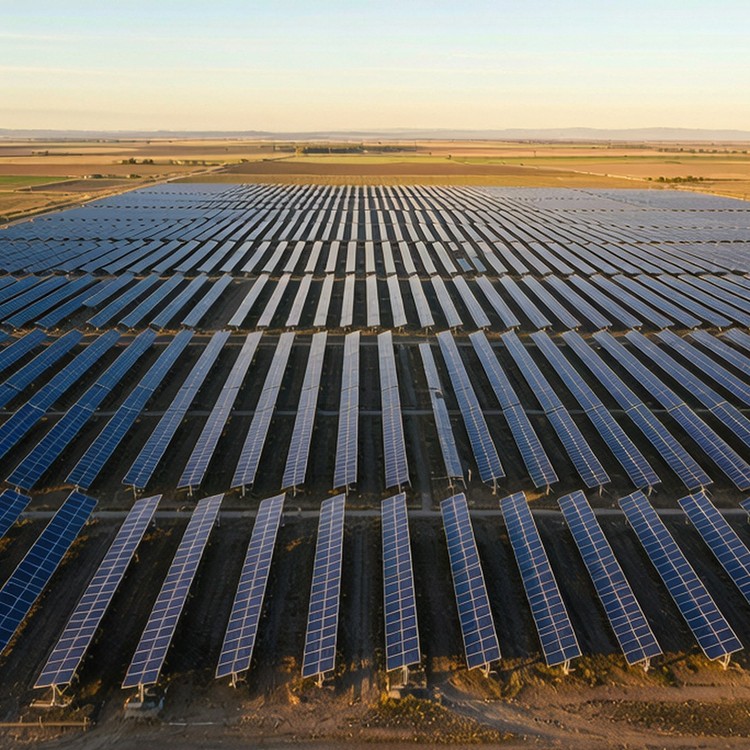
- A 13.7 MW farming-PV plant in Chiba, Japan, operating since 2017 with machinery cropping kept under elevated arrays. It shaped Japan’s farm-PV permit practice and clearance-height norms.
- A German dual-use cropland PV pilot running elevated rows over active farming, which published crop-yield and land-use-ratio data now used across Europe for agrivoltaic permitting.
Installation method and site productivity
A structure that fights the installer will cost you the savings it promised. Ours is designed to be installed by crews who have never seen the drawings before: identical parts across blocks, left-right symmetrical assemblies where possible, hardware kitted per table instead of per truckload, and torque tables that remove guesswork. Driven, screwed and ballasted foundation options are all supported with matching head details, and templates for pile driving are supplied or specified with the foundation design. Where terrain or access limits machines, we re-segment the tables at design stage so manual handling stays within safe limits. Commissioning support closes the loop.
Standards and compliance
- National dual-use / agrivoltaic definitions where enacted
- EN 1991 / ASCE 7 loads with machine-impact consideration near headlands
- ISO 1461 galvanizing for agricultural environments
- Soil-compaction and topsoil-protection provisions per local codes
- ISO 9001 production quality management; batch traceability
- CE / EN 1090 documentation where destination markets require
Budget drivers and lead time
- Clearance height beyond machinery needs is wasted money – engineer from the equipment list
- Compaction remediation costs more than prevention; corridors are cheap insurance
- Wider row pitch trades land-use efficiency for farmability; the balance is a business decision, not a default
- Lead time: 8-14 weeks; installation windows must avoid fieldwork seasons
- Quotations state steel grade, zinc mass and coating system explicitly; Incoterms and container plans are quoted to your destination port
Comparing supplier quotations
A useful discipline: score quotations on completeness before price. A complete bid states the structural design basis, foundation assumptions, material and coating specifications, module interface details, QA documentation list, delivery schedule with Incoterms, and warranty terms with claim criteria. Missing items are not savings – they are decisions deferred to the most expensive moment, mid-installation. We issue quotations in this complete form as standard, and we will re-cost documented alternatives (heavier sections against fewer piles, higher zinc against shorter maintenance cycles) so your award decision trades real variables, not hidden ones. Ask competing bidders to do the same; the industry needs more comparable paper.
Frequently asked questions
How is clearance decided for mechanized farms?
Can solar coexist with centre-pivot irrigation?
What about soil compaction from construction?
What spare parts should we hold on site?
Can lead times be shortened for urgent projects?
Ready to Start Your Farmland Project?
What to include in your RFQ
- Full machinery list with working height and turning radius
- Irrigation system type and layout, especially pivot positions
- Crop rotation plan and shading tolerance by crop
- Soil protection or compaction limits in the permit
From RFQ to commissioning: how we work
Procurement runs smoother when both sides know the sequence. Our standard flow: RFQ received – acknowledged within one working day with a list of anything missing (geotech data, design wind speed, module model, terrain category); engineering review – typically three to five working days; quotation – itemized, with steel grade, zinc mass, coating system and Incoterms explicit; sample or pilot lot – available for new partners who want to verify fit and finish before volume; production and inspection – your QC team or a third party is welcome at pre-shipment; shipping – container optimization against your unloading equipment; installation – manuals, videos and a named contact through commissioning. The flow is boring on purpose: fewer surprises, faster approvals.
Send your machinery and irrigation layout – we will build the clearance and layout around your farming operation.
Quality, warranty and delivery
We control quality at three gates: incoming steel certification, pre-assembly dimensional checks on jigs, and post-galvanizing thickness verification per batch. Warranty terms are written against load cases and environments, not adjectives – ask us to walk your QA team through the documents before award.
Control points from intake to handover
| Stage | What is checked | You receive |
|---|---|---|
| Material intake | steel grade and zinc mass verified against mill certificates | mill certificates and intake report |
| Production | weld quality, hole positioning and coating thickness sampled per batch | batch traceability sheet and QC photos |
| Pre-shipment | container loading plan, bolt-kit counts and packing list reviewed | packing list and loading photos |
| Site handover | installation walkthrough with torque values confirmed | installation manual, torque table and warranty letter |
| Site-specific check | traffic-lane span verified with machinery passage | project-specific method statement |
Documentation you receive
The paper trail matters as much as the steel. With each delivery you receive: mill test certificates traceable to heat numbers; galvanizing records per batch against ISO 1461 or your specified standard; dimensional inspection reports from pre-assembly jigs; bolt and hardware lot traceability; as-built drawings when site adaptations were made; and a warranty document that names covered load cases, service design life and claim procedures. O&M documentation includes a recommended inspection interval by environment class and a first-maintenance estimate in writing. Everything is indexed, so your asset register does not depend on one engineer’s memory.
Service life and maintenance planning
Plan maintenance around measurable triggers, not calendar guesses. Annual visual inspection of fastener torque samples, coating condition at cut edges and ground-contact zones; a detailed inspection after the first extreme weather year – typhoon, sandstorm or heavy snow depending on your region; re-torque verification after the first thermal cycle on long tracker runs. We supply the inspection checklist and acceptance criteria with the installation manual, so your O&M team measures against the same numbers our factory used. Where structures sit in aggressive soils or salt zones we advise higher zinc mass and drainage detailing up front – cheaper than retrofits.
