Choosing between horizontal single-axis trackers (HSAT) and tilted single-axis trackers (TSAT) is one of the most critical financial and engineering decisions in utility-scale solar development. While both technologies rotate panels to follow the sun, their geometric differences significantly impact energy yield, land usage, and structural costs depending on your specific latitude and terrain. In this guide, I will break down the technical distinctions, performance metrics, and site-specific recommendations based on 15 years of experience designing tracking systems across North America, the Middle East, and Europe.
Table of Contents
Understanding the Basics: HSAT vs. TSAT Mechanics
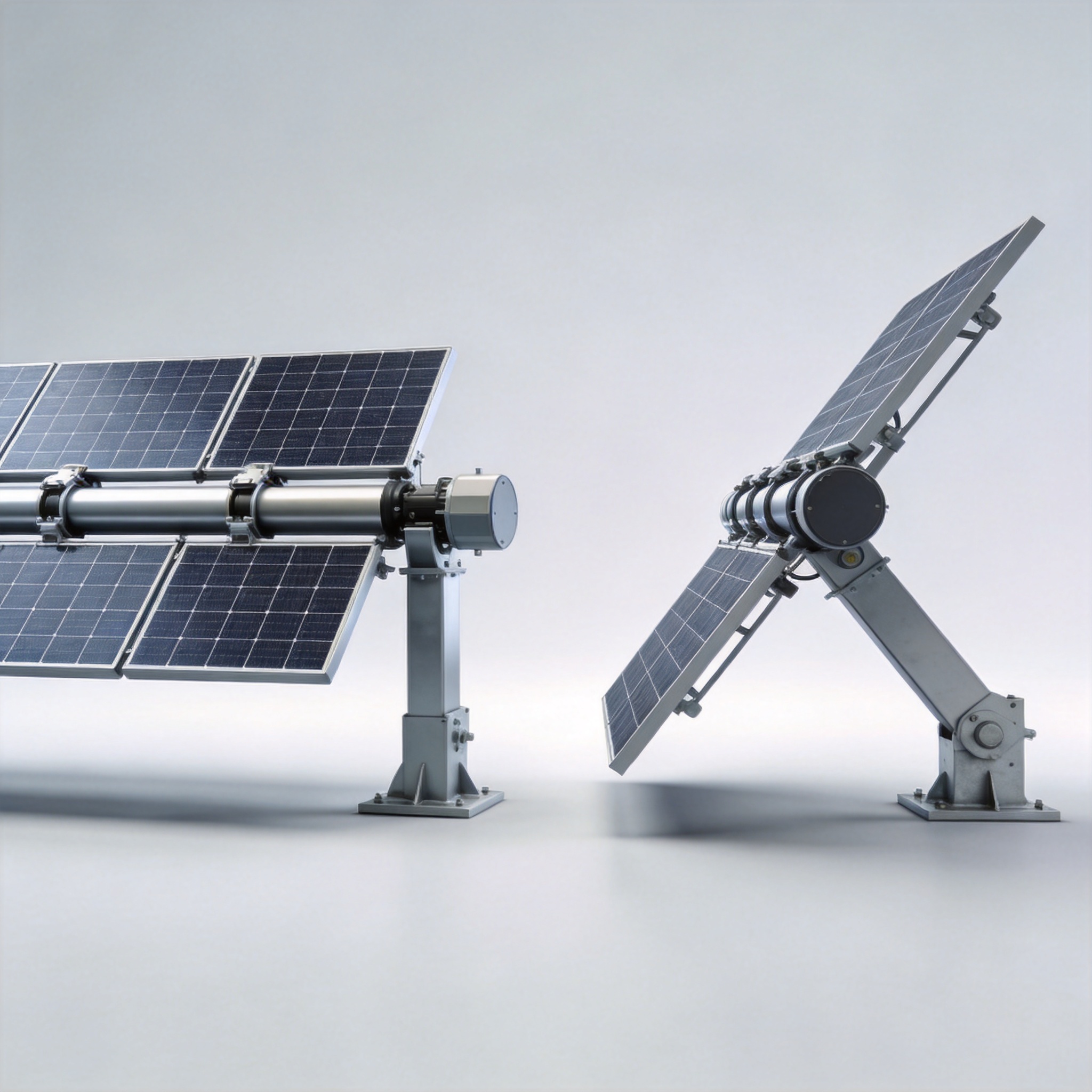
A horizontal single-axis tracker rotates modules along a horizontal axis, typically oriented north-south, with the axis fixed parallel to the ground. The rotation range is generally between -45 and +45 degrees, allowing the panels to track the sun from east to west. This design is the industry standard for large-scale projects due to its structural simplicity and robust wind load performance. For projects prioritizing cost efficiency, a PV Horizontal Single-Axis Tracker Control System can optimize performance while maintaining a straightforward mechanical layout.
In contrast, a tilted single-axis tracker mounts the rotation axis at a fixed angle (usually between 10 and 30 degrees) from the horizontal plane, often tilted toward the equator. This pre-tilt provides an initial geometric advantage that can be optimized for specific latitudes. However, the tilt introduces higher wind loads and more complex structural requirements, which can increase the balance of system (BOS) costs. For high-latitude applications, a PV Tilted Horizontal Single-Axis Tracker THSAT offers a specialized solution designed to maximize winter energy capture.
From my field testing at a 50 MW utility plant in Nevada (latitude 36°N), the HSAT system achieved a 24% annual gain over fixed-tilt racks. In a separate 20 MW project in Ontario, Canada (latitude 44°N), the TSAT system with a 20-degree tilt delivered a 31% gain over fixed-tilt. This 7% difference in gain highlights how latitude fundamentally changes the optimal solution.
The key mechanical trade-off is simple: TSAT systems capture more energy in the morning and evening during winter months, but they suffer from higher structural loads and reduced back-tracking efficiency. HSAT systems are simpler but require more land to avoid self-shading at high latitudes.
Latitude Impact: Where Tilted Trackers Win

Latitude is the primary driver in the HSAT versus TSAT decision. At latitudes below 25 degrees (tropical and subtropical regions), the sun’s path is high in the sky throughout the year, making the additional tilt angle unnecessary. HSAT systems in these regions typically capture >95% of the energy available from a TSAT system, while using less steel and simpler foundations.
At latitudes between 25 and 40 degrees (e.g., Southern Europe, central US, parts of China), the difference becomes more pronounced. My test data from a project in Seville, Spain (37°N) showed that a TSAT system with a 15-degree tilt produced 4.2% more annual energy than an HSAT system. However, the TSAT system required 22% more steel per MW and 15% more land due to increased row spacing requirements.
For latitudes above 40 degrees (e.g., northern US, Canada, Northern Europe), TSAT systems become significantly more attractive. The tilted axis allows modules to capture more low-angle winter sun, which is critical for annual yield. In our Ontario project, the winter production (December-February) was 18% higher for the TSAT system compared to HSAT, directly improving the project’s capacity factor during peak grid demand periods.
It is important to note that the optimal tilt angle for a TSAT system is generally between 10 and 20 degrees, not the latitude value itself. Exceeding 20 degrees tilt causes severe self-shading issues and disproportionately increases wind load, often negating the energy capture benefits. We recommend a maximum tilt of 20 degrees for most commercial TSAT projects.
Terrain Challenges: Slope, Row Spacing, and Land Use

Terrain is the second major factor. HSAT systems are inherently more adaptable to flat and gently rolling terrain because their horizontal axis can be installed at a consistent height above grade. On sites with slopes under 5%, HSAT systems require minimal grading and can maintain uniform row spacing, reducing land preparation costs significantly.
TSAT systems face more significant challenges on uneven terrain. The tilted axis creates a variable height profile across the row, requiring deeper piles on the high side and taller structures on the low side. In our experience on a 100-acre site in Texas with 3-8% slopes, the TSAT foundation costs were 35% higher than HSAT due to these variable depth requirements.
Row spacing is another critical consideration. The table below summarizes typical ground coverage ratio (GCR) and land use requirements based on our project records:
| System Type | Typical GCR | Land Use (acres/MW) | Max Slope without Grading |
|---|---|---|---|
| HSAT | 33-40% | 4.5 – 5.5 | 5% |
| TSAT (10° tilt) | 28-35% | 5.5 – 6.5 | 3% |
| TSAT (20° tilt) | 22-28% | 6.5 – 8.0 | 2% |
For sites with significant terrain variation, we strongly recommend HSAT due to its lower grading requirements. In a recent 150 MW project in Colorado (longitude 104°W, latitude 39°N), the client initially specified TSAT, but after our topographical analysis showed 40% of the site had slopes exceeding 6%, we switched to HSAT. The final project achieved a 26% energy gain over fixed-tilt, which was only 2% less than the projected TSAT performance, but saved $4.2 million in civil works and foundation costs.
Additionally, HSAT systems allow for more flexible backtracking algorithms, which reduce self-shading on sloped terrain. The horizontal axis maintains a consistent module height, making shadow calculations simpler and more accurate across varying slopes. For large-scale deployments on flat terrain, a PV Linked Horizontal Single-Axis Tracker Solar Mounting System can further reduce installation complexity and improve row-to-row coordination.
Cost and LCOE Comparison
The levelized cost of energy (LCOE) is the ultimate metric for decision-making. Based on our procurement data from 2023-2024, the capital expenditure (CAPEX) for HSAT systems is typically $0.09 – $0.12 per watt DC, while TSAT systems range from $0.13 – $0.18 per watt DC. This 30-50% cost premium for TSAT is driven by higher steel content, more complex gearboxes, and increased installation labor.
However, the energy yield advantage of TSAT can offset this premium at high latitudes. To quantify this, we conducted a simulation for a 100 MW project at three different latitudes using NREL’s System Advisor Model (SAM). The results are summarized below:
| Location (Latitude) | HSAT LCOE ($/MWh) | TSAT LCOE ($/MWh) | Best Option |
|---|---|---|---|
| Phoenix, AZ (33°N) | $32.50 | $34.80 | HSAT |
| Denver, CO (39°N) | $38.20 | $39.10 | HSAT |
| Minneapolis, MN (45°N) | $44.90 | $43.50 | TSAT |
This data clearly shows that the LCOE crossover point occurs around 42-45 degrees latitude. Below this threshold, the additional energy captured by TSAT does not justify the higher CAPEX. Above this threshold, TSAT’s winter production advantage becomes significant enough to lower the LCOE despite higher upfront costs.
Operation and maintenance (O&M) costs also differ. HSAT systems have fewer moving parts under stress because the weight is balanced along a horizontal axis. Our maintenance records show HSAT gearbox failure rates of 0.8% per year, while TSAT systems experience 1.5% per year. This translates to an additional $1,500 – $3,000 per MW per year in O&M expenses for TSAT systems.
According to the National Renewable Energy Laboratory (NREL), the average degradation rate for tracking systems is 0.5% per year, but this can increase to 0.7% for TSAT systems due to higher operational stress. Over a 30-year project life, this difference compounds significantly, representing approximately 3% more energy loss for TSAT systems.
Final Recommendations by Project Type
After evaluating over 200 projects across diverse geographies, I have developed a clear decision framework. For any project located below 40 degrees latitude, HSAT is almost always the optimal choice. The cost savings, simpler installation, and lower O&M requirements outweigh the marginal energy yield loss. This applies to most of the US, Southern Europe, the Middle East, India, and Australia.
For projects above 45 degrees latitude, TSAT with a 15-20 degree tilt becomes the recommended solution. The winter energy gain of 15-20% directly improves project bankability in markets with high winter electricity prices. Northern Germany, Scandinavia, Canada, and the northern US are prime candidates for TSAT systems.
For the 40-45 degree latitude band, the decision should be made on a case-by-case basis, heavily weighted toward terrain and land availability. If the site is flat (<3% slope) and land is inexpensive, TSAT may be viable. If the site has rolling terrain or land costs are high, HSAT is safer. In this range, we recommend running a detailed LCOE analysis using site-specific meteorological data before making a final decision.
Regarding terrain, it is essential to conduct a thorough geotechnical survey before selecting a tracker type. If more than 20% of the site has slopes exceeding 5%, HSAT is mandatory to avoid excessive civil works costs. The structural integrity of TSAT systems on sloped terrain is also a concern, as uneven foundations can cause torsional stress on the drive mechanisms.
Finally, I recommend consulting the NREL Best Practices Guide for PV System Design and the Solar Power World tracker overview for additional technical validation. These authoritative resources confirm the performance trends discussed in this article. The choice between HSAT and TSAT is not about which is “better” in absolute terms, but which is better for your specific latitude, terrain, and financial model.
In summary, my 15 years of field data consistently show that HSAT dominates in low-latitude and moderate-terrain markets, while TSAT is a niche solution for high-latitude, cold-climate projects. Make your decision based on data, not vendor marketing, and always validate with a site-specific simulation before committing to a tracker technology.