



Qué abarca este grupo
It is also the band where the engineering inputs become unavoidable: a geotechnical campaign rather than an assumption, a wind study rather than a code default, and a logistics plan rather than a delivery date.
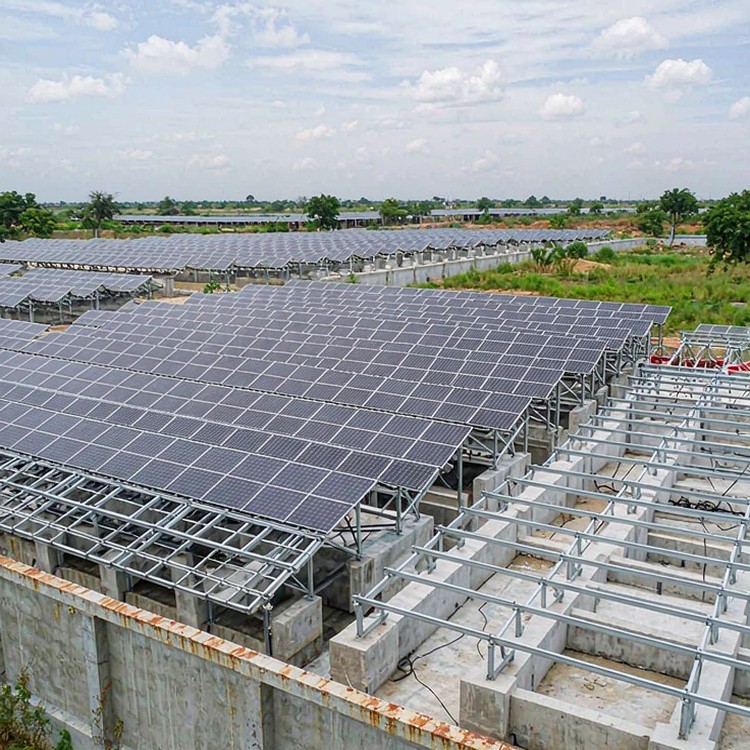
- Fixed-tilt table structures for large contiguous ground-mount blocks
- Single-axis tracker systems, including drive architecture and control strategy
- Pile foundation systems: driven, screwed and rammed, selected by soil report
- Geotechnical-to-pile mapping across zones of varying soil, and refusal risk on hard strata
- Batch supply sequenced to construction zones so installation crews never wait on steel
- Yield-driven layout: GCR, row pitch and DC/AC ratio that set both energy and land cost
Tres configuraciones para empezar
Three supply configurations cover most utility-scale procurement cases:
Línea económica
Q235B main steel, hot-dip galvanized to ISO 1461, driven piles. Best for: Large contiguous blocks with uniform, competent soil. Relative cost: 1.0 (baseline).
Línea estándar
Q355B main members, 85 um+ zinc, pre-assembled tables and brackets. Best for: Typical utility tenders with standard code loads. Relative cost: +15 to +25%.
Línea de sitio severo
Reinforced sections, duplex coating, sealed hardware, pre-drilling provision. Best for: Variable strata, high corrosivity or refusal risk. Relative cost: +35 to +50%.
Why utility-scale projects are demanding
Utility-scale ground-mount concentrates risk in the two places that are hardest to change later: what is under the ground and how the material arrives. Module and inverter choices can be revised mid-project; a wrong foundation decision or a broken delivery sequence is paid for in construction, where every day of a hundred-megawatt programme has a real cost.
- Soil strata can change every few hundred metres, so a single pile design rarely fits the whole site and a uniform assumption becomes a change order
- Refusal on hard strata or rock stops the piling crew entirely, and the recovery method decides whether the schedule survives
- Wind loads govern structure cost, and the perimeter and corner zones carry two to three times the internal loading, which only matters once the site is large
- Hundreds of thousands of piles and brackets must arrive in construction sequence – batch logistics failures look like productivity failures on site
- Yield optimisation and cost optimisation pull in opposite directions: wider row spacing protects yield, tighter spacing lowers land cost per megawatt
Requisitos de ingeniería
These are the inputs we require before freezing a utility-scale design. Each one changes the bill of quantities, and none can be substituted with a rule of thumb at this scale.
- Geotechnical campaign sized to the site: boreholes at a density matched to soil variability, with pull-out and lateral test protocols agreed before design freeze
- Soil-zone mapping: each foundation type and pile length assigned to a borehole zone, with pre-drilling provisions where refusal is likely
- Wind load study using site-specific terrain and exposure, with uplift zoning and edge-zone reinforcement defined per array block
- Structural fatigue check for clamps and rails over the full operating life, based on code or wind tunnel data for your module format
- Batch and logistics plan: delivery sequenced to construction zones, with container plans and a stacking plan that matches the piling programme
- DC/AC ratio and GCR agreed against the revenue structure, so yield, land cost and inverter sizing are optimised together rather than separately
Selection guidance: specify foundation type and pile length per soil zone, never site-wide. The savings from one conservative assumption across a whole site are usually a fraction of the cost of the change orders it creates.
Parámetros clave
| Parámetro | Especificación típica |
|---|---|
| Deployment | Fixed-tilt tables or single-axis trackers on driven or screwed piles |
| Capacity band | 5-100 MW, typically built in 20-50 MW blocks |
| Tilt and pitch | Fixed-tilt 20-30 deg typical; trackers at GCR 0.35-0.50 |
| Foundation | Driven SHS piles 60×60 to 100×100 mm, 1.2-2.5 m embedment, screw piles where refusal risk is high |
| Pile productivity | 150-300 piles per rig per day on competent soil, less where pre-drilling is required |
| DC/AC ratio | 1.30-1.50 for utility projects optimising revenue under time-of-use pricing |
| Land use | Typically 5-10 acres per MW depending on GCR, latitude and terrain |
| Geotechnical scope | Minimum one borehole per 2 acres above 10 MW; denser in highly variable soils |
Cómo lo entregamos
- Soil-zone design packages: separate foundation and pile schedules per borehole zone rather than one site-wide specification
- Refusal mitigation planning: pre-drilling provisions, pile tip geometry and contingent foundation types costed at proposal stage
- Uplift zoning with stepped structure weight and fixing density across field, edge and corner zones
- Tracker or fixed-tilt selection argued from the revenue model, not from a default preference
- Batch delivery sequenced to construction zones, with weekly production visibility and a stacking plan that matches the piling programme
- Yield-driven layout studies covering GCR, row pitch, backtracking behaviour and shading loss, so land cost and energy are optimised together
Normas y cumplimiento
- Combinaciones de cargas de viento ASCE 7 / EN 1991 y sísmicas EN 1998 / IBC, cuando corresponda.
- Niveles de prueba de carga mecánica del módulo IEC 61215 adaptados a la presión de diseño de su matriz.
- Clases de ejecución EN 1090-1/-2 o AISC para componentes de acero estructural
- Galvanizado ISO 1461 con masa de zinc escalonada según la categoría de corrosividad C2 a C5.
- Gestión de calidad ISO 9001:2015 y cualificación documentada de proveedores.
- Respaldo de DNV o equivalente en la revisión de viabilidad financiera para proyectos financiados.
Seguro de calidad
Cada lote se envía con certificados de fábrica, registros de espesor de recubrimiento y registros de pernos; las soldaduras cumplen con las normas EN 1090 o las clases de ejecución AISC. La garantía de la estructura es de 10 años, frente a una vida útil de diseño de 25 a 30 años, y los paquetes de repuestos están documentados para que las reparaciones del año 12 no dependan de la información del año 1.
Instalación y productividad en obra
Antes de comparar el precio del acero, pregunte cómo se instala una estructura. Nuestros sistemas se instalan con equipos de construcción estándar, sin herramientas patentadas ni soldaduras en obra en la ruta crítica. Las cimentaciones se instalan con plataformas estándar de la industria y plantillas que mantienen la tolerancia de posición; los módulos estructurales llegan preensamblados en kits secuenciados según su plan de construcción; el atornillado con control de torque, con valores de torque suministrados, reemplaza las conexiones soldadas; y los rangos de ajuste absorben la acumulación de tolerancias que dejan las obras civiles. Proporcionamos planos de instalación, un manual paso a paso, tablas de aceptación de torque y tolerancia, y asistencia remota durante su período de instalación. Si lo solicita, un supervisor capacita a su equipo en los primeros bloques.
Documentación que usted recibe
La documentación es tan importante como el acero. Con cada entrega, recibirá certificados de prueba de fábrica con trazabilidad a los números de colada; registros de galvanizado por lote según la norma ISO 1461 o la norma que usted especifique; informes de inspección dimensional de las plantillas de preensamblaje; trazabilidad de lotes de pernos y herrajes; planos finales donde se realizaron adaptaciones en obra; y un documento de garantía que detalla los casos de carga cubiertos, la vida útil de diseño y los procedimientos de reclamación. Todo está indexado, por lo que su registro de activos no depende de la memoria de un solo ingeniero.
Costos y consideraciones comerciales
- Foundation choice typically moves total racking cost by 15-30 percent, more than any rail gauge optimisation
- Steel price and galvanizing weight are the two dominant material variables and both should be stated explicitly in the quotation
- Pile length steps are priced discretely, so refusal assumptions must be agreed before contract rather than absorbed as a change
- Tracker supply adds 8-14 weeks to lead time versus fixed tables, and the premium must be justified by the revenue structure
- Batch sequencing failures show up as idle piling crews, which is typically the largest avoidable cost on a utility-scale site
Puntos de referencia
- The Bhadla Solar Park in Rajasthan, phased to roughly 2,245 MW, where summer air temperatures approach 50 C and racking combines hot-dip galvanizing with sand-aware clamps.
- The Sudair solar plant in Saudi Arabia, a 1.5 GW project on sandy terrain using driven piles and roughly 3.5 million modules, demonstrating how single-package pile-and-structure supply compresses multi-hundred-megawatt schedules.
- The Al Dhafra plant in Abu Dhabi, around 2 GW on roughly 3.5 million bifacial modules with single-axis trackers in high-dust conditions.
- Utility-scale ground-mount programmes in Australia and Chile where geotechnical zoning and refusal mitigation planning became the decisive schedule variable rather than module supply.
Planificación de la vida útil y el mantenimiento
La planificación de reemplazos forma parte del diseño: la geometría de las abrazaderas permite el intercambio de módulos individuales sin necesidad de cortar los rieles, las cabezas de los pilotes admiten la renivelación tras el asentamiento y los paquetes de repuestos se dimensionan según la clase de entorno y la capacidad requerida. Esto garantiza que las reparaciones a mitad de vida útil sean rápidas, predecibles e independientes del catálogo de productos del proveedor original.
Cómo controlamos la entrega
| Escenario | Lo que hacemos | Lo que recibes |
|---|---|---|
| Data review | geotechnical coverage and load assumptions checked before any pricing | data gap schedule and assumption register |
| Soil zoning | foundation type and pile length assigned to each borehole zone | soil zone map and pile schedule |
| Design freeze | wind and fatigue cases resolved, shop drawings signed by both engineering teams | signed shop drawings and structural calculation notes |
| Producción | weld quality, hole position and coating thickness sampled per batch | batch traceability sheet and QC records |
| Pre-envío | container loading sequence matched to construction zones | packing list, loading photos and stacking plan |
| Entrega del sitio | pile acceptance criteria and torque values confirmed before mass installation starts | method statement, torque table and warranty letter |
Send your geotechnical report and layout – we will return a soil-zone foundation plan, a pile count estimate and a costed supply package for your financial model.
Guías en este grupo
Sistemas de estanterías de inclinación fija a escala industrial
Lowest delivered cost per megawatt with minimal moving parts and simple maintenance.
Sistemas de seguimiento de un solo eje a escala industrial
Drive architecture, control strategy and the revenue cases that justify tracking.
Sistemas de cimentación sobre pilotes para parques eólicos a gran escala
Driven, screwed and rammed piles, soil zoning, refusal mitigation and pull-out verification.
Directorios de aplicaciones relacionadas
Esta escala se suele combinar con los siguientes grupos de aplicación, que abarcan el terreno, el tipo de suelo y las condiciones del emplazamiento.
Preguntas frecuentes
How do you set pile length across a site with variable soil?
When is a tracker worth the premium over fixed-tilt?
Can you supply piles and structures as one package?
What geotechnical work do you need before you can quote?
How do you handle refusal during pile driving?
Lo que necesitamos citar
- Site layout with target capacity, planned construction zones and build sequence
- Geotechnical report with borehole logs, groundwater level and any test pile results
- Design wind speed, terrain category, snow load and any seismic requirement
- Revenue structure or tariff basis, so tracker versus fixed-tilt can be evaluated properly
Hable con un ingeniero estructural.
Envíenos los datos de su emplazamiento, la capacidad prevista y el programa de construcción, y nuestros ingenieros le presentarán un concepto de estructura, una estimación de cantidades y un paquete de suministro con su correspondiente presupuesto.
 English
 Español
 Deutsch
 Português
 Français
 Italiano